
The Boy Who Harnessed the Wind is an inspiring true story about a boy who grew up in poverty in southeastern Africa. His family could not afford to buy electricity from their local utility. But, through determination and a sharp intellect, along with encouraging friends, this enterprising boy ‘harnessed the wind’ to get electricity into his family’s home. Here is The Boy Who Harnessed the Wind review and book banter!
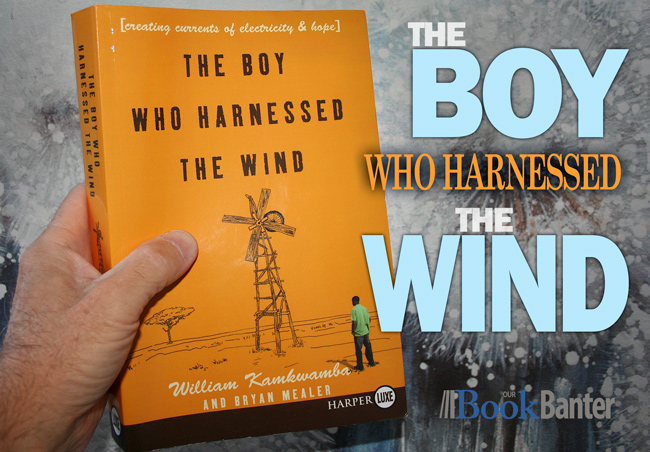
The Boy Who Harnessed the Wind review
Who is the boy who harnessed the wind?
The boy, William Kamkwamba, grew up in a poor village in southeastern Africa. Unlike many of his neighborhood friends, William was precocious and loved to learn. He spent hours reading at the library after work and studying at home to satisfy his quest for knowledge.
Unfortunately, his education was often interrupted when his family needed help to harvest crops, or haul water, or just try to survive each day. And during times of famine, William had to use clever ways to hunt birds and other game to get a little protein into his otherwise impoverished diet.
In other words, William had a very difficult childhood. In fact, many of his neighbors didn’t survive sicknesses or died from a lack of food during droughts. Each day was a struggle for survival. But, despite all those obstacles, William prioritized his education.
First-person narrative
William tells us his story using the first-person narrative. With the help of his author, Bryan Mealer, William made his childhood come alive.
I think that first-person style-of-narration was perfect, because the reader becomes immersed in the events of William’s life. We feel his hopes, and we feel his disappointments. But, we also feel his strengthening resolve to make his life better and maybe help his community, too.
Local government and corruption, along with feasts and famines
In addition to sharing memorable moments from his early years, William also talked about the government in his southwestern African community and country. Sometimes, the government officials did good things for their community, but other times, the leaders were corrupt, and his family and their neighbors suffered the consequences.
In addition, William shared memories of difficult days harvesting his father’s crops, and making deliveries for his mother to the local market. Many times, he had to go to school after having already put in long and hard hours of labor.
Many painful moments in this book
Because of the difficult times in William’s early life, some parts of this book were difficult to read. As I read, I shared William’s tragedies, along with his losses. But, I also learned about his hopes and his determination to have a good, meaningful life.
William not only wanted to get electricity for his family, but also wanted to help them irrigate their crops. And he wanted to help his whole village enjoy the benefits of ‘harnessing the wind.’
The Boy Who Harnessed the Wind book review
Two sections of The Boy Who Harnessed the Wind
First half—William’s family and community
The first half of this book reveals William’s early life, as told from William’s perspective (first-person narrative). He talks about his friends, and how most of them were very poor. But, William had one friend whose father was a powerful government official, and they lived in a comfortable home and even had electricity.
A light switch in a wall performed magic
William envied his wealthy friend, because in his home, he could flip a switch on the wall, and the lights would instantly turn on. It was if his friend could magically transform the dark night into a sunny day.
William became fascinated with electricity
It was that initial fascination with electricity that spurred William’s interest in obtaining electricity for their own family’s home. Unfortunately, the local electric utility charged a fortune to deliver their product. The high cost meant that William’s family, and other poorer households in the neighborhood, couldn’t afford electricity.
Could renewable energy provide electricity?
Then, William read everything he could get his hands on about renewable energy. He learned that people actually generate electricity by using windmills, which are powered by the wind!
But, he couldn’t afford to build a windmill. All of the parts were too expensive. So, what could William do about his dream of using renewable energy for electricity? Well, he starting looking around for junk, for stuff that didn’t work anymore, for things that people threw away.
Second half—William’s quest to generate electricity
Scrounged for parts to build a turbine
The second half of the book is where William reveals his ingenuity. Because he couldn’t afford to buy parts to build his windmill or turbine, William had to be resourceful. He read about renewable energy, and how people use windmills to generate electricity.
So, he visited what we might think of junkyards. There, he found pieces of metal, old motors, broken generators, or anything that might be useful as he constructed his windmill.
He assembled his windmill
He laid all the parts out that he had collected in his room, and slowly started to assemble the windmill (turbine). In addition, he had to build a tower to elevate the turbine, so there would be more wind to help it spin.
Thankfully, William had a couple of close friends who were anxious to see him succeed. Those two boys were about William’s age. One was from a poor family, just like William, but his other friend was a son of the local politician (they already had expensive electricity in their home).
Villagers were skeptical
As you might imagine, most of the older people in his village were skeptical. Shockingly, they even laughed at William and his childish dream. But since some were superstitious, they were even a little afraid as they watched William erect his tower and top it off with his turbine (windmill).
But, were the villagers correct to be skeptical? And, did the critics have the last laugh? To answer those questions, you’ll have to read The Boy Who Harnessed the Wind yourself!
This is where William Kamkwamba grew up, and where he built his windmill. It’s really nice to see the pictures, and it’s just like I visualized it, thanks to William’s excellent descriptions in his book.
FINAL VERDICT:
The Boy Who Harnessed the Wind review
Inspirational true story
As you can already guess, I really enjoyed reading The Boy Who Harnessed the Wind. At first, it was painful to see how much William had to work, and all the suffering that he and his family had to endure in their poor African community.
Read about southeastern African culture
But, reading about William’s childhood also taught me about their southeastern African culture. I was astonished with how it was much different that the cultural benefits I am fortunate to enjoy, here in the United States.
People are the same, all over the world
Yet, even though their culture was different, I learned that their people, including William and his family, had the same hopes and dreams for a good life. Most were caring people who wanted their children to succeed—I was happy to read about that.
And then, there was William’s attempt to harness the wind to generate electricity. He studied, and then he built his turbine. And, when he had a failure or something broke, he studied some more. And then, he rebuilt everything until his turbine was even better.
I loved The Boy Who Harnessed the Wind
So, if you enjoy reading about an underdog who overcomes very difficult circumstances, and then succeeds, then you will enjoy reading the inspirational book, The Boy Who Harnessed the Wind !
The Boy Who Harnessed the Wind book review
Thanks for reading The Boy Who Harnessed the wind review. If you have already read the book, or have heard William speak about his adventure, please share your thoughts in the comments section below!
For me, The Boy Who Harnessed the Wind reminded me of the book, October Sky. In that book, Homer Hickam had to work hard, and then study later. And people made fun of his dreams also. But just like William, Homer persevered and succeeded! I love those kind of stories!
Content and photos by Doug Martin and Our Book Banter


