
I first became aware of the massive content that Lewis and Clark had compiled during their multi-year expedition while watching Ken Burn’s excellent 1997 documentary on PBS. That tremendous documentary engaged me with its raw emotional admiration of the two intrepid explorers. Today, we can read edited excerpts from those journals. One good example is the excellent compilation which Bernard DeVoto edited. Here is The Journals of Lewis and Clark book review.
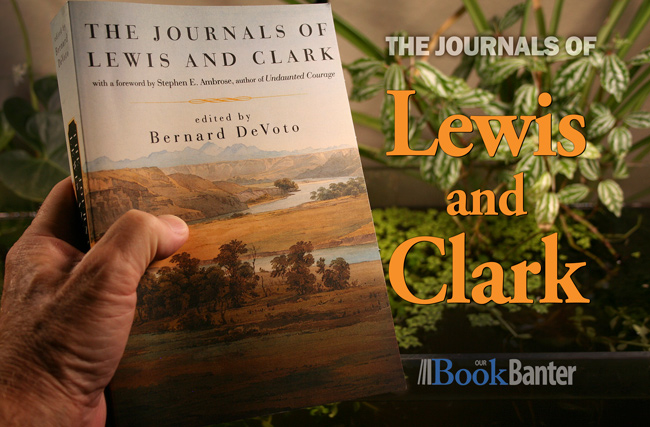
The Journals of Lewis and Clark book review
Thomas Jefferson orders an expedition
In 1803, President Thomas Jefferson ordered a information-gathering expedition from the Missouri River to the Pacific Ocean. He needed more information to see what roadblocks the young United States might encounter as they expanded their territories westward!
The Lewis and Clark mission and its lofty goals
Collect artifacts, specimens, and samples
The mission of this exploratory expedition was to collect artifacts, including animal specimens and descriptions, along with plant samples, seeds, and extensive descriptions.
Interact with indigenous peoples
In addition, Jefferson tasked the explorers to interact with, and document the local, indigenous peoples (Indians, or Native Americans as we describe them today). The travelers documented the customs of each tribe, including their mating customs and their unique grooming customs (including genital area grooming)!
Prepare the Native Americans for a takeover
Not only were they expected to interact peaceably with each local tribe, but they were also expected to prepare the local leaders for the imminent takeover of their local lands. Shockingly, many of the Native Americans were eager for the White Man’s presence. After all, they brought with them much-needed goods that would enhance their daily lives, such as furs, clothing, weapons, alcohol, medicines, and other amenities.
Map the unexplored territories
Above all, the explorers needed to compile an intricate, accurate map of the territories they passed through. The details included latitudes and longitudes, descriptions and drawings, and the wildlife they encountered.
Jefferson needed a qualified crew
But, Jefferson first needed to find qualified leaders for his exploratory expedition. They needed to be literate, so they could document their findings in journals, but they also needed to be experienced navigators and hunters. After all, they needed to supply their own high-quality proteins each day. To do that, they had to hunt for enough game to satisfy their hard-working crew and keep them healthy.
The Corps of Discovery
Officially named the Corps of Discovery, the crew of this exploratory 1804-to-1806 expedition to the Pacific Ocean needed qualified leadership. Jefferson selected two experienced men who would serve as co-captains. Together, they would lead other experienced soldiers, hunters, and explorers to complete their mission.
Some crew members of the Corps of Discovery
Meriwether Lewis (1774-1809):
Meriwether Lewis grew up on a large Virginia plantation. While just a young child, his mother taught him about plants, and immersed Meriwether in amateur studies about botany and plant identification. Later, just before launching their expedition, Jefferson arranged even more intensive studies about plants, as well as astronomy and navigation techniques.
In addition, Lewis had also studied the Greek and Latin languages, as well as mathematics, geography, and more natural sciences. Lewis would use all those skills during their life-changing expedition.
As far as his personality, Meriwether was more erudite and sensitive. He was a descriptive writer, and wrote detailed observations about the plants and wildlife their crew encountered. In general, he was more fluent in the English language, and wrote his observations with precise wording and spelling.
On the other hand, William Clark brought other valuable skills to the expedition.
William Clark (1770-1838):
While William Clark received less formal education than Lewis, he was well-read, and was literate in the English language. However, unlike his co-captain, Clark was a horrendous speller. His diary entries contained many varied, phonetic spellings for otherwise common English-language words.
Otherwise, Clark was a highly skilled navigator, which was an essential requirement for the success of the expedition. In addition, he was a good hunter, an excellent surveyor, and could survive in the wilderness.
Not only that, but both Lewis and Clark needed negotiation skills with the various Native American tribes they would meet. For instance, they had to barter for food, clothing, and information, and the Native Americans could be very tough negotiators.
Interpreters:
Also aiding in the expedition’s success were a few interpreters. One was George Drouillard, who was fluent in sign language, and also a skilled hunter. In addition, Toussaint Charbonneau was a skilled fur trapper who also served as an interpreter.
Sacagawea:
Another important interpreter for the expedition was Sacagawea. She was a 16-year-old Native American woman who was married to the much-older Charbonneau.
In The Journals of Lewis and Clark, the editor hints that William Clark might have had a crush on the enticing Sacagawea. In fact, after Sacagawea died, Clark did act as a guardian for her young son. However, I guess we’ll never know the full story about that relationship!
Other soldiers, fur trappers, and explorers:
In addition, there were other experienced soldiers, including sergeants who exercised discipline over the entire crew. And, to help provide food each day, there were skilled survivalists and hunters.
To prepare the food, some of the men butchered their game. In addition, they cooked, cured, and preserved the meat.
Here’s an interesting documentary about the Lewis and Clark expedition. And, if you get a chance, look for Ken Burns’ excellent 1997 documentary. That one, I believe, is the best, most engaging, and most moving retelling of this dramatic story!
The Journals of Lewis and Clark book review
There were no urgent care centers
As you can imagine, there were no doctors and no urgent care centers along the way. All of these courageous explorers were totally on their own. Even the slightest infection could have been fatal.
To protect themselves, they used herbal remedies and other primitive (but effective) methods to treat wounds, food poisoning, and even cases of STDs (sexually transmitted diseases).
They encountered STDs
What I found the most surprising about this two-year expedition was that the explorers had to deal with sexually transmitted diseases (STDs). In particular, one group of Native American women were afflicted, and many of the men became seriously ill.
The situation had gotten so bad that on the return trip, William Clark forbade his men from having any interaction with those Native American women, no matter how lonely they might have felt. STDs were a serious problem on this expedition, and to me, that was surprising!
Unfortunately and tragically, the Native American women became infected with STDs when European fur traders, explorers, and soldiers visited their tribes.
Only one man died on the two-year expedition
Remarkably, only one member of the expedition died, despite all of the harrowing hazards they had to deal with along the way. That man was Sergeant Charles Floyd, and he suffered from a ruptured appendix early in the expedition.
Pacific Ocean excitement
Of course, when the crew of the Lewis and Clark expedition saw the vast mouth of the Columbia River, they were overcome with emotion. In addition, they marveled as they saw the massive Pacific Ocean. The explorers had accomplished half of their mission—they were so happy that the stretch of land they had traversed would soon be a part of the United States!
Let’s hurry home to the United States
Then, on their way back, Lewis and Clark still needed to document their experiences. In addition, they had to collect botanical samples, along with animal skins and carcases.
Above all, the entire crew had to hunt every day for their food! And while they were doing that, that had to keep all of their artifacts and documents dry. This was a very busy crew!
But, each man yearned to get back to their homes, back to the then much-smaller United States. The explorers had been gone for two years, and they wanted to go home—back to the United States!
Feather quill, bottles of ink, and handwritten diary entries
Back then, there were no smart phones, no laptop computers, and no recording devices. The only technology available to both Lewis and Clark were feather quills and bottles of ink, along with what must have been very expensive paper. And, they had to keep all of their diary entries dry.
So every day, the co-captains had to reserve time for their extensive notes, drawings, and diary entries. Clark meticulously recorded topography data, and Lewis noted details about plants, animals, and birds. Amazingly, Lewis and Clark wrote every notation by hand, but only after dipping a feather into a bottle of ink!
Almost Heroes tells the fictitious comedic story of a group competing with the Lewis and Clark expedition in their quest to the Pacific Ocean. However, the characters in this comedy are very similar to the real-life expedition members. They undergo the same challenges, hardships, and conflicts that the Lewis and Clark expedition experienced, but with a lot of comedy thrown in. This is a very funny movie and one of my favorites!
FINAL VERDICT:
The Journals of Lewis and Clark book review
After watching Ken Burn’s wonderful 1997 documentary about the Lewis and Clark expedition, I knew I had to read their journals. So, I bought this 500-page, edited sampling of all of the extensive journals submitted by Lewis and Clark.
This journal is so eye-opening, and makes me marvel at the visionary forsight that Thomas Jefferson had when he commissioned the expedition. And, then I admire the unflinching courage exhibited by Lewis, Clark, and their entire crew.
Together, they documented uncharted territory while interacting with the Native Americans they met along the way. In addition, they had to deal with large, territorial and very dangerous bears and other animals as they hunted for their daily sustenance.
The Lewis and Clark expedition—what a remarkable story! If you’re interested in history, or you’re interested in human psychology, then you should read The Journals of Lewis and Clark! I promise you will find their story as remarkable as I did!
Lewis and Clark book review and book banter
Thanks for reading The Journals of Lewis and Clark book review. If you’ve already read this book, or you’ve watched the Ken Burns documentary, please share your thoughts in the comments section below.
Photos and content by Doug Martin and Our Book Banter


