
Is it possible that a rodent powered the economic development of the early United States? Yes, it is possible, but only if that rodent is the one classified as the common beaver (Castor canadensis). If you’re interested in this unique scenario, you might find the book, Beaverland: How One Weird Rodent Made America, by journalist and author Leila Philip, an interesting book to read. Here is our Beaverland book review and book banter.
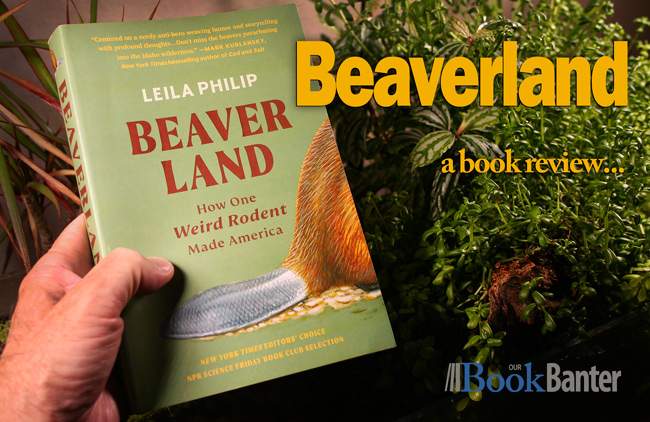
Beaverland book review
Beaverland premise
The book titled Beaverland: How One Weird Rodent Made America, tells the story of early fur traders in North America. Back then, trading fur was a lucrative business, and one that had helped make the exploration and settlement of North America possible.
But more than describing early fur traders and their love of beaver fur and meat, this book also tells the story about the mysterious beaver. It tells the story about beavers throughout their long history, and how they evolved into their current form.
Remarkably, this story also describes the beavers’ unique behaviors. Uniquely, they have a powerful and instinctual need to build damns. Beavers need to live in and near water, and they need a specific type-of abode to provide safety and create a food supply.
So, they engineer and prepare materials, and then create their own home. This home is fortified and secured by a damn, which surrounds their home with protective body of water.
The story of the beaver and their overwhelming need to build damns is one about their remarkable adaptabilities and determination. And luckily for us and our environment, this story shows how their habitats can be a vital protector of our fragile environment.
Beaverland author, Leila Philip
Journalist Leila Philip, who was a regular contributing columnist at the Boston Globe, researched and wrote the book, Beaverland. In addition, Philip wrote a few other nonfictional, award-winning books, and is also a professor of English.
Immersive investigative journalism
What I loved so much about Beaverland is that the author immersed herself into the subject of beavers. She shared her love of the beaver damns near her home, and how the daily visits to their intricately constructed abodes began to mean so much to her.
Over time, the author grew to admire this clever rodent. More importantly, she saw first-hand how the beavers have a vital, ecological role to play in our environment.
Trappers and their motivations
In addition, Philip spent time with and built nonjudgmental rapport with trappers. She followed trappers as they went on their daily routes, and shared their secrets for success.
Fur traders and their craft
As part of her investigations, she also spoke with and earned the trust of fur traders, and how they operated their centuries-old craft. Her first-hand, immersive observations are what make Beaverland such a special book.
When I was young, I tried trapping
I tried to trap muskrats
I grew up on a rather large farm in the Northeast. The property had pastureland, along with some small creeks and a larger stream nearby. And, much to my dismay, both then and now, I spent a week setting traps for muskrats.
But I had no trapping experience
An older relative thought this might be a good experience for a young, inexperienced boy such as me! Unfortunately, I didn’t receive any expert guidance on how to set the traps, or the actual behaviors of the animal I was attempting to trap.
Would I have a serious accident?
My biggest concern, as I woke at dawn and sleepily started my new endeavor, was to not accidentally chop off my fingers while I set each trap. Seriously, that was my biggest, almost nightmarish concern. The traps were very hard to set (at least for me).
I didn’t want to euthanize any living creature
Then, my second biggest worry was that I might catch an innocent animal in the trap. If I did, what would I have to do to the poor, innocent creature? I knew I would have to euthanize it, and that idea alone made me sick to my stomach.
An unsuccessful trapper
Thankfully, I was a very unsuccessful muskrat trapper—I didn’t catch a single creature during the week I tried trapping. I was so relieved, and vowed that I would never go near an animal trap again.
Thanks to Leila Philip and her beautiful book, Beaverland: How One Weird Rodent Made America, I became more interested in beavers and their thought-provoking behaviors. Fortunately, there are many riveting videos like this one available online. Such an interesting topic and compelling creature!
Beaverland book review
Beaverland is about commerce
Beavers were important to commerce
Believe it or not, fur trading was vitally important commerce in colonial and precolonial North America. After all, people needed to stay warm, and wrapping themselves with beautiful furs not only kept them warm but helped them look good, too.
Beavers provided warmth and nourishment
In addition, people had to eat, just like we have to eat today. So, in order to get protein to stay strong and healthy, people hunted animals and they trapped, too.
Lewis and Clark caught beavers
And beavers were in high demand back in those early, precolonial days. In fact, I’m current reading the diaries of Lewis and Clark again, and Clark noted all the times they had caught beaver for food, and enjoyed the good taste and nutritional value of its meat.
However, they didn’t mention doing anything with the fur, but I suspect they cherished that, also, especially during the brutally cold winter months of their expedition.
Beavers fueled economic development
In other words, beaver trappers and beaver fur traders helped fuel the early economy in North America. Even in Europe, the rodent was in high demand, and also fueled the fur trading industry developing in the ‘new’ continent.
Beaver history in Beaverland
All of this fascinating history about beavers and their importance in fur trading was an important part of Beaverland. I thought the history was so compelling.
Beaverland reveals interesting beaver behaviors
Above all, the author explored all of the interesting behaviors of beavers. As I read on, I became even more intrigued by this highly intelligent and also very curious creature—it is such an amazing animal.
Why do we need beavers?
Not only were beavers important in precolonial times in North America, but they are also important today. While we don’t use their fur so much, and don’t eat their meat as often, beavers still have an important role to play.
Throughout Beaverland, the author described how the beaver damns impact the surrounding environment. Sure, their damns unfortunately flood some inhabited areas, so they do need to be controlled—that’s where trappers help us out.
But, the damns also create unique wetland environments that encourage plant growth and provided abundant habitat for wildlife. In addition, the surrounding wetland environment serves as a sponge to sop up floodwaters, which can make floods less devastating.
The fascinating book, Beaverland: How One Weird Rodent Made America, contains all those intriguing details, and more.
FINAL VERDICT:
Beaverland book review
If you’re interested in a unique niche in North American history, Beaverland: How One Weird Rodent Made America, might be an interesting book to read. Surprisingly, despite being initially skeptical, I found this subject so interesting.
Beavers are ecologically and economically important
The author goes into picturesque detail about her observations about the beaver damns near her home. In addition, the author helps us understand the motivations of trappers and fur traders as she investigated the economic and ecological importance of beavers.
Fair and impartial observations
Beaverland is an excellent example of investigative journalism—the author was objective as she observed. Her nonjudgmental fairness and neutrality made the sometimes emotionally difficult subject of trapping and fur trading more easy to understand.
Beavers are important for our ecosystem
I really enjoyed reading Beaverland and learning about the important role this unique animal plays in our environment. If you enjoy reading about nature, and if you enjoy the psychology behind our sometimes perplexing motivations, especially when they concern beavers, you will definitely enjoy reading Beaverland: How One Weird Rodent Made America.
Thanks for reading our Beaverland book review. If you’ve already read the book, or have experience with beavers or have lived near a beaver habitat, please share your thoughts in the comments section below.
Beavers are a vital component to our fragile environment. They can even help restore our depleting water tables. We need this creature in our ecosystem!
Content and photos by Doug Martin and Our Book Banter


