
Gulag, written by Anne Applebaum, tells the bleak history of the network of labor and prison camps. The Soviet Union used them to punish criminals, along with other enemies of the Russian government and leadership. This book is an incisive history of their camps of forced-labor. Not surprisingly, many of those prisons and camps had similarities to the concentration camps prevalent in pre-WWII Germany. Here’s our Gulag book review and book banter.
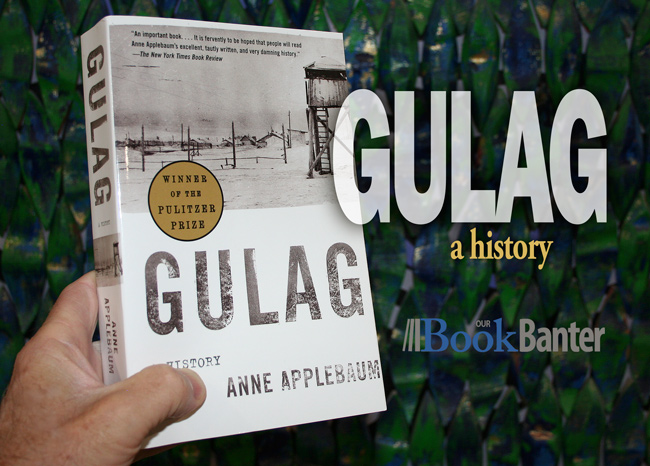
Gulag book review
Russian history never intrigued me
Before I get to our book review of Anne Applebaum‘s Gulag, I should let you know that Russian history had never intrigued me. However, when I was in tenth grade, I remember reading Alexander Solzhenitsyn‘s best-selling nonfiction book, The Gulag Archipelago.
That book tainted my overall vision of Russia. I pictured the large, picturesque country as being brutally cold, with even more brutally violent government leaders. Why would anybody want to live in Russia? That was my thought as I read Solzhenitsyn’s bleak, desolate book about the Gulag prison and labor camp network.
So, even though I don’t remember much about Russia’s Gulag from reading Solzhenitsyn’s older book, I still get the same nightmarish chills when I conjure up the word ‘Gulag’.
What is the nonfictional book, Gulag, about?
The historical book, Gulag, is about the brutal, forced labor camps which the Soviet Union operated throughout its vast countryside from 1917 to 1986. Gulag is an acronym, taken from Glavnoe Upravlenie Lagerei, which means Main Camp Administration in English.
By the way, Gulag, a history, won the 2004 Pulitzer Prize for general nonfiction. And, as I was browsing the list of other Pulitzer Prize general nonfiction winners, I saw the 1994 winner. That book was related to the subject of this book. Its title is Lenin’s Tomb: The Last Days of the Soviet Empire. I thought I might read that book in the future to learn more about the Soviet Union.
The goals of the Gulag network
The leaders of the Soviet Union wanted to quell dissent, and instill fear among every citizen. I won’t go into too much detail, because Gulag contains all the facts, data, and personal experiences of people who were actually there.
Punish dissidents, or enemies of the state
According to the author, both Vladimir Lenin and Joseph Stalin wanted to silence and punish dissidents. Those dissidents were private Russian citizens, as well as outspoken media figures.
As you can imagine, there were plenty of people who lived in the Soviet Union who were very critical of that country’s political and economic systems. If I were living there, I would have been a dissident, too. But, I would also have wanted to get out—but where could I or anybody else emigrate to?
That’s the dilemma many of those people faced—they didn’t want to leave their families, and flee the country that they loved, so they had to speak up. Unfortunately, that got many people into life-threatening trouble.
Build infrastructure in remote areas
The Soviet Union was a massive country, and much of the territory was undeveloped and unpopulated, and often situated in areas where the winters are brutally cold. It’s no wonder that their citizens didn’t want to live or work there.
To solve the problem, Lenin created forced labor camps to harvest the timber, mine the valuable minerals, and create a supporting, local city population in those areas. Part of the goal was to create an infrastructure of roads, bridges, railways, and canals.
The laborers were comprised of the critics, or enemies of the Soviet Union, along with criminals from the prison population.
Build factories
Lenin wanted the Soviet Union to become an industrial powerhouse. So, he used forced labor from the camps and prisons to build factories in those remote areas.
To an outsider like me, this idea seems so shortsighted and counterproductive. What about the profit incentive? Didn’t Lenin and the other leaders see how capitalism was fueling economic growth in other countries?
Sure, unbridled capitalism did create oligarchs in the United States, while many of the laborers didn’t share in the wealth, but that’s even more true of the forced labor camp system which you’ll read about in Gulag. The Gulag network was literally an unproductive nightmare.
Gulag author, Anne Applebaum, speaking about the Soviet Gulag system.
Gulag book review
Meticulous research
Government archives
Anne Applebaum, Gulag‘s author, meticulously researched this book. In addition to speaking Russian, and being thoroughly familiar with the culture and landscape, the author used archives from the old Soviet Union to compile statistics, trends, along with personal entries from the camp directors, operators, and employees.
Memoirs and diary accounts
Fortunately, hundreds of prisoner diaries and memoirs have survived that horrific era, and the author included excerpts in her book. The personal accounts even include interviews with living survivors and first-hand accounts of their experiences.
Systemized presentation of the facts
Part One: The Origins of the Gulag, 1917-1932
Applebaum began the first section of the book by sharing the fascinating, but at the same time, brutal origins of the Gulag labor camp network.
People were rounded up, and sent to forced labor camps. They didn’t know how long they’d be gone from their families, and many didn’t even know what they were accused of.
Part Two: The Life and Work in the Camps
By the time I got to section two, the horrific, factual content of this book was affecting by dreams. Fortunately, I didn’t have nightmares (I rarely do), but my dreams were very disturbing and unsettling.
The chapter that I found the most horrific was when the author investigated how inmates and workers were transported to the labor camps. That process was indescribably bad—if I had been in their position, I suspect I might have… well, I probably would have given up the will to live.
But, maybe not—it’s surprising how determined the human spirit can become under adverse conditions and circumstances. Somehow, we want to live, and we fight to find a way to deal with the terrible pain.
By carefully culling the first-hand accounts contained in the archives and memoirs, the author was able to paint a very disturbing picture of life in the labor camps.
For instance, hardened criminals were mixed in with mere dissenters of the Soviet Union. I’m not even going to describe what that horrific living situation was like. But, for everyone involved, the environment must have been hell-on-earth .
Part Three: The Rise and Fall of the Camp Industrial Complex, 1940-1986
Then there was World War II, and Germany was invading many European countries, and even invaded Russia. What a mess!
During this time, Germany had been using concentration camps to round up Jewish people, along with other people their leaders considered undesirable. In this book, the author contrasted the German concentration camps with the Soviet Union’s network of labor camps. They had many similarities, but also notable differences—that was very interesting to learn and read.
As the decades rolled by, politics evolved. And, that slow revolution did alter the administration of the labor camps. Despite the changes, they were still nightmarish places for the inmates.
Epilogue: Memory
This section reveals more personal remembrances of the laborers and inmates. As you might imagine, many of the memories were poignant, while others were tragic.
The inmates reunited with their families, if they were still alive, that is. Many times, spouses had remarried, sometimes with the encouragement of the inmates.
Appendix: How Many
The Soviet Union incarcerated millions of people in their forced labor camps, and the author included those statistics. Also included are the deaths of people traveling or marching to the labor camps and people living and working in those facilities. Just horrible!
This book also contains an excellent and helpful glossary, a bibliography, as well as other notes.
FINAL VERDICT:
Gulag book review
Anne Applebaum’s 2004 bestselling and Pulitzer Prize winning book, Gulag, was very disturbing and unsettling to read. Her nonfiction book is an in-depth history of the Soviet Union’s forced labor camp network.
For some reason, the leaders of the Soviet Union created a depraved environment, all designed to punish dissenters and hardened criminals. They forced people to build factories, infrastructure, grow food, and harvest trees, all to turn the Soviet Union into an industrial giant.
I don’t want to reveal too much about the book, so I won’t provide details of what happened to those innocent people in those labor camps. But, it caused me to have some very disturbing dreams—not nightmares, but the type of dreams that were extremely unsettling.
Gulag is not a pleasant book to read, but it is an important one to study if you want to understand more about Russian history. And, it’s important to understand that it can happen again, and is happening again—Russia is reviving the labor camp archetype.
Not surprisingly, we also know that a dissenter in Russia can still face harsh penalties—they might be imprisoned, or they might be poisoned, or they might just disappear. In other words, Russian gulags are making a come-back, and that’s unfortunate for our humanity.
Thank you for reading our Gulag book review. If you’ve already read this informative but disturbing book, please share your thoughts in the comments section below!
Content and photos by Doug Martin and Our Book Banter


