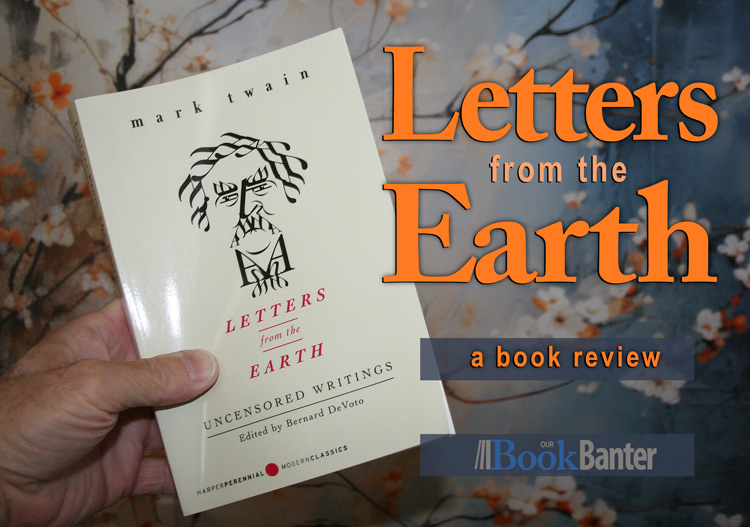
Letters from the Earth is a controversial book of observations written by Mark Twain. Despite some harsh dissension about the author’s brutal criticism of organized religion, the collection was published after his death. So, here is our Letters from the Earth book review and book banter!
Letters from the Earth book review
What is Letters from the Earth about?
A travelogue, observations, and a bedtime story
Mark Twain’s collection of short stories, letters, observations, and recollections, titled Letters from the Earth, was published in 1939. The book includes Twain’s remembrances of his trips throughout Europe, along with a charming tale about a fanciful cat that he used as a bedtime story for his young girls.
A writing-style critique
In addition, Letters from the Earth contains Twain’s writing-style critique of The Last of the Mohicans, the famous historical novel written by James Fenimore Cooper. In short, Twain felt the author’s writing style was too verbose.
To back up his claims, Twain included sentences from Cooper’s 1826 novel, and edited them for clarity and simplicity. Based on Twain’s examples, it’s probably true that Cooper could have edited his famous novel more carefully.
Critiques of organized religion
My favorite parts of Mark Twain’s Letters from the Earth was where he used logic, common sense, and scientific discipline to absolutely destroy the premises used by organized religion. It’s no wonder that his religious wife and his equally religious daughter, Clara, did not want Letters from the Earth to be published without heavy censoring.
Religion and scientific reasoning
Step-by-step, Twain used science, factual data, and logic to discredit the story about Noah and his ark, along with other stories cherished by organized religion.
As a devoted reader of Mark Twain, I recognized many of Twain’s rhetorical arguments from as far back as his novel, Adventures of Huckleberry Finn. The young boy, Huck, had gradually evolved from a superstitious boy who occasionally prayed, to one who doubted god and the power of prayer.
Kids can say stuff that adults can’t
In other words, I believe Huck Finn was already expressing the views that Mark Twain had included in Letters from the Earth. Fortunately, Huck was just a kid, and he was more playful and mischievous. That cute package made it a little more acceptable to express those controversial views.
Is heaven really that great?
In Twain’s Letters from the Earth, the author even analyzed the idea of a heaven. He considered all the good things that we humans enjoy so much on Earth, but that are missing in heaven. In addition, Twain listed all the things that are included in heaven, but that we dread in our lives here on Earth.
From those lists, Twain wondered why anybody would want to spend eternity in heaven. And, I bet that after you read Twain’s compilation of an everlasting life in heaven, you won’t be so anxious to go there, either!
Twain had a love of science
Disciplined thought processes
Mark Twain loved the disciplines required for scientific thought, and that surprised me. Today, I think of the renowned author as more of an artist than a scientist. However, Twain’s structured thought process was apparent in all of his critiques and observations, but especially the ones directed towards organized religion.
The human race is not really so great
For example, Twain used scientific rigor in the letter, The Damned Human Race, to destroy the fallacy that we are the center of the universe and that we are the most highly developed form of life. It was absolutely fascinating to read.
Mark Twain and Carl Sagan
At times, I felt like I was reading Carl Sagan’s Cosmos instead of a collection of Mark Twain’s letters and recollections. In fact, maybe Sagan borrowed some of Twain’s scientific conclusions as he was writing Cosmos! Of course, I’m joking, but that’s how good Twain’s critiques are in this book!
Twain’s philosophy of life
Mark Twain was a complicated person
Fortunes won and fortunes lost
The author of Letters from the Earth, Mark Twain, was a complicated man. He experienced many of the highs that a famous and wealthy writer could experience, but he also had some very low points. He lived a wealthy life of luxury, but at times he was also struggling with finances.
Twain was adored worldwide
On one hand, a world-wide audience adored Twain. His folksy witticisms connected with a diverse audience. And the author really enjoyed the adulation of his fans.
Troubled family life
However, Mark Twain was also very troubled. He watched as two of his daughters, Susy and Clara, endured physical and psychological pains throughout their short lives.
In addition, his middle daughter, Clara Clemens, was the only daughter to outlive her father. Unfortunately, despite Twain’s unique gift of communication and his efforts to reconcile, they rarely seemed to connect.
Twain did have one son, Langdon Clemens. He was the first child Twain and his wife had conceived. Both parents had high hopes for their beloved son. But, Langdon died when he was only 19 months-old, and his death shattered Twain’s lofty dreams for his son.
Mark Twain led a uniquely fascinating life. Not only was he a great author, but he was also a celebrated orator, steamboat pilot, and journalist.
Letters from the Earth book review, continued
Were all of the Letters from the Earth interesting?
I didn’t like all the letters
To be honest, I didn’t find all of the letters and short stories interesting. For instance, Twain included one fable that he had made up for his daughters. It was a bedtime story to help them fall asleep. To me, that letter was boring, but still worth reading.
Sure, Twain’s writing style and intellect were apparent, even in the letters that I didn’t find compelling. Unfortunately, some of the content didn’t intrigue me, and that’s why I didn’t find them interesting. Still, I found that even the uninteresting letters were worth the time to read and savor.
I loved the letters that critiqued religion
Critiques of organized religion were the best parts
To be honest, I do have a spiritual side, and believe in many unexplained things that we cannot see or document. However, I am skeptical about all organized religions and their dogmas. My skepticism comes from my own personal experiences.
Twain wasn’t afraid to express his skepticisms
That’s why I found Mark Twain’s refreshing and scientific crtiques of religious dogma and teachings so fascinating. If we’re honest, I think we all have those skepticisms, but we might be afraid to express them.
But Twain did the expressions for us, and he did it while using a disciplined, scientific process of logical thought. If that type of reasoning scares you, then Letters from the Earth will not be for you! However, I relished Twain’s work in this book!
FINAL VERDICT
Letters from the Earth book review
While I did find some part of Mark Twain’s Letters from the Earth to be uninteresting, and even a little boring and self-indulgent, I still loved most of this compelling collection.
I especially loved Twain’s honesty, common-sense, and scientific discipline when he presented his observations. Fortunately, Twain skewered many topics that we might consider sacred, and that’s what made this book so interesting, and so compelling.
If you’re not afraid of ideas that challenge conventional thinking and beliefs, then I think you would really enjoy reading Mark Twain’s surprising collection of observations, Letters from the Earth, a compelling read!
Thank you for reading our Letters from the Earth book review and book banter. If you’ve read this collection, please share your thoughts in the comments section below.
Content and photos by Doug Martin and Our Book Banter.