
Watership Down, written by Richard Adams, was first published in 1972 as a children’s story. Since then, the epic story about rabbits as they struggled to survive in their precarious world, has also become an adult classic book. Here is our Watership Down book review.
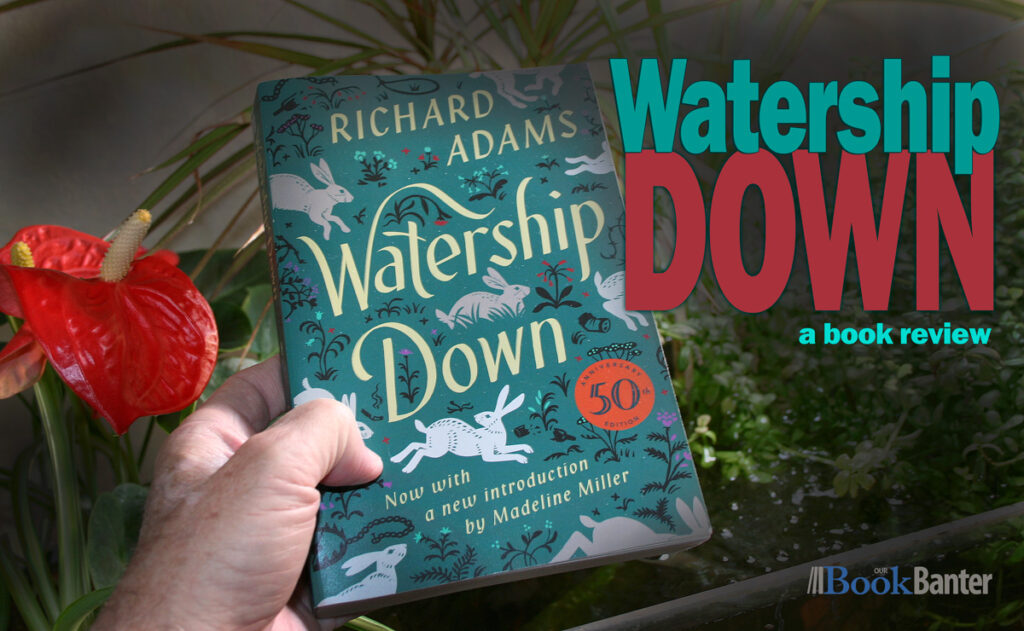
Watership Down book review
How I first heard about Watership Down
While Watership Down was a commercial success almost immediately after its first publication, I had never previously heard of the book. But, as I was reading Stephen King’s novel, The Stand, I became intrigued when one of the characters in that book raved about how much he loved Watership Down!
Engaging and thought-provoking
So, after I finished reading The Stand for a second time, I immediately read Watership Down. The book was engaging, with delightful characters, lots of nail-biting plot twists, and surprisingly adult, thought-provoking themes.
The plot of Watership Down
One of my favorite rabbit characters, the small, introverted male named Fiver, has grim visions that their commune, which is known as a warren, will be destroyed and many of the resident rabbits will be killed.
He tells his older brother, Hazel, about his visions. Unfortunately, Hazel is the more practical rabbit of the two, and he is skeptical.
Eventually, though, Hazel believes Fiver, and rallies other rabbits to leave with them and find a safer location to live. Their journey is filled with menacing predators, along with dangerous humans and rugged terrain.
Main characters are rabbits
The main characters of Watership Down are rabbits. They each have unique personalities and skills as a rabbit, and each of them has an important role in their warren.
The rabbits were not cartoonish
When I first began reading, I was afraid that the rabbits would be cartoonish and have exaggerated, Bugs Bunny type of behaviors. Instead, there was a gritty realism with each of these rabbits.
The realism made it easy to empathize with the rabbits
Each rabbit knew that most of them would have a short lifespan. And they were also aware that almost every other creature that they would encounter could hurt or kill them.
And, if they got hurt, and couldn’t walk or feed themselves, they knew they’d have to be left behind. Grimly, they also knew that an injury could ultimately mean a slow, agonizing death.
That was the realism that each rabbit faced as they headed to their new home.
Nail-biting struggles for survival
That gritty-but-courageous realism made each of these rabbits easy to empathize with. I was able to put myself in their place as I read, and their adventures became real, nail-biting, harrowing struggles for survival.
Two protagonists, and maybe even more
The two main protagonists were Hazel and Fiver, the two mismatched brothers. Hazel was the older, more practical rabbit, while Fiver was the younger, smaller, and more socially awkward rabbit.
Fiver has dreams or visions which he can’t control. Coincidentally, I found this aspect similar to a character in Stephen King’s novel, The Stand.
For me, Fiver was the most interesting and engaging character. On the other hand, Hazel showed surprising foresight and courage as he led the pioneering rabbits.
At first, Hazel had doubts that he had the characteristics needed to lead his group of explorers. But, like all of us might do, he rose to the occasion, and surprised many of the other rabbits with his courage.
Other characters were also interesting
While Fiver was the spiritualist and Hazel was the practical leader, there were other very interesting characters, as well.
For instance, one rabbit was larger and stronger than the rest. He was considered the warrior and defender of the pioneers. Another rabbit was a good problem-solver, and was able to get the group out of difficult situations by using his creativity.
Each rabbit had self-doubts
Despite each rabbit’s strengths, each one also displayed their weaknesses, their vulnerabilities, and their self-doubts. Those doubting inner voices also created empathy.
A rabbit language
If you’ve spent any time with animals, you know that animals have their own forms of communication. Each species has a unique song, or sound, or other non-verbal forms of communication to display happiness, fear, caution, and more.
In Watership Down, the rabbits also had many nonverbal forms of communication. But, in this fictional novel, they also had their own unique language which they called Lapine. Fortunately, the author translated this rabbit language to English, so we could all understand what the rabbits were talking about.
A trailer of a film adaptation of Watership Down, which I have not seen. However, it has the gritty realism of the book, but I believe the book was better.
Watership Down book review and themes
Adult themes portrayed honestly
After I finished reading Watership Down, I was shocked that this was considered a children’s book in 1972. The author introduced many adult themes as he wrote about the community of rabbits.
Science and logic versus religion
For instance, the rabbits had many traditional old stories that they passed down to each new generation. The stories told of good and bad things that happened, and how their god had guided them through the tough times.
The fire creature approaches
In one case, the rabbits were running for their lives. They came to a railroad crossing, just as a large, metal “fire creature” was approaching on the tracks.
The ground shook with frightful noises
Quickly, they all jumped over the first track and crouched down in the mud as the “fire creature” passed overhead. As it rumbled over them, the ground shook, and the creature made frightening noises.
Their ‘Lord’ had saved them
The rumblings and the noises scared their pursuers away from the area, and the rabbits were able to jump to safety. They credited their Lord with sending the “fire creature” to save them, just in the nick of time.
Logical explanation
Of course, we know the rabbits had jumped between two railroad tracks just before a train passed over them. So there was a logical explanation, but the rabbits didn’t know that—they thought they had experienced a supernatural event. And, they credited their ‘Lord’ for saving them.
In that artistic way, the author was showing us human beings that we often use organized religion to explain things that really have a scientific or logical explanation.
Rabbit mating rituals
The author accurately described the rabbit mating rituals. Not in graphic terms, of course, but in terms of their animal-like behaviors when it comes to selecting a mate and breeding.
What’s love got to do with it?
In the rabbit world, there is no such thing as love. Instead, female rabbits are attracted to the strongest male rabbit (maybe that’s how the human world acts, too).
After all, they want their offspring to be strong enough and intelligent enough to survive and thrive into their adulthood. So, they need the best genes.
Fidelity? Maybe yes, maybe no
Before breeding, there is no marriage ceremony in the rabbit world. A male might be loyal to one female, but probably not. In order to spread his genes around, and keep their colony genetically more vibrant, a rabbit male might mate with many females.
While the female might be more practical, she, too, might quickly move on to another mate. It all depends on what’s happening in their warren, whether there’s enough food, and whether her first mate makes her feel secure.
Honesty is the best policy
All of these mature mating behaviors were honestly described in this book. So, that honesty did shock me a little bit, especially since this was first marketed as a children’s book!
However, in all cases, I believe that honesty is the best policy, especially with these adult topics.
Nature can be brutal
Despite our inclination to think of the natural world and its creatures as being pleasant and heavenly, the real natural world can be brutal. And, I’m talking about blood, guts, and no mercy.
Life is short with no guarantees
Each rabbit was aware of their own mortality. They knew many of them wouldn’t live for more than a year! Instead, they could be brutalized by a hawk, or ripped apart by a coyote, or trapped by a human being for their fur.
Unfortunately, in our own human world, our lives are not guaranteed to be safe, either. Tomorrow is guaranteed to no living creature. That is the brutally honest, but gritty reality that was portrayed in this book.
As I read some of the difficult situations these rabbits got into, I thought that some parts were too difficult for a child to read. As a child, I believe I would have been bothered by the nightmarish scenarios that these wonderful rabbits had to endure.
Here’s an animated trailer of Watership Down. It looks pretty good, but I believe the book is better.
Political philosophies
In Watership Down, the reader is introduced to various forms of government. After all, a warren filled with rabbits needs to have rules and regulations, a good supply of food, as well as a good security system.
Democracy in Watership Down
So, the warren that Hazel, Fiver, and their other group of rabbits were seeking was a warren where every rabbit is considered a valuable member. And, every rabbit is respected, no matter their size, their power, or their personalities. They wanted their warren to be a democracy.
Centrally controlled, militaristic
On the other hand, a much larger warren nearby had chosen a more centrally controlled, militaristic type of government. The rabbits in that community felt safe, secure, but also more regimented.
Gave up their own power to be cared for
In one larger rabbit community, the rabbits had all the food they could possibly eat. They didn’t have to gather it, or fight for it. It was placed right there by human beings.
They were secure from predators (mostly), and lived a comparatively luxurious life for a rabbit. The only one trade-off is that occassionally, some of the rabbits would disappear—they would be trapped and killed by the nearby humans.
Fortunately (or unfortunately), most of the rabbits in that well-off community didn’t have a clue of what was happening as some rabbits had disappeared. They just thought they had wandered off or ran away. So, they were trading luxury for their freedom.
Brutal nature also has a good side
The rabbits had victories and triumphs
Despite all of the horrors our heroic rabbits encountered in this engaging story, there were also some triumphs. These victories elevated the spirit of each rabbit. They were victories of the soul that is in each living creature in nature.
They aspired, and then worked to achieve that aspiration
Hazel, Fiver, and the other brave rabbits aspired for a better community. One in which each of them would be welcomed. And, one in which they all would have a valuable part.
Uplifting story about good overcoming evil
And that’s the bright, uplifting aspect of this wonderful story. Sure, it’s a brutally honest story, but it’s also an uplifting story about how good can overcome evil.
Watership Down book review
Watership Down book review and final verdict
I loved Watership Down. There were so many plot twists, and unexpected moments. In addition, I loved the way the author introduced the adult themes of religion, caring for other community members, mating habits of rabbits, as well as aspiring to have a better life and do the right thing.
Unfortunately, I don’t think this is a children’s book. If I had read this when I was only seven or eight years old, I think I might have been traumatized a little bit!
But, I suspect that a teenager could handle the frank discussions and portrayals. If you haven’t read Watership Down, I recommend you do, as soon as possible!
Thank you for reading our Watership Down book review! If you have already read the book, please share your thoughts about this wonderfully engaging book.
Photos and content by Doug Martin and Our Book Banter


