One of my favorite travel authors is Paul Theroux. He is a brilliant observer of people and their unique environments. In other words, Theroux is the author of gritty travel books. I especially enjoyed his book from 1995. That book chronicled his travels along the Mediterranean Sea’s coastline. Read my thoughts about this unique, eye-opening travelogue in The Pillars of Hercules book review.
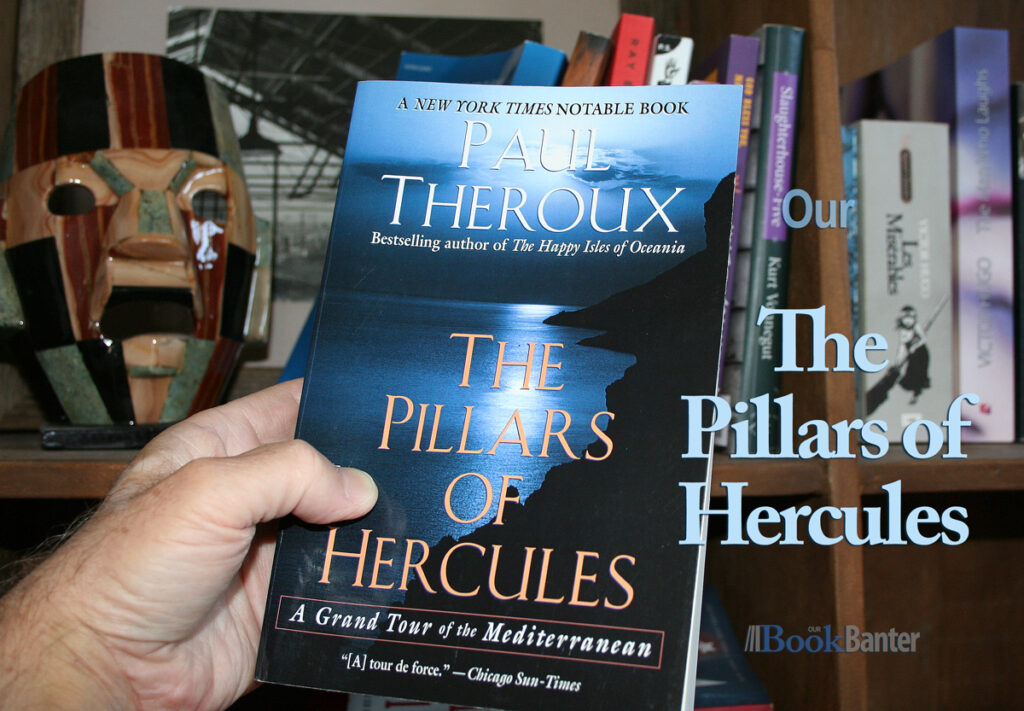
The Pillars of Hercules book review
What is The Pillars of Hercules about?
The author’s goal was simple! He documented his travels around the Mediterranean coastline, starting with Britain’s Rock of Gibraltar territory.
From there, he hopped up to Spain’s Mediterranean coast and continued in a mostly clock-wise route. Along the way, he talked with people trying to survive and thrive in their own little communities.
When possible, Theroux avoided tourist traps that other travel writers seem to flock to. Instead, the author focused on lesser-known locations throughout his trek—places where the locals go—those places usually not included in glossy travel pamphlets or highly polished travelogues.
Critics say that Theroux had cruel observations
Some critics of this book argue that Theroux had unnecessarily cruel observations about the local people he observed, as well as some of his travel mates. For instance, the author saw a French tourist while on the peninsula of Gibraltar.
Gritty but honest details
This tourist was taunting an female ape that was quietly sitting and breast-feeding her baby (there are about 250 apes living freely in Gibraltar, and are fed by a local government agency). As the tourist was getting closer and making faces at the ape, the author noted all the gritty details.
As he wrote, Theroux characterized the female tourist with ape-like attributes. Personally, I appreciate his honest but gritty details, and this ironical observation made me laugh. But, I do agree that his characterizations can sometimes be cruel, and maybe a little juvenile.
So, that’s how his honest observations can get the author some honestly negative reviews. I understand those critiques, but I think the author’s witty and gritty observations make him a valued travel writer.
Countries that Theroux visited
As I followed the author’s journey, I think he visited all the islands (some islands were large) in this almost land-locked sea, as well as many of the smaller towns and larger cities along the European, Asian, and African coasts.
The countries Theroux visited included:
- Spain
- France
- Italy
- Slovenia
- Croatia
- Bosnia and Herzegovina
- Albania
- Greece
- Turkey
- Cypress
- Syria
- Israel
- Egypt
- Libya
- Tunisia
- Algeria
- Morocco
- Sardinia
- Corsica
- Crete
Danger mixed in with the beauty
To me, many of those countries sound like risky places to visit. They were dangerous, and I believe his life was at risk at certain times. He knew the danger and wrote about it, but continued on anyway.
When he did encounter danger, like crossing the border of an authoritarian country, he kept a sense of humor.
When his driver ran out of gas at night in a desolate location, he philosophized about his life and some of his failures as the driver left him all alone. I really admire the author’s honesty about his own life, as well as his honest appraisal about the dangers surrounding him.
Forms of government the author observed
No matter where you travel on this planet, diverse political beliefs are a central theme in peoples’ lives. That is especially true in the countries surrounding the Mediterranean Sea.
The author encountered adherents to democracy, socialism, fascism, as well as brutal dictators who sometimes appeared benevolent. Many of the countries had a confluence of those philosophies in their local governments.
I thought the author’s experiences with fascist governments and those run by dictators were especially interesting. He wrote about the characteristics of fascism, and how it has seduced many people throughout the years.
The dangers of fascism
Unfortunately, those same concerning symptoms of fascism unfolding today in the United States.
Theroux noted that the fascist leaders in some of the Mediterranean countries regularly disparaged the independent press, they ridiculed scientists along with what they considered the educated elite. In addition, fascist leaders in Europe ridiculed democratic elections, and called them ‘rigged’ when they lost.
If you live in the United States, those characteristics sound familiar. We would be wise to study Theroux’s observations about the detriments of fascism in the countries he visited.
The author used many modes of travel
Theroux had a lot of places to visit, so he used many modes of transportation. He used local taxis and hired ordinary citizens to drive him to locations. Along the way, he talked and got to know the drivers, their passengers, and their motivations in life.
Engaged with fortunate and not-so-fortunate people
The author also hopped trains and ferries. He interacted with people fleeing bad situations in one country for a new life in another. Many of the people he saw and had spoken with had nothing, and were heading towards nothing.
Other more fortunate travelers had the luxury of disposable money and lots of free time. They were traveling the Mediterranean because they could, not because they had to.
The author’s ability to engage with people, no matter their social status, is what really makes his travel books unique.
I could vicariously meet people who were living another life
One of my favorite things about reading Paul Theroux’s travel books, is that he meets and talks with people that I never would. For instance, if I were traveling, I would never trust a local person I had just met to drive me into a dangerous situation.
But Theroux did that often, not because he loved danger, but he found it necessary to put his trust in strangers to get from one location to another. And many times, the author was surprised at the generosity of the people he met!
Strangers were very generous
For instance, poor people who had nothing gave the author money and food. In addition, they gave him advice on how to stay away from dangerous situations. And, they welcomed him into their homes, unconditionally.
Unique situations
Of course, there were some bad people along the way, too. Theroux exposed himself to unique situations that most tourists never see, and I would never attempt myself.
Instead, I can vicariously experience those uniquely dangerous situations from a safe distance through the author’s eyes.
Reading Theroux is an educational experience
Another benefit of reading any Theroux travelogue, and especially The Pillars of Hercules, is that you will assimilate many things. I not only learned about the Mediterranean’s geography, but I learned about its diverse cultures all around the sea’s coastline.
While he told his story, Theroux also sprinkled in quotes from other authors to add a historical perspective. Throughout his Mediterranean adventure, the author often referred to Homer’s Odyssey.
The Odyssey references were really fascinating to me. They helped open my eyes to the impact the Mediterranean Sea has had on our modern world.
TAKEAWAYS:
The Pillars of Hercules book review
So far, I have enjoyed every travel book by Paul Theroux, including his wonderful Deep South book. But, I have particularly enjoyed The Pillars of Hercules!
Today, I think that Paul Theroux is among my favorite authors! I enjoy his honesty and admire his braveness. He will go where no tourist would venture. The result of the author’s adventurousness creates a rich travel experience, even though it is a vicarious one for the reader!
Because of the diverse political and cultural experiences the author documented on his trip, I recommend every person in the United States reads The Pillars of Hercules. Reading this book has made me a better person, and one who now has an historical perspective on this important region.
Thanks for reading The Pillars of Hercules book review! If you’ve read the book, please share your thoughts in the comments section below!
Content and photos by Doug Martin and Our Book Banter