
Unfortunately, we live in a world where not all people are treated equally. Even in the United States, where “all men [all people] are created equal” (The U.S. Declaration of Independence), some people are treated better than others. One man who fought to bring that declaration of equality to all people was Frederick Douglass. Here is our Frederick Douglass Prophet of Freedom book banter, and why you should read this enlightening book.
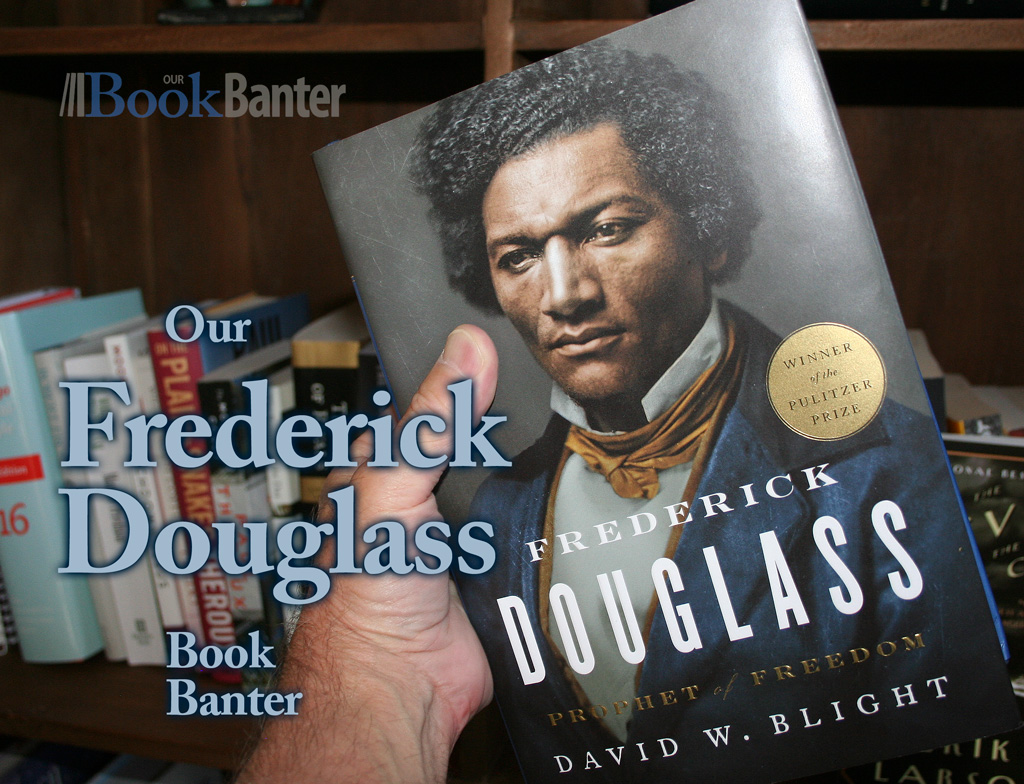
Our Prophet of Freedom book banter and review
Our Prophet of Freedom book banter is not a book report
Personally, I hate reading book reviews that reveal all the details about the plot and about the main characters. So, I promise not to do that in our Prophet of Freedom book banter!
Instead, I’ll discuss my own thoughts about this gifted man’s life, as well as the turbulent events that were happening in the 1800’s right here in the United States. In other words, I’ll reveal fragments, but not entire details of the book.
Writing and research was excellent
The author, David W. Blight, obsessively researched the life of Frederick Douglass. And, after reading this book, I can understand his fascination—Douglass was a talented and courageous man.
Blight culled his research from his lengthy investigations, which included some of Douglass’s own writings. He included quotes from Life and Times of Frederick Douglass, which is his well-written autobiography.
At times, the writing was repetitive
My only complaint about this 2019 Pulitzer prize-winning book was that it was repetitive. However, the repetitions did illustrate different perspectives of each of the politicians working for emancipation.
The most repetitions were during Douglass’s adult life when he earned a living as an orator. He also became involved with politics, and supported the progressive Republican party as they fought against slavery.
In a way, the repetitions provided a good foundation for us to more completely understand those complex historical times. To be honest, though, I did skim through many pages in the middle of the book. I picked up the gist, which I had already read before, and then I moved on to the next theme.
Frederick Douglass was a gifted communicator
Just as David Blight pointed out in this book, Frederick Douglass was a gifted communicator, and spell-binding orator. As I read sections of Douglass’s autobiography, I was amazed at how well he could paint a picture with his eloquent words.
The more I read, I quickly found that his writing was magical. Douglass taught himself to read and write. And, from a young age, his innate rhetorical skills helped him convey those ideas.
Was I not paying attention in school?
Why had I not learned about Frederick Douglass when I was in high school? I don’t remember reading or hearing anything about this brilliant former slave until many years after I graduated. Our teachers must have mentioned him, but maybe I wasn’t paying attention. That was my loss.
His younger years were traumatic
Frederick Douglass’s spent his pre-adult years on various plantations and that was very interesting for me to read. But, for the young boy born into slavery, those years were very traumatic. The author did an excellent job of researching many fascinating aspects of the slave child’s formative years.
His early years were not easy, but they provided the foundation and motivation for his adult life. In most of Douglass’s orations, he mentioned his youthful years as a slave.
As a young adult, he finally fled his slave owner and worked as a freeman. But, because of his race, his employers paid him much less than his White counterparts. For much of Douglass’s life (until emancipation), he lived his life as a fugitive.
The handsome Douglass made affluent white women swoon
Frederick Douglas had a white father, and a black mother. Women, especially affluent white women from the North, found him attractive. They loved his handsome face, his authoritative voice, and his extensive vocabulary.
While the book didn’t explicitly offer details, the book did imply the alluring effect that the handsome, tall man had. After emancipation, many attractive, affluent women from the north had eagerly helped Douglass with his cause and swooned as he spoke.
I thought I understood the Civil War
When I was young, I enjoyed reading about our country’s history. I already knew that our founders had structured our Constitution and Bill of Rights to allow for improvements.
But what I didn’t really understand were the complex issues that led up to the Civil War. Well, what was so complex about freeing the slaves? Wasn’t that the ‘Christian’ thing to do?
Back then, many slaveholders, even as they claimed to be Christians, didn’t consider enslavement of a specific race a sin. Of course, most slaves like the young Frederick Douglass did consider his enslavement a sin, a crime, and something that all slaves had to resist.
Slave owners were spiritual hypocrites
Douglass wrote and spoke about his owner’s spiritual hypocrisy. How could they be followers of Jesus Christ and enslave a person? How could they use human beings for labor and not pay them fair wages, or use the females for their own sexual pleasure? A follower of Jesus could not have done that!
In fact, Frederick Douglass believed his own father was a white slave owner. He believed he knew exactly who his father was, too. And, that’s all I’m going to say about that!
The Emancipation Proclamation did not end the Civil War
The Republican President, Abraham Lincoln, signed the Emancipation Proclamation on January 1, 1863. The U.S. was still in the Civil War, but at least there was an official proclamation that freed most of the Black slaves.
However, the proclamation did not end the Civil War. It would drag on for another two years. Another surprise was the liberal philosophy of the Republican party in those days.
Lincoln’s Republican party was not like today’s Republican party
As I read Prophet of Freedom, I learned that the Republican party that had backed Lincoln for U.S. President was not the same Republican party that had backed a reality television star in 2024.
Back then, Republicans believed Lincoln was too conservative! In fact, many members of the old Republican party felt that Lincoln was not progressive enough.
They feared he was being too conservative and trying to appease the South! Republicans felt Lincoln was not working quickly enough to free the slaves.
TAKEAWAYS:
Our Prophet of Freedom book banter and review
You should read this book about Frederick Douglass
At some point in your life, you must read this book about Frederick Douglass. The former slave and brilliant, world-famous orator played a large part in our country’s history.
And if you’re like me, you’ll learn new, surprising things about the early history of the United States. The book contains adult content that was mostly implied. However, there were no graphic details about the violence inflicted on Douglass.
After all, Douglass’s father was a white man. And as an famous orator, Douglass attracted attention from many admiring white females. The implications of this understandable behavior (it’s understandable to me, at least) were mostly hinted at in this book, but I got the message.
In the future, we will also review his autobiography, Life and Times of Frederick Douglass. His autobiography was well-written, and might even be a better reference book than Prophet of Freedom.
Thanks for reading our Prophet of Freedom book banter. If you’ve already read this book about Frederick Douglass, or his autobiography, please share your thoughts in the comments section below.
Content and photos by Doug Martin and Our Book Banter


