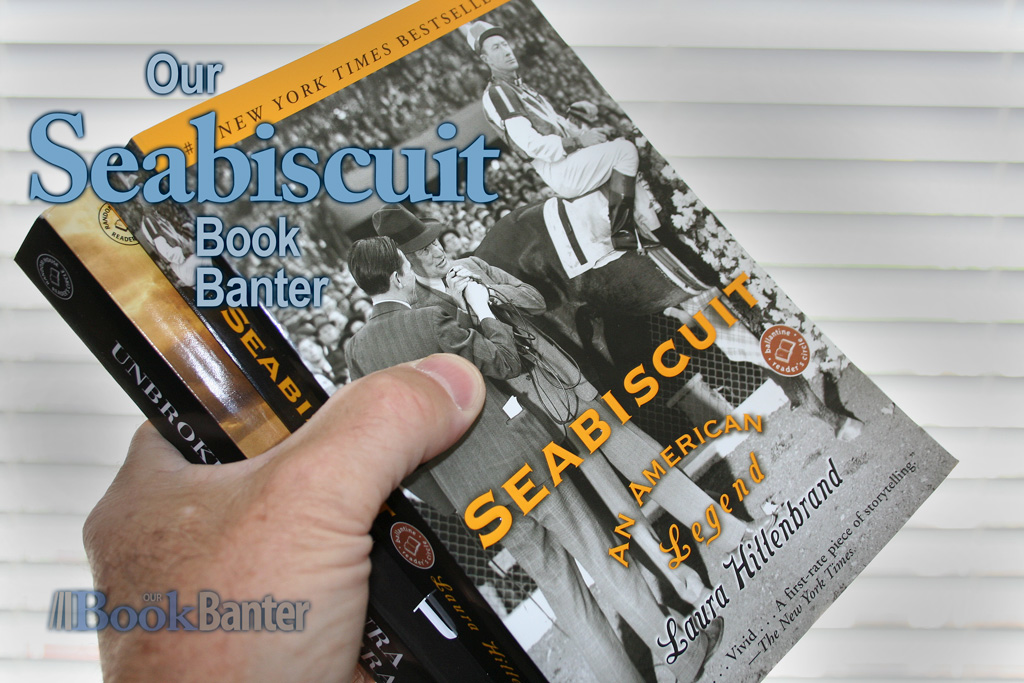
Some of our favorite books were written by Laura Hillenbrand. One that touched us the most was her true story about Seabiscuit, an American Legend. This is our Seabiscuit book banter review, but if you haven’t read the book or seen the movie, do not worry—we promise not to reveal too much of the story.
Another favorite book of ours is Unbroken, also by the same author. Both books are about people in difficult circumstances, and how they conquered their fears and overcame their desperate circumstances. I had read Seabiscuit when it was first published, but I’ve only recently enjoyed Unbroken.
Our Seabiscuit book banter
Why is Seabiscuit one of my favorite books?
Just like many of us, the characters in this story had experienced tremendous losses in their lives. Despite suffering setbacks, they pushed on and continued to fight for their goals. That’s what endeared me so much to this story. It’s a story about underdogs who do not take “no” for an answer.
Seabiscuit—a story about misfits
Even Seabiscuit, the horse, was a misfit and an outcast. Surprisingly, he was an unlikely race horse. He was smaller than most, had a bad temperament, and short, wobbly legs. It was only when luck, or even fate, brought Seabiscuit together with the other misfits in this story that he started to win races.
Some of the ‘misfits’ who cared for Seabiscuit
Charles Howard, Seabiscuit’s owner
The person who eventually bought Seabiscuit was a self-made, wealthy entrepreneur. Charles Howard had made a fortune selling horseless carriages. In fact, he believed that the day of the horse was past, and he had no interest in buying one. Still, Howard loved going to the races, and one day he crossed paths with Seabiscuit.
Tom Smith, Seabiscuit’s trainer
Tom Smith was the mysterious trainer who lived a secretive life. While he had trouble communicating effectively with people, he had an innate talent for talking with horses. He admired Seabiscuit’s feisty rebelliousness, and saw potential in this unlikely race horse.
Red Pollard, Seabiscuit’s jockey
Smith also saw potential in an equally rebellious jockey named Red Pollard. While Pollard was in his teens, his destitute parents had left him with a caretaker. Pollard’s nagging sense of abandonment haunted him for the rest of his life.
Despite being taller than most jockeys, Pollard had an obsession with riding horses. He didn’t take “no” for an answer.
George Woolf, Red’s friend who also jockeyed Seabiscuit
hen there was George Woolf, who became one of Pollard’s closest friends. Woolf was a successful, stylish, and dapper jockey who had a secret—he had type 1 diabetes. To stay alive, Woolf had to take daily insulin injections. Back then, there were no portable, inexpensive blood glucose monitors.
Given my own experiences as an insulin-dependent, type 1 diabetic, I am certain there were times when Woolf was competing while his blood sugar was too low. When I have hypoglycemia, I can’t think logically and I have trouble coordinating my movements. It’s very dangerous for me to drive with low blood sugar. During one hypoglycemic episode, I even passed out on my back porch, at night, in the desert.
In 1946, Woolf was jockeying a horse. Witnesses saw him slip from his saddle and hit his head on the ground. Many people speculated that his blood sugar was too high, or he was just suffering from his long-term diabetes. My theory is that Woolf’s blood sugar was dangerously low from too much insulin, and that he had passed out.
They all suffered heartbreaking losses
Each of the main characters I just listed above suffered heartbreaking losses. I don’t want to give away too many details of the story, but they all struggled with physical limitations and personal tragedies.
The author was able to capture those shortcomings, disappointments, and losses, while also giving the reader the sometimes dry details of the horse racing industry.
First read Seabiscuit, the book, then watch the movie
Seabiscuit, an American Legend, was published in 2001. I can’t believe it’s been that long since I first read this compelling book. The 2003 movie which followed included great actors like Toby Maguire as Red, and Jeff Bridges (Jeff Bridges has an awesome website) as Charles Howard.
As I watched the movie for the first time those many years ago, I remember how glad I was that I had read the book first. Without all the information from the book, I might have misunderstood who the characters were and what was going on in the plot.
My recommendation is to read the book first, and then watch the movie. That way, you’ll get much more clarity and meaning out of the film.
My favorite moments in the book
Some of my favorite moments in the book were also my favorites in the movie. Don’t be surprised, though, if the movie changed the actual events a little. That was okay with me, because the film captured the spirit, struggles, and emotions that each character felt.
For instance, Red Pollard had misjudged a competitor and lost a race that he might have easily won with Seabiscuit. In the book, Pollard never revealed to Seabiscuit’s owner and trainer that he was blind in one eye and he didn’t have good depth perception. If Pollard had confessed his secret physical defect, his jockeying career would have been over.
In the movie, however, Pollard is confronted by both Howard and Smith, and he does reveal his handicap. Smith wants to fire him immediately, but Howard, the wealthy car dealer, refuses. Instead, he repeats Smith’s earlier words back to him:
“You don’t throw a whole life away just because it’s banged up a little.”
So good, and so true. I have experienced those moments, and I’m sure you have, too.
Red wants to race with Seabiscuit just one more time…
Close to the end of the book and the movie, Red Pollard suffered a serious injury. His doctor said he’d never race again. Of course, Red had built his life around Seabiscuit, and he wanted to compete with the horse and win an important race.
In the book, Red’s friend, journalist David Alexander had a conversation with Charles Howard about Red’s injury. Here’s the excerpt of that conversation:
“If Red breaks that leg again, it will cripple him for life.” —Charles Howard
“Maybe it was better to break a man’s leg than his heart.” —David Alexander
In the movie, however, Red’s friend George Woolf took the place of Alexander. I really liked that change because Woolf understood Red’s obsession and his need to compete while riding Seabiscuit.
Woolf and Pollard understood that they were all broken, and by competing and struggling to overcome their shortcomings, they had helped fix each other.
Our Seabiscuit book banter—the whole book was a big favorite moment
Along with those two favorite moments in the book, there were many others. Together, they all build to…well, I can’t tell you what they build to or I’d reveal too much of the story. Just take it from me that this book is a must-read. Even if you don’t know a thing about horse racing or gambling, you will love this book.
At the end o fthe book, there is an interesting epilogue, along with extensive notes, acknowledgments, and a reader’s guide. If you’re like me, this book will prompt more research about all the characters who surrounded Seabiscuit.
Spoiler: this movie clip does reveal the end of the story. However, this clip also encapsulates the reasons why every person who has faced adversity should read the book and watch the movie. It is brilliant, and I loved it!
TAKEAWAYS:
Our Seabiscuit book banter review
Seabiscuit is one of our all-time favorite books. The author expertly wove details about the horse racing industry into the diverse characters who came into contact with Seabiscuit. Every single character, including the horse, had flaws and frailties. In some way, they were all broken.
Despite their shortcomings, they didn’t take “no” for an answer.
I’d recommend reading the book first, and then watching the movie. Trust me, you will love the book, and you will love the movie, too.
Thanks for reading our Seabiscuit book banter and book review. Please share your thoughts about the book or the movie in the comments section below!
Photos and content by Doug Martin and Our Book Banter