
Ever since I was a kid, I’ve always been interested in psychology. To be honest, I believe my own quirkiness and inability to connect with most people drove me to psychology in the hopes of bettering myself. Unfortunately, those efforts mostly failed, yet I did learn a lot. I guess that’s why I was drawn to the book, Memories, Dreams, Reflections, as told by the psychiatrist C.G. June. Here is our Memories, Dreams, Reflections book review.
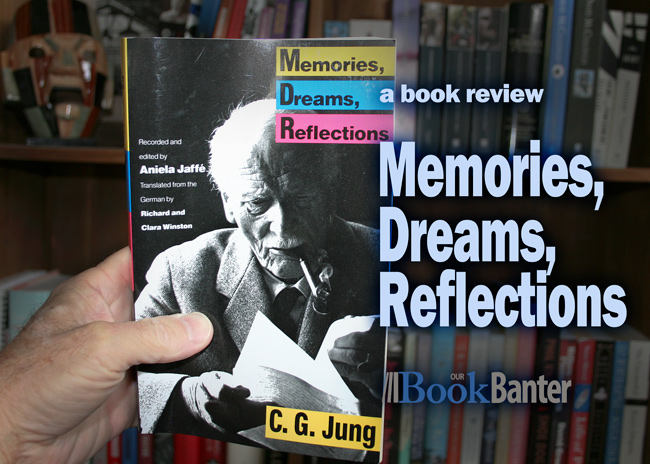
Memories, Dreams, Reflections book review
Semi-autobiography of psychiatrist C.G. Jung
Memories, Dreams, Reflections is the true story of the life and philosophies of the renowned psychiatrist, Carl Jung, or C.G. Jung. Most of this autobiography was recorded and edited by Jung’s personal secretary, Aniela Jaffé, but Jung also wrote some of the passages of his eventful life himself.
Masterful translation from German to English
Originally written in the German language, Richard and Clara Winston then translated Memories, Dreams, Reflections to English. The reason I use the word “masterfully” is because this book’s writing style was so pleasurable to read.
Each idea that Jung expressed flowed seamlessly from one idea to the next. I don’t know if those beautiful transitions should be credited to the translators, or if the editor, Aniela Jaffé, deserves more of the credit. Or, maybe C.G. Jung deserves the ultimate credit for overseeing such a beautifully written story of his life.
Either way, this book was beautifully and masterfully written and was a pleasure for me to read!
Early life of Carl Jung
My favorite part of this book was when Jung talked about his earlier years of life. Jung’s earliest, childhood experiences were fascinating. Coincidentally, I also felt and experienced some of the same things he did.
For instance, Jung confessed that he was accident-prone as a child. Looking back, he speculated this his ‘accidents’ might have suggested “…an unconscious suicidal urge or, it may be, to a fatal resistance to life in this world.” (Memories, Dreams, Reflections, First Years, pg. 9)
I empathized, because I felt that I have also had an underlying “fatal resistance to life”, for all of my life. It’s strange, but I could instantly empathize with the psychiatrist because of those revelations, and others.
Jung’s father was a parson
Jung’s father, Paul, was a parson, or a Protestant pastor, in Switzerland. Naturally, Paul Jung clung to the dogmatic teachings of the Protestant faith.
However, Carl was a precocious child with a ferocious thirst for knowledge. He read his father’s books about philosophy, religions, along with archeology.
Dogmatic beliefs stifle the truth
While still young, Jung’s evolving outlook on life and religion changed. He watched as his father clung to his dogmatic beliefs, and how the church took advantage of, and even enslaved his father’s mind.
Based on Carl’s observations, he realized that people who cling to dogmatic religions are really repressing the truth about life. In fact, those dogmatic beliefs hide the real world, as well as hide each person’s true self behind a shell of false beliefs.
Mark Twain had similar beliefs about religion
As I read Jung’s childhood evolution, I realized he observed the same things that Mark Twain did, as Twain formulated his own hatred of organized religion.
Twain expressed his beliefs about god and religion through his character, Huckleberry Finn. Young Huck realized that god had answered none of his prayers. In addition, Huck observed that god does not help people avoid tragedies in this world—if god is there, why isn’t he helping people who really need help?
Interpreter of dreams
Throughout his life, C.G. Jung was an interpreter of dreams. This book is filled with the dreams he had throughout his life, including his earliest and most memorable dreams from his childhood.
Disturbing dreams
Surprisingly, Jung had a very similar dream that I had been having in the past year. In my dreams, I owned a large, old house, but only lived on the top floor. Because the house was so large, I rarely went into the other rooms, especially on the first floor.
But, one night, I decided to check things out, and make sure there were no plumbing leaks or other maintenance issues. While exploring the first floor, in the dark (why didn’t I turn the lights on?), I saw a large dining room table, lit by candlelight, and I saw that someone had been eating.
Who were those people in my house?
In the distance, in a dark hallway, I caught a glimpse of an old woman! But, whenever I got closer to her, she would disappear into another room, almost like a ghost.
That dream, to me, was very disturbing. Throughout the next few months, I had similar dreams, but they all involved people living in my house, who I could never find or talk to. Those dreams were very unsettling to me.
Jung’s interpretation of his similarly unsettling dream focused on the furniture that he found, while mine did not. So, his interpretation of that similarly disturbing dream was different, and didn’t really apply to my dream.
Life-after-death?
Despite Jung’s intense distrust of dogmatic religions, he often contemplated thoughts of god and life-after-death. For me, that obsession confused me, because I believe it is impossible to prove there is a god, and it is also impossible to prove there is life-after-death!
Contradictions
But, my beliefs are really irrelevant—each reader of this book will have their own beliefs! But, Jung asserted in his chapter titled “On Life after Death”, that each of us has an obligation “…to form a conception of life after death…” (page 302).
Speculations
To me, his assertion is contradictory to his dislike of dogma. After all, while it might be nice to speculate about an afterlife, or the exitance of a god, it is a complete waste of time! Am I correct, or not? I don’t know, but I believe it’s a time-waster!
Memories, Dreams, Reflections is thought-provoking
Above all, C.G. Jung’s autobiographical (semi-autobiographical) book, Memories, Dreams, Reflections, contained so many thought-provoking ideas. Also, I found it extremely interesting to read, and it really captivated my imagination.
Even when I didn’t agree with all of his dream interpretations, his ideas did make me think outside of my own comfort-area, and that was a good thing!
Extremely interesting interview with Carl Gustav Jung! At times, though, I found his interpretations to be contradictory. What are your thoughts about Jung? Please share them in the comments section below!
FINAL VERDICT
Memories, Dreams, Reflections book review
C.G. Jung led such a fascinating life. And, I was especially interested in his formative years as a child. It was during those years when he developed his distaste for dogmatic beliefs.
In addition, Jung shared many of his personal dreams that he experienced throughout his life, and the meanings he attached to those dreams. They were all so intriguing!
The German-to-English translation was flawless, and I found the English version to be so-well written. In fact, it was a pleasure to read.
Despite some places where I might have disagreed with Jung’s conclusions and philosophies, I found Memories, Dreams, Reflections to be thought-provoking, and intriguing—a definite must-read for any person interested in psychology!
Content and photos by Doug Martin and Our Book Banter.


