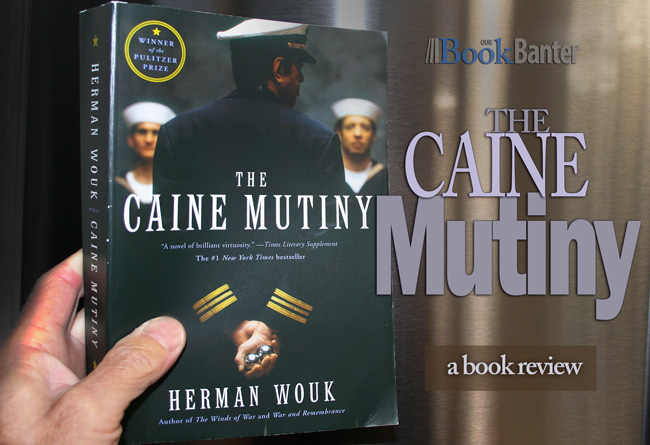
At first, I didn’t think I would enjoy an old but epic novel about the Navy. But, as I started to read, there was something that intrigued me about 1951’s The Caine Mutiny. Read The Caine Mutiny book review and book banter, and see if you might be intrigued, as well.
The Caine Mutiny book review
The author was also a writer and a Naval officer
Herman Wouk also served on an old minesweeper
As a comedic writer and a Naval officer, Herman Wouk was also an officer on an old minesweeper, similar to the mythical USS Caine described in the book. In addition, Wouk had already published two comedic novels, and had worked as a scriptwriter for Fred Allen, the radio comedian.
Despite his writing and comedic experience, Wouk was not familiar with writing an epic, dramatic war-time novel. So, The Caine Mutiny would be his first of many novels that share the drama, hardships, and rewards of serving on sea in the Navy.
As I read The Caine Mutiny, it was apparent that the author had in-depth knowledge about the Navy, including its strict protocals of behavior and record-keeping. It was also obvious that the stringent paperwork requirements were necessary in such a complex organization.
The Caine Mutiny premise
Ensemble cast of characters
Herman Wouk’s 1951 epic novel, The Caine Mutiny, follows an ensemble cast of young, inexperienced midshipman who are assigned to the USS Caine. While surrounded by spiffy looking, very large and imposing battleships, the old, rusty, and obsolete minesweeper, the USS Caine, looks obsolete to the young recruits.
In the Navy, captains for the USS Caine can frequently change. When midshipman Willie Keith first stepped onto the USS Caine, he was unimpressed. And, he blamed the captain, de Vriess, for the dilapidated appearance. However, Keith and the other newcomers soon had to grudgingly admit that de Vriess knew how to maneuver the old minesweeper.
New, by-the-book commander for the Caine
When a new captain was assigned to the USS Caine, most of the midshipmen were relieved. The new Lieutenant Commander, Philip Francis Queeg, believed in running his ship by the book. He wanted a clean, sharp-looking ship that obeyed every Naval regulation, even the most trivial.
Easily distracted commander
However, the midshipman soon observed that Queeg could easily be distracted from his commanding duties, by even the most trivial breach of conduct by the sailors. His lack of attention slowly revealed a lack of competence in maneuvering his minesweeper.
Incompetence and deadly danger
The author describes in hair-raising detail some of Lieutenant Commander Queeg’s commandeering blunders, along with his arbitrary enforcement of the rules-and-regulations. His incompetence soon puts every sailor’s life in danger during an unusually strong and violent typhoon in the Pacific Ocean.
Mutiny
That’s when the executive officer, Steve Maryk, reinforced by the communications officer, relieved the Lieutenant Commander, and seized control of the ship. In other words, Maryk committed an act of mutiny, which Maryk believed was justified by Article 184 of the Naval Regulations.
Court-martial
Afterwards, Steve Maryk is charged with mutiny, and a high-stakes court-martial trial follows. All of the characters, including the defense lawyer, the prosecution, and the Naval officers in charge of hearing the case, are so interesting.
Unfortunately, I cannot reveal any more about the story, but it builds to a surprising and stunning climax. Please continue reading The Caine Mutiny book review and book banter!
I didn’t see this 1954 film adaptation of The Caine Mutiny, but this clip looks really good. Humphrey Bogart perfectly portrayed Captain Queeg.
The Caine Mutiny book review
The Caine Mutiny ensemble cast of characters
All of the characters in this novel were extremely interesting. And, thanks to the author’s own experiences in the Navy, all of the characters were authentically portrayed.
The character development in this novel was superb! As I read, I was drawn, more-and-more, into each character’s psyche, and their responsibilities on the ship. In fact, the authentic character development helped make this novel top-notch and required reading!
Willie Keith:
Keith was wealthy and spoiled
As one of the main characters in this ensemble cast, Willie Keith comes from a wealthy family. And, he was a spoiled guy—he was used to getting everything he wanted.
He was a talented piano player
Prior to joining the Navy, he was a talented musician and played piano in lounges. His musical talent even garnered some fans among the top brass in the Navy.
The Navy transformed Keith into a man
However, when Keith reported for duty, he started at the bottom. He was assigned to the USS Caine, and quickly learned the routine. Throughout his service in the Navy, the regimented discipline transformed Keith from a boy, into a self-reliant and confident man.
Initially, he really didn’t like Captain de Vriess. However, soon after Lieutenant Commander Queeg took over, he realized that de Vriess was actually a talented seaman, and he had run an efficient and safe ship. Unfortunately, Keith eventually grew to dislike Queeg with a passion.
Keith was one of the sailors who urged Steve Maryk to assume command of the Caine from Queeg. He was one of the witnesses in the mutiny trial.
May Wynn:
Wynn was a pretty nightclub singer
The beguiling May Wynn had almost instantly attracted Willie Keith. She was a nightclub singer, and Keith loved her beautiful appearance and shapely figure.
Poor working-class family
Unfortunately, May came from a poor, working-class family, so Keith felt that she could never be marriage-material for the upper-class Keith family. Still, they talked, they dated, and May kept in touch with Willie while he served in the Navy.
Will they ever marry?
Eventually, as Keith matures in the Navy, and learns to seek his own path in life, he realizes that May Wynn might be the perfect mate. But, will the highly desirable May be patient and wait around as the young, fickle man makes up his mind?
Lieutenant Commander Philip Francis Queeg:
Strict and by-the-book
Initially, Lieutenant Commander Queeg was welcomed onto the USS Caine as a refreshing sign of renewed discipline and pride. However, Queeg’s strict, by-the-book, commandeering style of leadership quickly alienated him from most of the crew.
He was a short man, which possibly made him overcompensate with his domineering leadership style. In addition, the midshipmen soon learned that Queeg avoided dangerous combat situations.
Psychological conflicts
To sooth Queeg’s troubled psychological conflicts, he carried two steel, palm-sized balls with him. He rolled them in his hand during stressful interactions.
Eventually, the midshipmen and officers questioned Queeg’s abilities to command a ship. His inaction and ineptness prompted Steve Maryk to exercise Article 184 of the Naval Regulations to assume control of the USS Caine from Queeg.
Steve Maryk:
Talented, experienced sailor
As a highly talented and experienced sailor, Steve Maryk had earned the respect of Queeg and the other officers and midshipmen on the Caine. He took his responsibilities as the ship’s Executive Officer seriously.
Intensely loyal to Queeg
Maryk encouraged loyalty to Queeg throughout the ranks. And. as a dedicated Navy officer, he refused to participate as other members of the crew disparaged Queeg.
Mutiny and court-martial
However, Maryk eventually realized that Queeg might be psychologically unfit to command the USS Caine. And, egged-on by some of the other crew members, Maryk seized control of the ship during a dangerous typhoon.
Eventually, he underwent a court-martial trial, and the results of that trial might forever change his life.
Thomas Keefer:
Just like the author, Herman Wouk, the Thomas Keefer character was an author who served in the Navy. He was the Communications Officer for the USS Caine. In his spare time, he wrote his novel about life in the Navy.
He is the first character in this novel who told Maryk that Queeg might be insane, and unfit for commanding a ship. In general, Keefer was dismissive of authority, but he was a bright, dependable officer who did his job well.
Barney Greenwald:
Reluctant defense attorney
Barney Greenwald was a fighter pilot and was injured in combat. Fortunately, he was also a gifted, brilliant, and highly successful lawyer. He was Maryk’s reluctant defense lawyer during his court-martial proceedings.
He experienced anti-Semitism
In many ways, Greenwald was one of the more interesting characters in the The Caine Mutiny. He was Jewish, and experienced anti-Semitism on an almost daily basis.
Maybe because of the prejudice he experienced, Greenwald was sympathetic to Lieutenant Commander Queeg as an officer. In addition, Greenwald was sympathetic to Maryk’s situation, and could intellectually understand why Maryk had seized control of the USS Caine.
But would he be fair?
However, despite his ‘sympathies’, Greenwald believed in the Naval chain-of-command, above all. So, would Greenwald help Maryk defend himself, or would he do a haphazard job to help out Lieutenant Commander Queeg?
That’s for me to know, and for the reader of this engaging novel to find out!
This 1954 film adaptation of the 1951 best-selling wartime novel, The Caine Mutiny, starred Humphrey Bogart as Captain Queeg. From my perspective, this version is the best. Many of the scenes are taken word-by-word from the excellent novel.
FINAL VERDICT:
The Caine Mutiny book review
I loved reading The Caine Mutiny
At first, I doubted that I would like this novel. For instance, I was expecting a lot of stereotyped characters that had no depth, or didn’t seem real. But wow, I was really wrong about that!
Superb character development
Each character was authentic, and each character seemed real. In fact, they seemed like people who I have interacted with in my own life. The superb character development really helped me become engaged with this spell-binding story.
Moral ambiguities, just like in real life
I was especially intrigued by all of the morally gray areas, or morally ambiguous scenarios that touched the life of each character. Those ambiguous scenarios starkly contrasted with the regimented, unambiguous mindset of the U.S. Navy.
Believable and engaging story
This entire novel had me engaged. Each character was believable. And, the author wrote each scenario as if it had actually happened in real life.
I believe that, even though this novel was written in 1951, you will also enjoy reading The Caine Mutiny. It’s a compelling and timely story, no matter the season or the year.
I want to read more books by Wouk
In fact, I loved Wouk’s novel, The Caine Mutiny, that I want to read more of his books. Other novels include The Winds of War and War and Remembrance.
Thanks for reading The Caine Mutiny book review and book banter. If you’ve read the novel or have seen any of the film adaptations, please share your thoughts in the comments section below.
Content and photos by Doug Martin and Our Book Banter