
Through the years, I’ve had lots of chances to watch the movie, Breakfast at Tiffany’s. But, I suspected it would be a sugary-sweet romantic story with a happy ending, Hollywood-style. So, I just wasn’t interested in that. Still, I knew that Truman Capote, a writer whom I admire, had written the original story in 1958, so I thought I should read it while I had the chance—and that’s what I did. Here is our Breakfast at Tiffany’s book review.
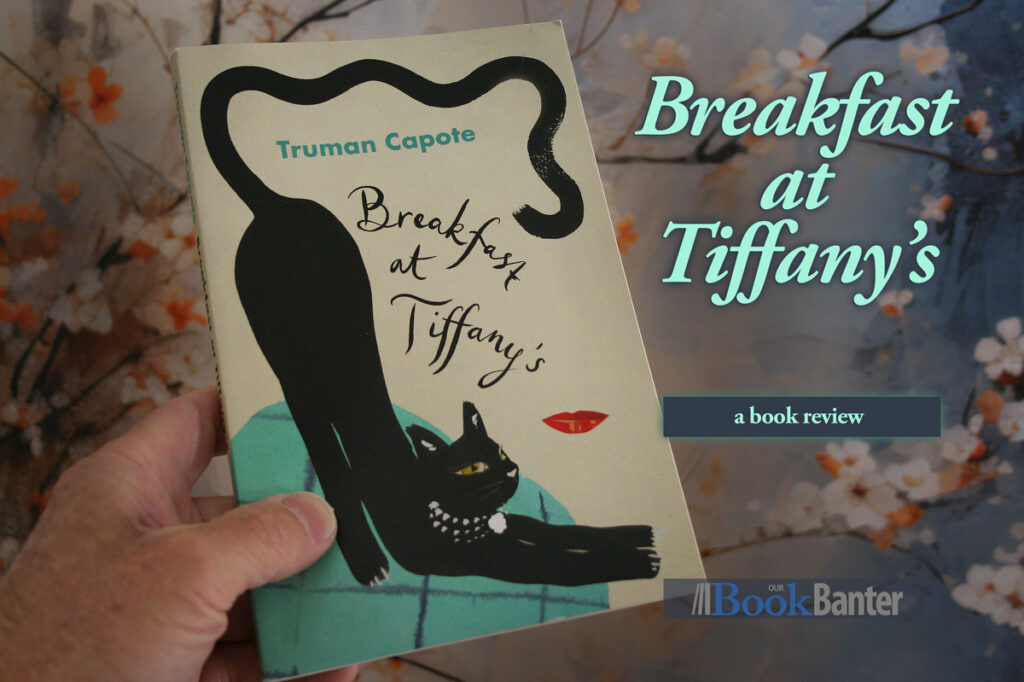
Breakfast at Tiffany’s book review
A Breakfast at Tiffany’s book review, but not a book report
All reviews at Our Book Banter never reveal story endings, or important plot twists-and-turns. Instead, we discuss the characters, the themes, and the author’s writing style.
We jealously protect the reading pleasure for everyone reading this book review.
Truman Capote was a great writer
I’ve been a big fan of Truman Capote ever since I read his true-crime masterpiece, In Cold Blood, several decades ago. He was a master at choosing the precise, descriptive words, and then wrapping those words in phrases that grabbed my attention.
Capote wrote In Cold Blood
Only recently, I read In Cold Blood again—I was chilled as he described how, only hours and days before, each member of the murdered family had made future plans. Those revelations revealed that our time on this planet is fleeting, and we could depart at any moment, despite our best-made plans.
Capote’s writings are well-researched
Truman Capote was a master of compiling research. He was able to then take those arbitrary factoids and arranging them all together into compelling stories. That’s what he did in his book, In Cold Blood, and that’s also what he did in Breakfast at Tiffany’s.
I’m sure Capote had extensively researched the World War II era, and how the world war had affected the lives of people living in New York City. In his brilliant Breakfast at Tiffany’s novella, the characters had to ration provisions, or substitute other items.
Generally, though, each character seemed to be living and celebrating each day of life, and they did it with a gusto. Especially the idiosyncratic protagonist, Holly Golightly—she lived her young life to the fullest!
Breakfast at Tiffany’s plot
The story revolves around an attractive, petite, young socialite named Holly Golightly. She supports herself as she enjoys New York City by accompanying or ‘escorting’ wealthy men to events.
Do some of those events lead to intimacy between Holly and her wealthy companions? Possibly yes, and possibly no. It’s kind of complicated, but I’ll let you, the reader, figure that out for yourself.
Men seem destined to become obsessed with her—not only because she is pretty, but also because of her uniquely unusual personality. Holly attracts attention no matter where she goes, and since she is well-traveled, she goes lots of places.
The narrator, who Holly calls Fred, also seems obsessed with her. He relates how he came to know Holly, their lives as they lived in the same brownstone in New York, and how he lived after Holly left.
Breakfast at Tiffany’s themes and style
The book really surprised me with its realism
The book, Breakfast at Tiffany’s, really surprised me with its realism. Mistakenly, I had imagined the book would be like the movie, with its overly sweet, romantic view of life, and its glamorous portrayal of Holly’s life.
Holly used vulgar language
Instead, the book was a gritty, honest portrayal of Holly’s bittersweet life. The language was vulgar, but frank and honest, too. And I liked it, a lot!
Some people might be shocked by the language Holly had used in the book. I was surprised, and maybe a little shocked. The honest, adult language and portrayals of characters really startled me, but in a pleasant way.
When I read a book, or when I watch a movie, I want honest portrayals—not sugar-coated, glossy, Hollywood-style happy endings. I want authors to keep it real, and Truman Capote did ‘keep it real’ in Breakfast at Tiffany’s.
Holly didn’t fit in with conventional society
This book took an honest look at Holly’s unconventional life. She was honest about what she wanted in life, and wasn’t afraid to get it.
Alienated, and maybe a little lonely
Many times, her goals, and means she used to attain her goals, alienated her from people, even those who had been her friends. And yet, even those who had become alienated from Holly were still interested and even obsessed with her.
Breakfast at Tiffany’s book review
Breakfast at Tiffany’s main characters
Holly Golightly:
Holly was the main protagonist. Fortunately, her upstairs neighbor revealed her story, little-by-little. She was a poor country girl (as we later learn), who ran away to live in the big city, the way she wanted to live.
She was a petite, attractive, beguiling young woman who lived in an apartment in a large, classic brownstone in New York City. Neighbors lived below her, and above her. Many of those neighbors enjoyed being around Holly, but one neighbor often complained about her exploits in the building.
Holly entertained often. And, men were the most invited guests, most of whom were affluent. They were handsome men, talented men, and sometimes powerful, affluent men. The one thing these men had in common was that they adored Holly.
Holly led a nomadic life
Unfortunately, Holly’s nomadic life would continue, even after living in New York City. I won’t include any details, because they’ll be fun for you to read, as you learn more about Holly Golightly.
The more I learned about Holly, the more I could empathize with her. She was living a bittersweet life, just like most of us do.
As her neighbor, Fred, was soon to discover, Holly was a difficult person to really get to know. She kept many aspects of her life secret, and most people did not completely, really know Holly, despite being close friends.
Of course, this scene from the film adaptation wasn’t in the Breakfast at Tiffany’s book, but it does capture Holly’s lonely, yearning, and dreamy spirit. Audrey Hepburn was perfect for the part of Holly.
Fred, the narrator:
Fred lived upstairs from Holly. He was often in his apartment because most of the time, he didn’t work a conventional job. Instead, he was an author and wrote stories at home.
In many ways, I suspected that Fred, Holly’s neighbor, had many similarities to Truman Capote. Fred was a writer, and enjoyed Holly’s companionship, but only in a platonic, intensely friendly way.
However, there were some moments in this story where I think Fred could have been enticed by Holly. And maybe something more did happen between the two—but, I’m not sure about.
Creepy behavior? Or just innocently obsessed?
As the narrator, Fred shared all the details of how he interacted with Holly. Once, he even obsessively followed her into the library, and sat at a distance, just secretly observing her.
In a way, that’s a creepy type of behavior, but he was obsessed with Holly, just like many other men. He, and they, couldn’t help themselves.
Fred had honest observations
I really enjoyed Fred’s honest observations. And in many ways, I also empathized with Fred, especially as he got to know Holly more.
Surprisingly, I think Fred discovered that the ‘real’ Holly was difficult to get to know. Holly was a very private person, but Fred learned more about Holly than most men were able to discover.
Joe Bell:
Joe Bell owned a small, local dive bar. Both Holly and Fred, the narrator, went to Joe’s bar often. They enjoyed the drinks, and they enjoyed Joe and his other patrons.
Like many men, Joe Bell had a secret crush on Holly. And, like many men and their Holly-crushes, Joe’s never revealed his crush on Holly to anyone (although Fred did suspect it).
I liked this character. The author made him so believable, and I believe Joe Bell also felt alienated, just like Holly did. But, he suffered alone, and in silence.
Mag Wildwood:
This stunningly tall model showed up at many of Holly’s get-togethers. She had her own unique, confident personality, despite have a speech impediment—she stuttered.
This pretty model was an acquaintance of Holly’s, and they both lived together for a short while. Most of the time, their relationship was friendly and supportive, while also being competitive and even toxic beneath the surface. Many times, that toxicity boiled over and exploded.
This character was so interesting. She had a unique personality, and lived an equally unconventional life. I could empathize with her, thanks to the author’s writing skills.
Holly Golightly had a cat with no name. The cat was an important aspect of the Breakfast at Tiffany’s novella and its film adaptation.
Doc Golightly:
Surprisingly, this older, grizzled, poorly dressed man shows up in the story, too. All I can tell you is that he was a veterinarian, and he lived in Texas. You’ll have to read the book to discover the rest of his story.
However, I will say that I could empathize with this character, also. He was living a difficult life.
Rusty Trawler:
Rusty was not conventionally handsome—he had a round, baby-type of face. But his wealth and his willingness to flirt made him popular with the ladies. In fact, Holly had a special, but unconventional relationship with Rusty.
Eventually, Rusty spent more time with, and eventually married Miss Wildwood. That relationship caused even more tension and anxiety for Holly.
Because of Capote’s writing skills, I was even able to empathize with Rusty Trawler, even though I didn’t care for him as a person, all that much.
O.J. Berman:
O.J. wanted to make the young, pretty, and enchanting Holly a big Hollywood star. Unfortunately, Holly didn’t want to comply—she wanted to stay true to her heart, and do something with her life that was meaningful.
As a Hollywood talent agent, O.J. new lots of important people in both Hollywood, and in New York City. He was often at Holly’s apartment. And, because Holly thought that her neighbor, Fred, was a talented writer, she often tried to get him to show O.J. his writings.
I liked the O.J. character, and enjoyed his interactions with Holly and Fred.
Breakfast at Tiffany’s book review
Final Verdict
The Breakfast at Tiffany’s novella was entertaining
As I read Truman Capote’s 1958 novella, Breakfast at Tiffany’s, I was thoroughly surprised. Instead of being a happily-ever-after, gushing Hollywood love story, I found it to be a gritty, real-world portrayal of a young woman living in New York City.
Vulgar language, and I loved it
I loved the forthright, and sometimes foul language that some of the characters used. And, I was surprised, shocked, and delighted at Holly’s sometime’s earthy, vulgar way of speaking.
Interesting, engaging characters, each one
The quirky characters in Breakfast at Tiffany’s were engaging, and they all lived interesting lives. Even the most mundane character lived a surprisingly unconventional life.
To be fulfilled, might also mean being lonely
As Holly’s life demonstrated, when she started on her trek to lead a fulfilling life, and one that pleased her, she often went alone. And, despite all the glitz, glamour, and celebration, the young and pretty Holly often slept alone.
Breakfast at Tiffany’s was a bittersweet story
This compellingly written novella didn’t really have a happy ending. Instead, it was a bittersweet story about a young woman trying to do her best in life, and trying to follow her heart. It was a bittersweet, dramatic novella.
I recommend Breakfast at Tiffany’s wholeheartedly
For a good time, and for a pleasant reading experience, I recommend you read anything written by Truman Capote. And, I especially recommend you read his 1958 novella, Breakfast at Tiffany’s!
Thanks for reading our Breakfast at Tiffany’s book review. If you’ve read the book, or have read other stories written by Truman Capote, please share your thoughts in the comments section below.
Content and photos by Doug Martin and Our Book Banter


