
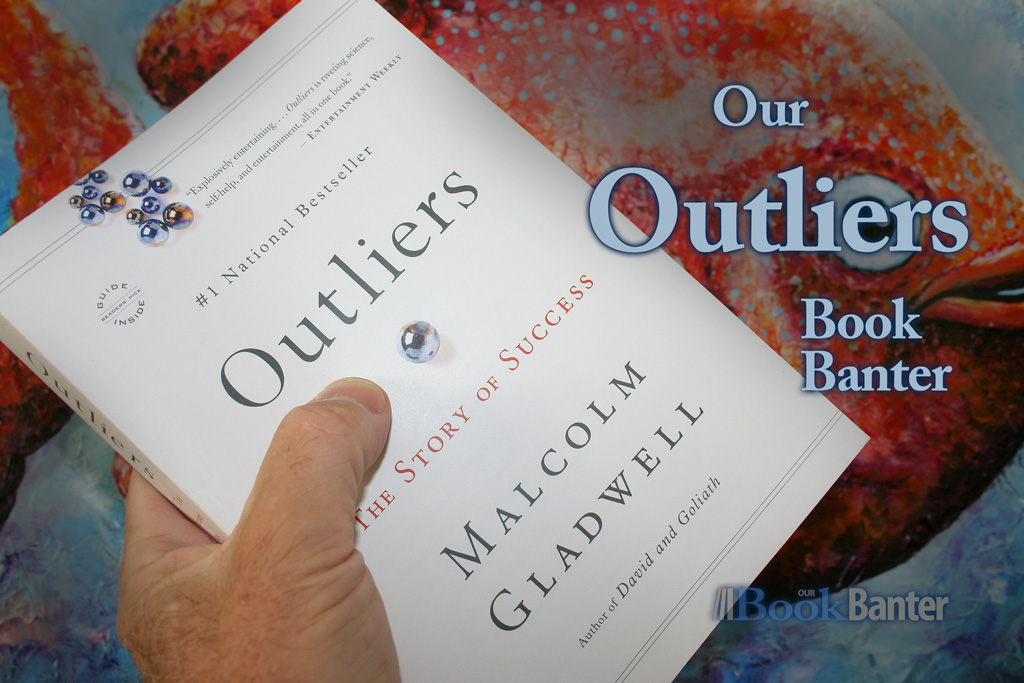
This is our Outliers book banter and review. Like all my book reviews, I promise not to present a detailed book report that reveals secrets, plot twists, or motivations. Instead, I will focus on the content presentation, the author’s writing style, and how the content impacted me.
Our Outliers book banter and review
The author, Malcolm Gladwell, had been a staff writer for The New Yorker magazine for over 20 years. Outliers, the Story of Success, is the first book I have read by this author. Because of his unique vantage point, Gladwell gives the reader a distinctive perspective on successful people and how they achieved their goals.
Successes and failures
Not only is Outliers a book about successes, but also about failures. Even though we all work hard and make sacrifices, we also experience failure in our lives. Gladwell helps us view our own failures and successes from a new angle.
In Outliers, the author introduces us to the smartest man on Earth, and why we have never heard of him. This was exactly the type of writing and topic that I still enjoy reading in The New Yorker, where he had also written.
In all the years that I’ve read the magazine, I have admired The New Yorker‘s openness to diverse and unique perspectives that each author contributed. It was only natural that the author of this book would have written for The New Yorker for so long. And, it was only natural that I loved Gladwell’s Outlier book so much.
What is an outlier?
The focus of this book was about an outlier, which the author defined as:
“a statistical observation that is markedly different in value from the others of the sample.”—Outliers Introduction, page 3
Gladwell also used another, similar definition for an outlier, but the one I included above was one that I felt most appropriately described the subjects in the book.
Outliers is not a self-help book
Outliers is not a “self-help” book in the way we might think of typical self-help books. For instance, books like Emotional Intelligence 2.0 or the always-popular How to Win Friends and Influence People both give the reader specific steps for improvement.
However, the author of this book focused on successful people, the work and sacrifices they made, and their familial and cultural environment. The author dissected the life and background of each person. But in addition, he also pointed out aspects that most biographies overlook.
There are no successes without hard work
Many successful people make their successes look easy. Musicians and actors seem to become overnight sensations.
However, the author studied the lives of successful people like Bill Gates and Steve Jobs. He revealed that their success stories included many early years of working, studying, and sacrificing. They worked because they loved it and felt compelled to perfect their skills—not necessarily to attain wealthy or success.
However, hard work is not enough
Despite our best efforts, hard work and sacrifice might not enough to ensure success. For instance, the author analyzed the players in junior ice hockey teams. He included a chart with the players’ vital statistics, including height, weight, birth date, and hometown.
I was shocked to learn that almost all players shared one of those vital statistics. And, it wasn’t the obvious height and weight stats that I immediately checked. Still, the one vital statistic gave some hockey players a surprising edge.
In order to not reveal too much of the story, that’s all I’m going to divulge about that finding. But the author demonstrated how athletic teams and educational systems have used those studies to open up more opportunities for their students and potential players.
Our familial and societal backgrounds count
As unfair as this might sound, our backgrounds and our ancestors can contribute to our chances of success. Do we respect people so much that we do not correct their mistakes?
The story about an airline crash was especially fascinating. The flight crew had trained well and had garnered respect. Yet, in their last flight together, the pilot and co-pilot made a few simple, careless mistakes. Had the pilot and co-pilot been more effective communicators, they would not have allowed their mistakes to have gone unchallenged.
Society had taught them to respect authority figures, and to never challenge their choices. Showing respect is an admirable quality in any person. However, that admirable character trait prevented the crew from correcting their colleague’s mistakes, and caused a fatal plane crash.
Thankfully, airliners have learned from those mistakes. Trainers have recognized how a pilot’s upbringing and cultural environment might influence their behaviors. In fact, this book taught us that our society influences us all, for both good and bad results.
Successful outliers had opportunities
Where would our world be without Bill Gates and Steve Jobs? Only 50 years ago, a supercomputer cost millions of dollars.
Today, thanks to their visionary work, our indispensable desktop, laptop, and other portable devices are vastly more powerful than the ancient supercomputer, and much less expensive, too.
Yet, if Gates and Jobs had not had supportive families, neighbors, and unique educational opportunities, they might be unknown names. Because of their devotion, sacrifices, and long hours of work, both visionaries were ready to seize their opportunities.
The author gave examples of how even the poorest students in New York City were given opportunities for academic success. Those students seized those educational opportunities that were usually only reserved for the well-to-do neighborhoods.
To succeed, they got up early and studied late. Their hard work had paved the way to their academic successes. Yet, without the opportunities, their aspirations for a better life might have been in vain.
Hard work and a little luck?
Without their commitment or hard work, those students would not have been prepared to seize the opportunities. Opportunities to study, work, and dream gave those students the helping hand they needed.
The author told a few stories about a father and son. In one true story, both worked harder than most people. Yet, only the son was an outlier and had amassed a vast fortune. They had similar skills and education, but the son was born in a different era—he had unique opportunities to exploit his skills.
Sometimes, no matter how much we work or study, we also have to be a little lucky. It’s not a bad thing to admit that fact, and it’s not an excuse for our failures, either.
Our Outliers book banter and review
Outliers: the Story of Success, should be required reading for everyone
Every student, parent, school administrator and teacher should read Malcolm Gladwell’s Outliers. The writing was superb—each outlier was thoroughly researched. Their successes and failures were well-documented, and presented from a unique perspective. In addition, the stories were packaged in a concise, entertaining format.
Thanks for reading our Outliers book banter and review! If you’ve already read the book, please share your thoughts in the comments section below!
Content and photos by Doug Martin and Our Book Banter


