
Despite being an avid reader all of my life, there is one prominent author whose works I had not read. His name is Gabriel García Márquez, and he’s won a Nobel Prize in Literature for his writings. One of his most renowned works is One Hundred Years of Solitude. This is our One Hundred Years of Solitude review and book banter!
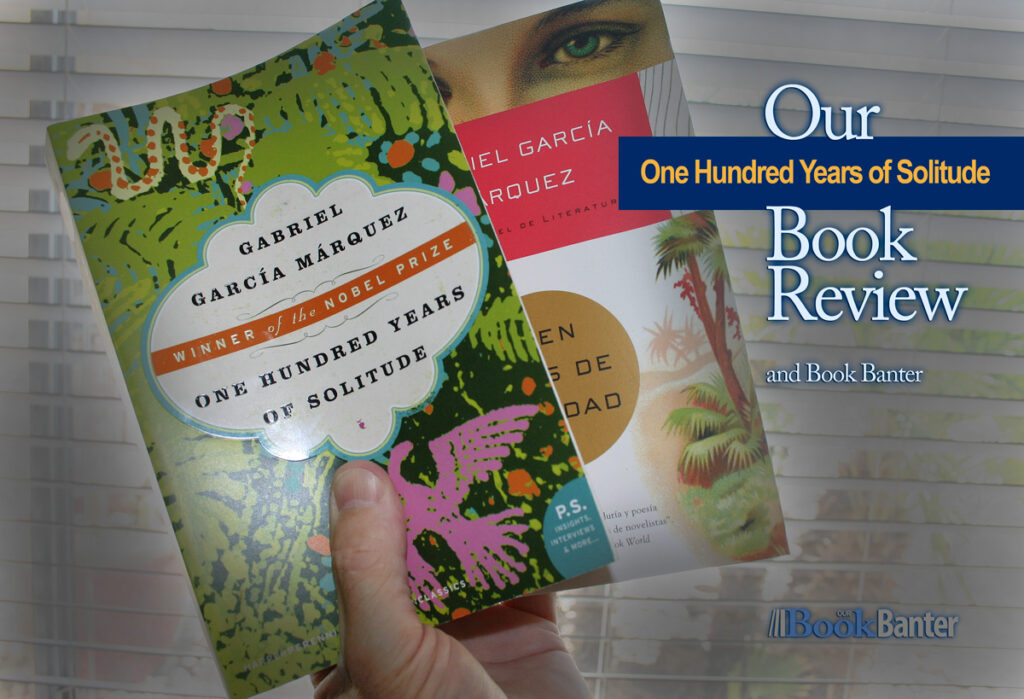
Our One Hundred Years of Solitude review and book banter
Solitude and alienation:
The title, One Hundred Years of Solitude, immediately caught my attention. I guess it’s because I love authors like J.D. Salinger who wrote about alienation, loners, and misfits in society. However, while this book had characters like Úrsula, who had experienced loneliness, solitude, and alienation, it also had a much larger tale to tell.
Úrsula was the matriarch of the colorful but mythical Buendía family, whose exploits were lyrically described by the author. Not only did the Buendía family experience loneliness and disappointments, but they also enjoyed all the rewards that family units throughout the world experience.
A story about everything and about nothing… Continue reading Our One Hundred Years of Solitude review for more of our thoughts! And, check out the theatrical trailer below.
Love and rejection:
This is a story about every human emotion that the process of living can elicit in us. I’m talking about love and lust, along with jealousy, pain, and rejection. Then, there was the incest. Shockingly, there was a lot of incestual behavior going on behind closed doors.
At times, the incest seemed so common, and to me, pretty disgusting. Still, the author told about those affairs in such a matter-of-fact manner that it didn’t repulse me or make me stop reading.
Márquez also described the physical love and spiritual adoration the Buendía lineage experienced through subsequent generations. Almost every member of the Buendía family had their share of love, lust, jealousy, and heartbreak. Sometimes the heartbreak and jealousy triggered violence.
Hatred and violence:
In addition to love and lust, the book had lots of violence. Many times, the violence was barbaric and heartless. It made me wonder how human beings can be so cruel to each other.
Despite the barbarism, the author told the violent stories without embellishment. It was almost like I was reading an impartial news report, but with all the graphic details. Ironically, Márquez still retained his lyrical style of beautiful writing even while relating those barbaric tales.
War and peace:
Throughout humanity’s own history, there have been turbulent periods of war, and also prosperous times of peace. The same thing was true throughout the Buendía family’s history.
Not only did they have wars between each other, but they also banded together to fight neighboring territories. Many townspeople were barbarically slaughtered.
Drama and comedy:
Just like all families, the Buendía clan had their ups and downs. They had their laughters and their tears. Even though their experiences were outlandish, I think I and other readers could identify with what they were going through.
The writing is lyrically poetic:
I was especially struck by Márquez’s unique writing style. Even though he used a matter-of-fact tone when he described even the most barbaric deeds, his words were superbly chosen and his sentences were expertly composed.
This author chose his words almost as a symphony composer might select melodic keys, chords, and notes. For instance, here’s a small excerpt describing the death of José Arcadio Buendía (from One Hundred Years of Solitude, page 140, excerpt from last paragraph):
“A short time later, when the carpenter was taking measurements for the coffin, through the window they saw a light rain of tiny yellow flowers falling. They fell on the town all through the night in a silent storm, and they covered the roofs and blocked the doors and smothered the animals who slept outdoors…”
from One Hundred Years of Solitude, page 140, excerpt from last paragraph
Spiritually beautiful images:
There’s nothing for me to say about that excerpt, except that it is a spiritually beautiful image typical of this book. The author conjures up images, thoughts, and experiences in the most beautiful way ever. It’s no wonder he won the Nobel Prize for Literature.
Our One Hundred Years of Solitude review (cont.)
Things I didn’t like about One Hundred Years of Solitude
In spite of the author’s superb style of writing, there were aspects that I didn’t like about this book.
Paragraphs were too long:
Sometimes, the paragraphs ran on for several pages. Even many of the short paragraphs were still too long. Their length made it difficult for me to read. To keep from losing my place, I used my finger as a guide as I read.
No central plot or main protagonist:
In a way, this was a story about nothing and maybe everything at the same time. For instance, I couldn’t sense a central plot to the story. Instead, there were hundreds of little plots, with their own characters and conflicts.
I found the conflicts and characters interesting, but I never sensed a cliff-hanger that would have compelled me to keep reading. Many of the conflicts resolved themselves quickly, or sometimes with lots of blood, sweat, and tears. Usually those elements would create a feeling of suspense, but for me, they did not.
Things I really liked about One Hundred Years of Solitude
Despite this book’s unconventional drawbacks, I still found it a compelling, worthwhile book to read. Here are some of the elements I liked most about One Hundred Years of Solitude.
Magical realism:
Márquez used the magical realism style of writing to retell the astounding Buendía sagas with a matter-of-fact style. While he wasn’t the first author to use this relatively new and predominantly Latin-American narrative writing style, he was probably the best.
Clairvoyance:
For instance, many of the characters in this book had extra-sensory powers. A few members of the Buendía family were clairvoyant, especially a younger, more solitary and quiet boy. In a way, his characteristics reminded me of my own childhood.
As strange as it may sound, when I was younger, I could sense or foretell some future events. They weren’t prognostications of large natural disasters or airline crashes or anything that dramatic. Instead, I was able to “know” what would happen in the future.
As I’ve aged, my clairvoyant senses have diminished. But, my experiences have shown that we all have unseen, maybe even magical powers. Maybe that’s why I was able to appreciate all the unique characters, and how they could harness the unseen powers of nature and our spirits.
Lyrical and poetical writing style:
One of the best things about reading this book was the chance to enjoy the author’s beautifully lyrical and poetical style of writing. Many times, I found myself in awe as Márquez conjured up what would otherwise be a humdrum scene and made it magical with his words.
Spanish version has more vivid imagery:
I believe the English translation still retains the beauty inherent in the original Spanish version. To see whether the English or Spanish version might better capture the author’s imagery, I bought both versions.
While I’ve only read a few selected sections (my favorites) of the Spanish version, I did note that the native language version contained more vivid imagery. Of course, I am a native English language speaker, so I may have missed some of the nuances in the Spanish language version.
Suicide or murder:
Either way, the author’s precise word choice along with the magical realism narrative style make this a special book to read. Here’s an example describing the aftermath of a husband’s apparent suicide (or was it murder?) (from One Hundred Years of Solitude, pages 131-132):
“A trickle of blood came out under the door, crossed the living room, went out into the street, continued on in a straight line across the uneven terraces, went down steps and climbed over curbs…went in under the closed door, crossed through the parlor, hugging the walls so as not to stain the rugs…went through the pantry and came out in the kitchen, where Úrsula was getting ready to crack thirty-six eggs to make bread.
from One Hundred Years of Solitude, pages 131-132
“Holy Mother of God!” Ursula shouted.”
The vivid imagery of how the victim’s blood traveled through the streets captured the magic of the people involved, and is a good example of the magical realism narrative style. After reading the excerpt, I laughed, and I thought about the people who were involved.
Yes, despite the violence, drama, almost barbaric love affairs, and extra sensory magic, this book will make you think. In fact, I’ve wondered if the author had a larger vision in mind as he wrote this wonderful, magical story.
Metaphor for the rise and fall of civilizations:
I might be crazy, but the more I read this book, the more I sensed a metaphor for the rise and fall of civilizations. For instance, many of the politicians’ outlandish thoughts in this book reminded me of the statements were hear today from our own bureaucrats in power.
Just as the people in this story experienced their successes, failures, and eventual death, so do all the great societies in our human history. I especially noticed that while a few of the Buendía males experienced great successes, their victories made them arrogant. Their arrogance then led to their downfall.
Arrogance can have the same effect on civilizations. Prior to World War II, Imperial Japan and fascist Germany had arrogant leaders. They wanted to take over the world, because they arrogantly believed they were the best leaders for the world. Today, we all know what happened to those two empires!
Or, maybe the book is just a story about a large family and what they ate, who they married, how they earned a living, and how they died. I don’t know, but I suspect our talented author took that answer to his grave.
After reading our One Hundred Years of Solitude review, please watch the theatrical trailer below!
TAKEAWAYS:
Our One Hundred Years of Solitude review and book banter
I recommend this book!
Despite the cons, the pros were overwhelmingly positive—I recommend this book. In fact, I think it should be required reading, with a few caveats thrown in.
For instance, if you can’t get used to reading a book without cliff-hangers, or a central plot, then you might not enjoy this book—I can definitely understand that! However, I slowly eased into the writer’s unique storytelling style, and slowly embraced the images and messages. After that attitude adjustment, this was a very good book, indeed!
Thanks for reading our One Hundred Years of Solitude review. If you’ve read the book, please share your thoughts in the comments section below!
Content and photos by Doug Martin and Our Book Banter


