
When I first saw the October Sky movie, I was already a middle-aged adult. Looking back now, I wish I had watched the movie and read the book when I was younger. Read our October Sky book banter and review, and then leave your own comments about the story below.
It’s been 20 years since the October Sky movie was released. Since then, I’ve seen the movie many times. Each time I was captivated by Homer Hickam’s story. He wrote about the United State’s space race with Russia, and how he wanted to be part of that race to space.
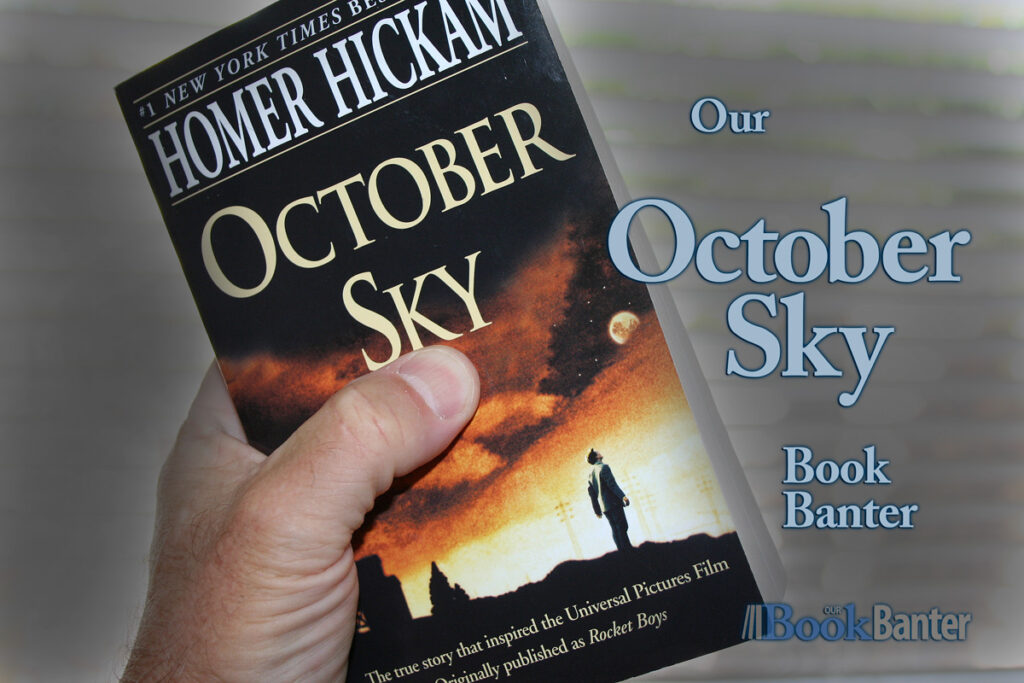
Our October Sky book banter
I loved the October Sky movie
The movie included all the elements that I love in a good story. Those elements consisted of characters who aspired to do great things, but also characters who struggled against overwhelming obstacles.
In fact, I was so moved that I think October Sky is one of the top five movies I have seen. Other inspiring movie-and-book combinations were Seabiscuit and Rudy.
If you saw the movie, do you need to read the book?
Yes, the book contains all the elements from the movie, plus more details about Homer and the other boys. The story is told from Homer Hickam’s perspective—he was a small-town boy who was expected to work in the coal mines of West Virginia when he grew up.
The book adds depth to the characters
However, in addition the important elements shown in the movie, the book adds additional depth to many of the characters. For example, I learned some surprising facts about Homer’s father, which the movie didn’t clarify.
In one example, I was surprised when I learned that Homer’s father had taught himself differential calculus. Without reading the book, I never would have learned that vital detail about the father. He was much more complex in real life than what he appeared in the movie.
We can learn to be self-actualized
In fact, not only did I learn new details about the characters in Homer’s childhood memoir, but I also learned lessons about how to succeed in life. The lessons of life from Hickam’s October Sky can help a person become self-actualized. Psychologist Abraham Maslow described those steps to self-actualization in his Hierarchy of Needs.
In addition to self-actualization, the book contains other important lessons about leading a good life.
Important lessons from the October Sky book
As I read October Sky, I noted at least four good life lessons. Just like all exceptional story-tellers, the author didn’t always come right out and make the lesson obvious. Instead, the lessons were disguised as innocent observations from people in his own community.
Learn math, science, and chemistry
The rocket boys quickly understood that their advanced courses in mathematics, science, and chemistry helped them build better rockets. In fact, Homer learned from his father that those disciplines were also important in the coal mining industry.
For instance, trigonometry helped the rocket boys measure how high their rockets flew. Differential calculus helped them compute the proper amount and combinations of fuel to make each rocket larger.
Chemistry helped them choose the best materials to keep their rockets from oxidizing and burning up. In addition, chemistry was a vital resource which helped them select the most potent fuels to provide the most thrust, but also remain stable enough not to be hazardous as they worked. Chemistry kept them from blowing themselves up.
Science developed disciplined critical thinking. As the rocket boys tried different nozzles and different fuels, they tested their theories each time they launched a rocket. When one theory didn’t work, the boys tried another theory and another test.
In other words, the rocket boys learned that their mistakes provided valuable lessons for improvement. When one theory didn’t work, they tried another theory. With each step, they documented their good-or-bad results with scientific precision.
Today, we need critical thinking skills more than ever.
With hard work, anything is possible in life
The rocket boys learned that with hard work and determination, anything is possible in life. Each one struggled with shortcomings that would have discouraged many people from reaching for their dreams.
Surprisingly, Homer struggled with algebra in high school. He revealed that he did much better in English class than he did in algebra class.
Homer wanted to be an engineer at NASA
To succeed in his dream to become an engineer who worked for NASA, Homer knew he would have to work harder to understand algebra, trigonometry, and calculus. To do better in his algebra class, Homer befriended Quentin, a not-so-popular classmate who excelled in all his classes.
Quentin was gifted, but he also had problems to overcome. His family was poorer than most, so Quentin knew he had to work harder than most to afford college. By excelling as a rocket boy, Quentin could show his value to prospective colleges.
Through their hard work and dedication, each rocket boy defeated insurmountable obstacles.
Appreciate the unique talents of all people
As I read October Sky, I could see that Homer saw the good in all people—even with the bullies who picked on him in high school. That doesn’t mean he was a push-over, though. In fact, I think his lofty goals and struggles to reach his dreams also helped him to stand up for himself and what he believed in.
Not surprisingly, Home really cared for his pets. He enjoyed their company, and took special care of each of them. In turn, his pets gave him their unconditional love.
When he told the story of losing one pet dog in an untimely accident, I thought of my own childhood and the loss of my own special dog. He took his dog’s death very hard, as did I.
Personally, I think his love for animals demonstrated his high level of character and sense of personal responsibility. Those are good traits for every young person to learn.
Homer’s caring for other living creatures naturally extended to the people in his life. When tragic things happened to the good people that he knew in his community, he took those incidents very hard, too. That characteristic is one of the many that I admire in Homer and all the rocket boys.
Live a life of service and give back
As the rocket boys were preparing for their science fair presentation, Homer went shopping for a new suit in a neighboring town. He wanted to make a good impression with the judges.
Homer spoke with JFK
He had the good fortune to see Senator John F. Kennedy campaigning for president. Homer had even asked JFK about space exploration after he had given a short speech.
When the future president prompted Homer about what we should do in space, he responded, “We should go to the moon.” Homer continued, “…we could mine it just like we mine coal here in West Virginia” (page 390, paperback edition).
Anyway, even though the author had made a point not to mention his own political or religious beliefs, I got the sense that the young JFK had made a big impression. In fact, the rocket boy had noticed that JFK seemed to have a lot of back pain while he made his speech. But, those physical short-comings didn’t stop him from following his dreams or from even serving in the Navy.
The reason I bring this up is that, after reading the book and learning how much Homer was excited about working for NASA, he put those dreams on hold. Instead, he “volunteered for Vietnam…”
October Sky epilogue
According to the Epilogue, Homer wrote that, just like JFK, he believed the United States should go to the moon, and we should also “fight for freedom across the world.” The fact the this young rocket boy, with so much potential, could risk it all to fight for what’s right is a noble achievement.
Homer’s unselfish act of service makes him a person of high honor in my eyes. Thankfully, I believe there are young people just like him who believe that we must stand up for freedom all over the world.
So, those are the four lessons to learn while reading October Sky, including the Epilogue.
October Sky has adult language and mature situations
Of course, the rocket boys had heard their share of four-letter words and they had their share of mature dating experiences. Homer relates those instances with honesty, but also in a way that will reassure parents that those situations are only hinted at and not spelled out graphically.
They also ran into their fair share of moonshiners and ladies of the evening. Back then, moonshine stills must have been a regular-type-of-thing in West Virginia. Heck, maybe they still are.
TAKEAWAYS:
Our October Sky book banter
October Sky is a book about honesty, hard work, and lofty aspirations
The only thing I know for sure is that book will bring out the best in you and your children. It will inspire your kids to do the best that they can with their talents. It will also motivate your teen to work hard, be an ethical person, and to treat people fairly.
Because of those reasons, I urge you and your family to read October Sky. And, if you’ve already read the book, please share your thoughts about our October Sky book banter in the comments section below!
Thanks for reading our October Sky book banter! If you’ve already read the book, please share your thoughts in the comments section below.
Content and photos by Doug Martin and Our Book Banter


