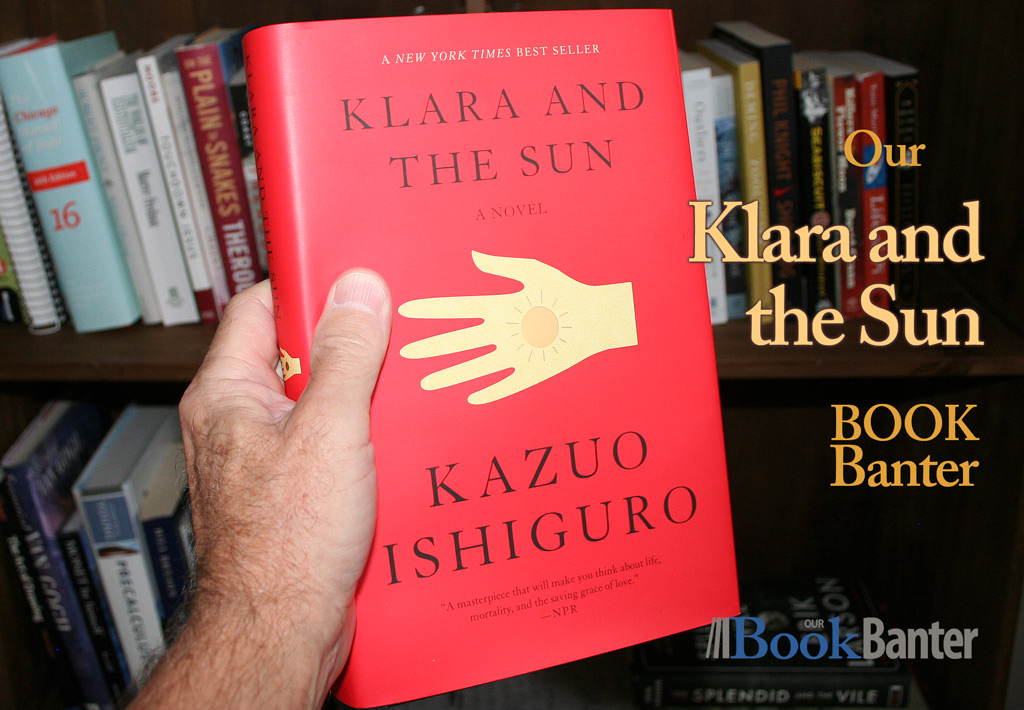
Ever since I read The Remains of the Day by Kazuo Ishiguro, I have been a big fan of the author’s writing style. Since then, I bought three more of his books. One of those included his latest best-selling book about a robotic artificial friend (AF). This is our Klara and the Sun book banter.
Unlike most book reviews, I promise not to reveal too much of the plot. Instead, I will focus on the author’s writing style and explore some character motivations.
My Klara and the Sun book banter
Is this science fiction?
You might think this novel is part of the science fiction genre, but the technology in the book exists today. As I read each page, I thought this could easily be our future in ten or twenty years.
But in fact, this type of interaction between man and machine is happening today. As the years tick by, we will see more refinements in robot technology. The refinements will make the machines act and appear more humans.
Klara and the Sun is not about science, but is instead about our human existence, and the emotions we experience and the beliefs we create to get through our days.
A story about nothing?
In a way, I can see how some readers might not like this book. At first glance, it appears to be a boring story about nothing (remember Seinfeld’s show about nothing?).
Klara, the artificial friend, spends her day observing, conversing with customers, and gathering the warm rays from the sun that sustain her.
As I read, though, the mundane actions of Klara and other characters slowly became more profound.
Did Klara have emotions?
Did Klara have emotions like a human being? Initially, I don’t think she did. And even though the book did not provide any technical information, I believe she had been programmed with algorithms to gather data and to learn. Eventually, Klara evolved so much that she was able to feel joy, pain, and spiritual awe.
In today’s world, we know this ‘information gathering’ as artificial intelligence, or AI.
I began to observe my environment just like Klara observed hers
One of the amazing things about this book is that, after reading only the first 20 pages-or-so, I began to observe my own little world just as Klara observed hers. I really noticed the little things, and how they were the same or different from before.
I also experienced that same feeling of empathy as I read the author’s book, The Remains of the Day. As I read that book, I began to think just as the butler did while performing his daily, mundane tasks.
What appeared to be mundane was profound
Just like Ishiguro’s novel about the butler, Klara’s daily routine appeared deceptively mundane at first, at least to this reader. As the story progressed, I sensed a greater depth with all the elements this human-like machine encountered.
The growing sense of revelation that I felt as I read each page really amazed me. The author’s subtle and slow character development revealed his genius.
I’m speculating that, as the author wrote this novel, he also thought and processed information like his main character did. Everything the robot sensed seemed so real to me.
I became worried for Klara
As I read more and learned more about Klara, I became more worried about her. I was worried that a careless, thoughtless human might hurt her feelings or even physically harm her.
I really felt Klara’s pain. And yes, I do believe that she eventually did learn to feel pain, a concern for others, as well as how to marvel at nature, specifically the sun.
This book was an amazing journey through this character’s development.
Please stay safe, Klara
The more I read this book, the more I had to read. I could not stop. Because of Klara’s vulnerability, or what I perceived as her vulnerability, I was really worried about her (or it!).
As I read, I thought, “Please stay safe, Klara.”
Wow, I had an emotional response
After I read the last paragraph of Klara’s journey, I thought, “Wow.” I closed the book, thought about this fictional artificial friend named Klara, and had an emotional response. In other words, I cried.
This book was so good, and the brilliance is that the goodness almost caught me by surprise.
Takeaways:
Klara and the Sun book banter
I loved this book. It was such a uniquely brilliant story about a machine. Yet it was so much more. Klara became almost like a human being. In fact, by the end of the story, I believe she could feel emotions—she felt rejection, she felt love, and she felt disappointment—this was such a beautiful but bittersweet story.
I recommend you read Klara and the Sun by Kazuo Ishiguro. I think you’ll love it, too.
Thanks for reading our Klara and the Sun book banter and book review. If you’ve already read the book, please share your thoughts about Klara in the comments section below!
Content and photo by Doug Martin and Our Book Banter