Our Killers of the Flower Moon book banter and review will not reveal plot-twists, and will not reveal whodunit. Instead, our review will include my thoughts about the writing, research, as well as my own biased social commentary.
Positive reviews make me suspicious
When I first opened the book, I found six pages of positive reviews—that was disappointing. Normally, when someone has to tell me how great they are, or how fabulous their book is, I get suspicious. Especially when they take up six pages for those great reviews.
After all, we’ve all read about the fake 5-star reviews on popular retail websites. Usually, I ignore most of those 5-star reviews.
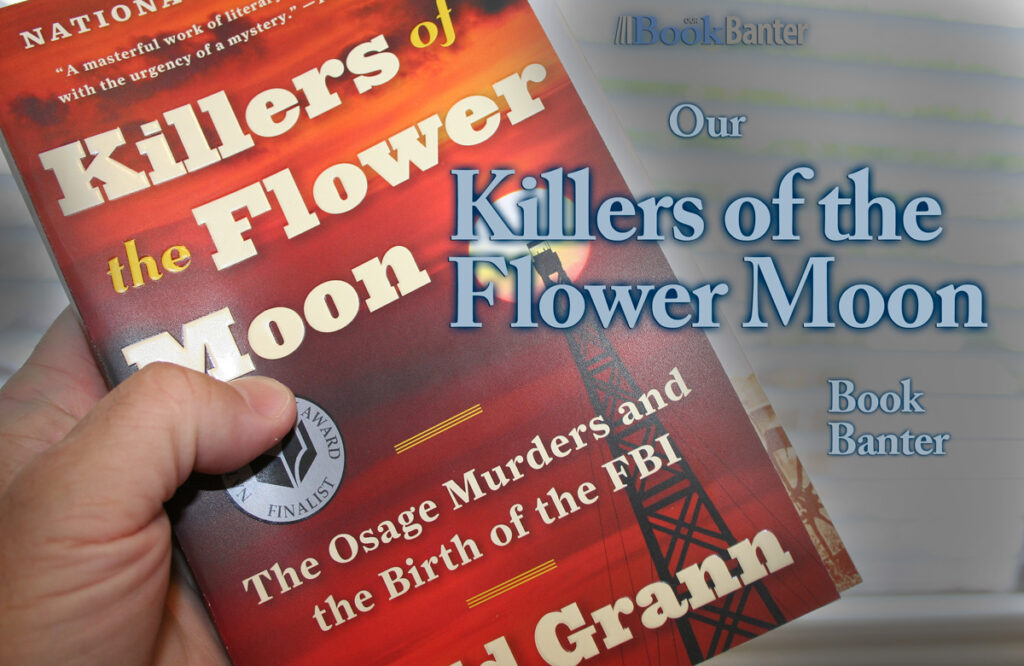
Our Killers of the Flower Moon book banter
Quickly became entranced
However, after I ignored the reviews and went directly to the first chapter, I quickly became entranced and lost track of time.
Plot twists and historical backgrounds
This book has all the ingredients of a blockbuster movie. It has murders, lies, corruption, bribes, adultery, incompetence, racism, jealousy, and greed. But, is the plot believable? Well, it should be, because all the events in the book had actually happened.
It’s a true story about the mysterious murders of wealthy American Indians in oil-rich Osage County, located in the relatively young state of Oklahoma. Along the way, innocent law enforcement officers are drawn into the web, and some are also murdered.
As the author told the story of the Osage murders, he flawlessly wove in historical background for many of the characters. The revelations included many facts about our young United States that I had never learned.
History came alive
Even though history is sometimes dry and flavorless, the author made it come alive. He used history to put the murders and the investigation into a compelling frame which I was able to use to judge each character’s motivations. I had to remember that Oklahoma had only become a state 10-or-so years before the murders.
Birth of the FBI
When I was young, I don’t remember reading about the Osage murders, or how the investigation had led to the birth of the Federal Bureau of Investigation (FBI). That was odd, because when I was in junior high school, I read every book I could about the FBI and J. Edgar Hoover. Still, I don’t remember hearing about the Osage murders.
As I read Killers of the Flower Moon, I learned that, prior to the FBI, each state had their own, independent Bureau of Investigation. I did not know that!
Because of the large number of murders in this case, and the widespread corruption that investigators had uncovered, the Department of Justice decided to form a nationwide Bureau of Investigation. I did not know that, either!
Criminal investigations were primitive
Back in the 1920’s, the book revealed that crime investigations, including coroners’ reports, were primitive affairs. Scientific techniques to solve crimes were crude by today’s standards.
An except from Killers of the Flower Moon:
“…the coroner in most counties of the United States was an ‘untrained and unskilled individual’ and had ‘a small staff of mediocre ability, and with inadequate equipment.’ “—The National Research Council (1928)
Still, I was surprised at the cunning many of the investigators had used as they uncovered botched investigations, and falsified crime scene reports. Many of the early FBI investigators on the Osage murder case were recruited from the Texas Rangers. Others were local sheriffs or even recent college graduates.
As the story unfolded, I learned the fascinating childhood and early adult experiences of the investigators. Their stories were sub-plots that in the end, tied the whole experience together into one compelling book.
Lead investigator’s background
I especially enjoyed the story of Tom White’s childhood. White was the FBI’s choice to head the Osage murder and corruption investigation. His father had been a sheriff, and had also operated a large jail in the fledgling town of Austin, Texas.
Just as the author had done throughout the book, he weaved in interesting historical information about early life in the wild west. He portrayed White’s father as a lawman with integrity, and how his son, Tom, had carried on his father’s honorable legacy.
One really compelling part of this sub-plot was when Tom witnessed his first public execution. The convicted person did not experience a humane death, and Tom even wondered if he had actually committed the crime. As Tom became an adult, he became opposed to the death penalty.
Here’s an excerpt from the book that explains Tom White’s thoughts about executions:
‘Perhaps because he witnessed this—and other executions—or perhaps because he had seen the effect of the ordeal on his father, or perhaps because he feared that the system could doom an innocent man, Tom grew to oppose what was then sometimes called “judicial homicide”. And he came to see the law as a struggle to subdue the violent passions not only in others but also in oneself.’
Racism was accepted
As I read this book, I realized that human nature doesn’t change all that much. We are still the flawed creatures we have always been. Sure, society has progressed, but as human beings, we are all flawed. After all, how could one person justify their mistreatment of another solely because of the color of their skin?
Well, racism was rampant throughout the world, and especially in the young United States. So was jealousy, especially if the person of a different race was also wealthy. Because the American Indians in Osage County were wealthy, they were the subject of malicious gossip and conspiracy theories of how they had obtained their wealth.
In the community, there were some hard-working Caucasian folks who thought they should have posessed all that wealth. They thought the American Indians were just ‘lucky’ and that the U.S. government had unjustly rewarded them. Doesn’t that philosophy sound familiar in today’s political climate?
Connection with Little House on the Prairie
When I was young, I used to love watching the Little House on the Prairie. The true story was about a young family struggling to survive in the new world. Back then, I admired their determination, will to survive, and their faith in themselves, their god, and their country—I still do admire them.
However, the Ingalls family and the Osage American Indians had a common connection. Both groups had claimed the same land in Kansas. The author of this book wove the remembrances of Laura Ingalls Wilder into the story to illustrate how even good people can be overcome with hatred.
“Why don’t you like Indians, Ma?”—Laura Ingalls asks her mother in one scene.
“I just don’t like them; and don’t lick your fingers, Laura.”—Laura’s mother
“This is Indian country, isn’t it? What did we come to their country for, if you don’t like them?”—Laura Ingalls
Yes, even the people who we admire as good human beings can be flawed, just like us all.
TAKEAWAYS AND RECOMMENDATION:
Our Killers of the Flower Moon book banter
You should read Killers of the Flower Moon
The writing was superb, and the editing was top-notch. In today’s world of fast-paced digital posting and publishing, those characteristics are often sidelined in favor of the quick-and-easy. Still, the book’s success shows that good writing and editing are still valued by today’s reader.
It is no wonder that the book has earned so many rave reviews by The New York Times Book Review, The Boston Globe, Rolling Stone, and The Wall Street Journal. Killers of the Flower Moon is one of the best books I’ve read in my life. You should read it, too.
Thanks for reading our Killers of the Flower Moon book banter and book review. If you’ve read the book, or if you’ve seen the movie, please share your comments below!
Content and photos by Doug Martin and Our Book Banter