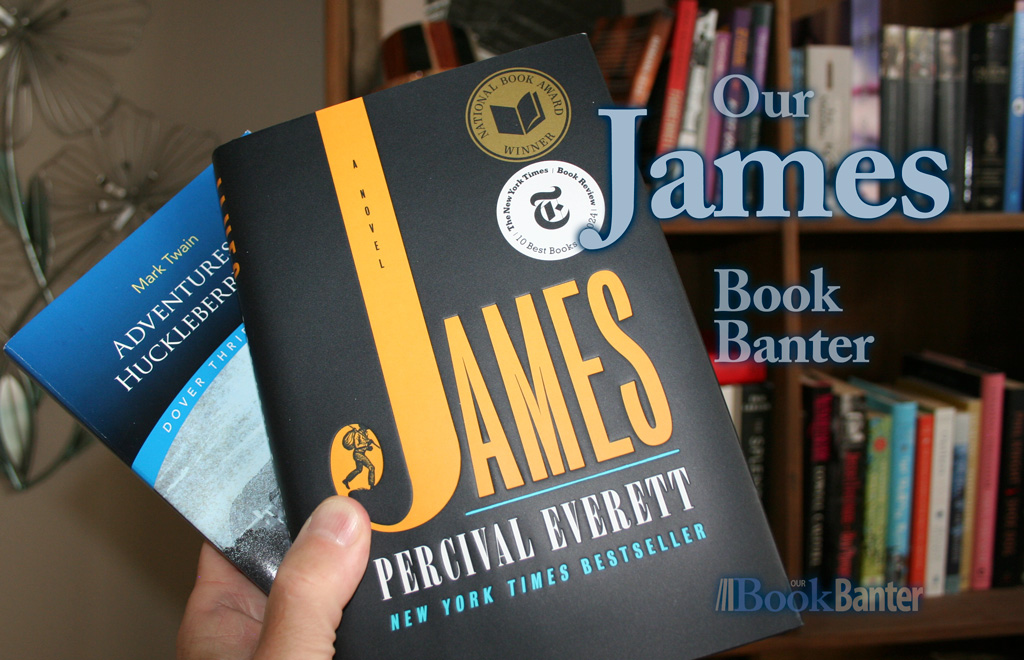
As I write about Percival Everett’s novel called James, I promise not to reveal too much of the plot. Instead, I will focus on Jim’s mindset as he tries to stay alive and reunite with his family. Read our James book banter and review for Jim’s perspectives on life and how they at times matched Huck’s beliefs and perspectives.
Our James book banter
James is the story of a slave named Jim, along with his friend, Huckleberry Finn. The book chronicles the adventures of Huck Finn and Jim as they embark on an unplanned and dangerous adventure on the Mississippi River.
Must you read Mark Twain’s Huck Finn novel first?
No, the novel James is so well-written that it can stand on its own. The author made Jim’s perceptions easy-to-understand and relatable. So, there’s no need to read Mark Twain’s book, Adventures of Huckleberry Finn first (but in my opinion, that book was Twain’s best)!
Jim’s owner will sell him
Just like in Mark Twain’s book, Adventures of Huckleberry Finn, Jim learns that his owner will soon sell him. To prevent the sale, he will have to move far away from his family. So, he runs away, in the hopes that he can return later and reclaim his wife and children.
Slaves were property that could be bought or sold
Back then, Jim knew that most White slaveholders believed their slaves were their property, and were no better than animals or a desk. They often sold a slave’s children or spouse without considering the ‘feelings’ of the Black father, or his wife and children.
I think Jim’s opinion was correct—we have to admit that disgraceful fact.
Jim wanted the best life for his family
However, Jim revealed his deep committment to his family, and did not want to be separated from them. Just like any good father, he wanted his children to grow up and have a good, and a free, life.
Unfortunately, his love for his family meant that Jim had to makes some hard decisions that the White slaveholders could never understand. So, he ran and hid.
And that’s when he accidentally stumbled upon Huck Finn, whom he already knew.
Plot deviates from Twain’s Huck Finn
While the plot generally adheres to Mark Twain’s Huck Finn adventure, Jim relates the story from his perspective. He revealed his heart-break after being separated from his family and how they were all treated like animals.
And later in the book, the plot is mostly different from Twain’s Huck Finn version. Jim separates from Huck, and is determined to reunite with his family.
Jim was a slave who was literate
In reality, Jim had taught himself to read and write—he was a literate slave, which was rare. Many slaveholders did not want their slaves to read or write, because the slaves then might want to live like all human beings are entitled to live, and to be free.
He discretely taught other slaves how to read
Because of their fear of losing their ‘property’, many slaveowners punished their slaves if they showed any interest in reading or writing. And that’s why Jim had to teach himself various academic skills in secret. Then, he taught his children and wife how to reach and write, also. But, as always, he had to do it discretely.
Jim pretended to be ignorant around White people
For Jim and other slaves, self-deprecation was a survival technique. According to Jim, he purposely spoke with a southern Black dialect that was common among other illiterate Black people.
When Jim was with his family, he spoke without a dialect
Ironically, when Jim and the other Black slaves gathered to talk with each other, Jim and the other literate slaves spoke English without a dialect—they sounded well-educated, and they were!
You can call me ‘James‘
While among his family members and other slaves, Jim was known as James. But to the White community, Jim was always known as the less formal-sounding Jim.
Jim pretended to have primitive beliefs
The author cleverly made Jim’s differing behaviors a comedic aspect. When around White people, Jim and the other literate slaves would purposely speak with a dialect and southern accent, despite their literacy.
They pretended to have a small vocabulary, and they often used words incorrectly (on purpose). In addition, they pretended to believe in magic, witches, and primitive gods, which further solidified their appearance of being ignorant.
Jim learned from harsh experiences that when in the company of White people, it was important for Black slaves to appear dumb. Otherwise, they subjected themselves to unwarranted punishments and whippings.
Comedy was an important characteristic of James and this book
Just like Mark Twain’s Huck Finn novel, comedy was an important aspect of telling the story of Jim. However, this novel’s humor, told from Jim’s perspective, had a different tone.
But as I read, I often laughed out loud at the irony of their sometimes unbelievable situations. Jim and Huck got themselves into some very sticky, dangerous predicaments. Despite being very dangerous, many of them had comedic aspects. I won’t relay those situations specifically, because that might spoil the novel.
As it progressed, the novel James became more serious and dramatic
Despite the earlier comedic nature of Jim and Huck, the novel gradually grew more serious and somber. The somberness happened, I believe, when Huck separated from Jim.
Huck felt guilty about helping Jim
Strangely, at least from Jim’s perspective, Huck felt guilty about helping Jim avoid his ‘owner’. Huck knew that Jim was ‘owned’ like a piece of property—so what right did he have in ‘stealing’ him away from his owner—that was the dilemma for Huck.
What an interesting philosophical quandary we find Huck struggling with. But, it had nothing to do with their separation in this story.
Jim’s primary goal
The goal of reuniting with Jim’s family became his primary focus. So, the overall tone became a little more dark and dramatic. Despite that, there were still moments of subdued humor.
A lust for revenge emerged
Understandably, Jim developed a need to inflict revenge, especially as he recalled all the injustices and barbarisms inflicted by the slaveowners on his family. And that was where things got a little murky for me as a reader.
I didn’t want to see this well-developed character descend into a person who was a ‘slave’ to his emotions. We’ve seen that all-too-often in low-budget revenge movies.
Thankfully, Jim was able to intellectualize the primitive human feelings that we all have, and not go too far (for the most part). Either way, I can understand everything that Jim was thinking, and if I had experienced half of what he had gone through and seen perpetrated against his family and other slaves, I would have had the same lust for revenge.
A guardian angel for Jim and Huck?
As the story progressed, I was thinking that both he and Huck must have had a guardian angel helping them out. I think that was also true in Mark Twain’s Huck Finn novel.
Neither of those characters believed in miracles or believed in prayer or believed in a benevolent god (although Jim pretended to believe those things when speaking with White people). Yet, they sure went through some really close calls together, and somehow miraculously survived for another day.
I couldn’t stop reading James
The characters in James were so compelling, I couldn’t stop reading. I liked, and could identify, with both Jim and Huck.
So, that’s it with our James book banter! Please read our synopsis below, and then share your thoughts in the comments section below that!
TAKEAWAYS:
Our James book banter
James is a uniquely good story
If you’re a fan of Mark Twain’s beloved Huckleberry Finn, then you must read this book, too. Presenting the perspective of Jim, the slave, and contrasting that with Huck’s perspective, was a clever idea. Because the book was so well-written, I will read more of Percival Everett’s works. And, I recommend that you put James on your reading list, too!
Thanks for reading our James book banter and review! Please share your thoughts in the comments section below!
Content and photos by Doug Martin and Our Book Banter