
Usually, I’m not a fan of short stories. Instead, I like novels, so that I can get to learn the protagonist really well and empathize with their predicaments. However, I do like James Joyce’s collection of short stories called Dubliners. Here is our Dubliners book review and book banter.
As usual, I will not submit a book report outlining or giving away plots or endings. Instead, I’ll examine the themes, characters, and how I related to the author’s style of writing.
What is the book called Dubliners about?
Dubliners is a collection of 15 short stories written about people who lived in Dublin, Ireland. By the way, Dublin is the capital city of Ireland, as well as that country’s largest city.
James Joyce wrote the book from 1904 to 1907, when he was in his early 20’s. The entire collection was published in 1914. At that time, Ireland was on the brink of civil war.
So, despite living in Ireland’s capital city, its citizens were likely stressed and enduring economic hardships. At the time, Ireland was considered to be a part of the United Kingdom of Great Britain and Ireland.
Simply, Dubliners is a book about people—different kinds of people in different walks of life. These people, all individuals, are living one day at a time, just as we all do. And, that’s it! They are living and feeling the same emotions we all feel as we live our lives.
Our Dubliners book review
Things I liked about Dubliners
Excellent character development:
Every character in this amazing collection of short stories was well-developed. In fact, the author somehow introduced us to each one, and compelled us to empathize with their plight. And, he did it in a few pages!
In comparison, other authors struggle to accomplish that level of empathy with their characters in much longer novels. Even after hundreds of pages, I sometimes don’t care about the major protagonist, because I don’t empathize with them…
Magical book of characters:
…not so in Joyce’s Dubliners collection! I empathized with the characters and could feel the disappointments and the joys that they felt. I could also vividly feel the streets they were walking on, their homes and their rooms, and their dreams at night.
Even more haunting, I could feel their fears and their loneliness. At times, it became heart-wrenching, especially with a character that I could identify with.
The author’s deep, ingrained talent:
But, how did he accomplish that in only a few short pages? That’s the magic of this book, and it illustrates the author deep, ingrained talent as a writer!
No wasted words:
Joyce used a precise choice of words and phrasings to paint his vivid pictures in the reader’s mind. Even now (in that previous sentence), I’m trying to imitate his style, but I don’t even come close—he is one of the best writers that I’ve ever read!
Helpful dictionary of Irish colloquialisms:
At the end of the book, there is a very helpful list and definitions of local Irish colloquialisms. The local way of speaking in Ireland helped ingrain me even more in their conversations.
I could even hear their Irish brogue as they bantered with each other on the sidewalk. Or, in the dining room, and even in the bedroom. That accent, coupled with the empathy I felt for many of the characters was so Irish, and so good!
Themes that we all encounter in our lives:
The characters in Dubliners were all dealing with the everyday feelings we all encounter—every one of us! There was death, being afraid to change, feeling trapped, disappointment, both with themselves and with the church and with their Irish community.
We all experience those overarching themes, and those themes evolve as we age. And, maybe that’s also what was so easy to empathize with the characters. In only a few pages, they evolved as they experienced their lives—it was so engaging!
Things I didn’t like about Dubliners
Stories were too short:
Each story was too short—each one could have been a separate 300-page novel that I would have loved! As I read, I quickly became involved with the characters, and was disappointed when the story ended, sometimes abruptly.
I wanted the stories to go on-and-on; I wanted each character to continue striving, or at least living each day the best they could. But, the stories ended, just like all good things do!
Once again, I credit the author’s extraordinary talent with making me want to continue reading, even when I was at the last page.
The greatest artists want to be better:
Had James Joyce continued writing with the style he used in Dubliners, I’m sure he would have been a great commercial success. However, many of his books were difficult to read and dealt with controversial content.
But like all great artists, Joyce wasn’t satisfied with his writing style, so he continued to evolve. He continued to inovate his stream-of-consciousness techniques, and his innovations encouraged other writers to adopt his stylings.
Recently, I read a wonderful book by Virginia Woolf titled Mrs. Dalloway. I could see Joyce’s influence on her writing style, and I liked it.
Our Dubliners book review and other James Joyce books
James Joyce’s other books
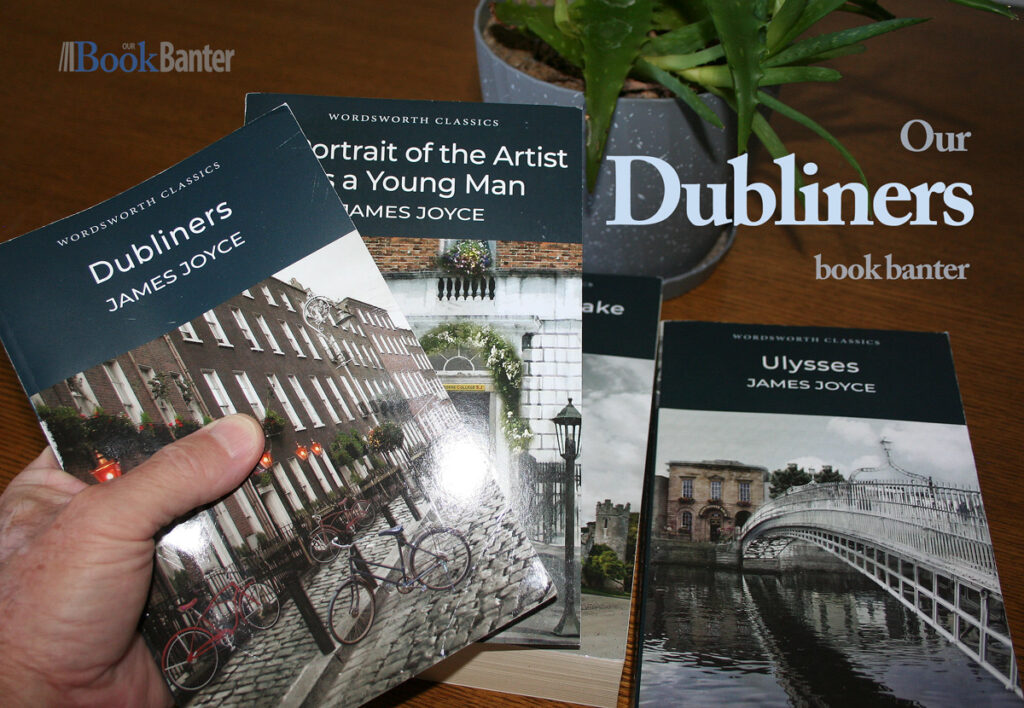
In fact, I loved Dubliners so much that I bought a few of his other books. However, I was disappointed after reading some of his other renowned books. Here’s my summary of the other few James Joyce books in my library.
Ulysses:
I started reading this book, but only got to page 53 the first time. The plotline and characters completely baffled me, so I gave up. I put the book on the shelf, and only started reading it again after six months.
Then, to eliminate my reading frustrations, I decided to just read and go with the flow. If I didn’t understand, it didn’t matter—I just read and tried to enjoy each sentence in its simplicity.
And, that attitude adjustment really helped me to completely read Ulysses. Unfortunately, the tedious process still disappointed me. I felt that Ulysses would have been a much more compelling book had he continued using the same writing style he used in Dubliners.
A Portrait of the Artist as a Young Man:
This book was a little easier to read, at least compared to Ulysses. Joyce continued some of the same stylings he used in Dubliners, but he was evolving as a writer. And, I didn’t really like the evolution.
Once again, I felt this book would have been much more compelling with his old style of writing.
Finnegans Wake:
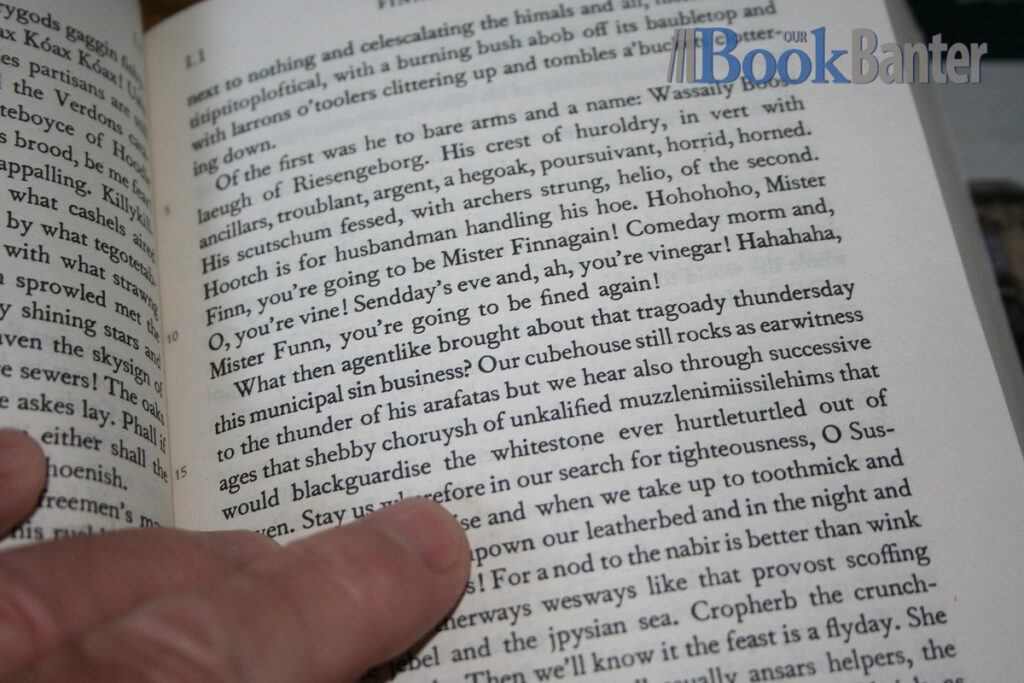
And this, Finnegans Wake—just thinking about it make me laugh. Was the author trying to insult us, or was he playing a cruel joke? I don’t know, but I don’t think so.
When I look at the unintelligible words, I think there must be a story in there somewhere—probably a very good and profound one. But, will I ever devote the time out of my busy life to read it? I might, but I doubt it! Life is too short!
TAKEAWAYS:
Our Dubliners book review and book banter
James Joyce’s Dubliners was one of the best books I’ve ever read. His character development was superb, and the storylines were so engaging! I highly recommend this book!
However, the author’s later works disappointed me. They were difficult for me to understand and follow the plotlines, but I did read a few of them. I can understand why such a great writer would want to evolve and maybe improve his writing style, but for me, his advancements didn’t work.
Thanks for reading our Dubliners book review! Have you ever read Finnegans Wake? How did you approach the process of reading, and did you enjoy it? Please share your thoughts in the comments section below!
Content and photos by Doug Martin and Our Book Banter


