Before you read our Boys in the Boat book banter and book review, please remember that I’m not an athlete, and I don’t enjoy watching sports on television. And surprisingly, the only Super Bowl I have ever watched was in 1980—for me, that was an excruciatingly tortuous experience.
Despite my lack of athleticism, I really enjoyed reading this book about competitive rowers and their goal to row in the 1936 Olympic games.
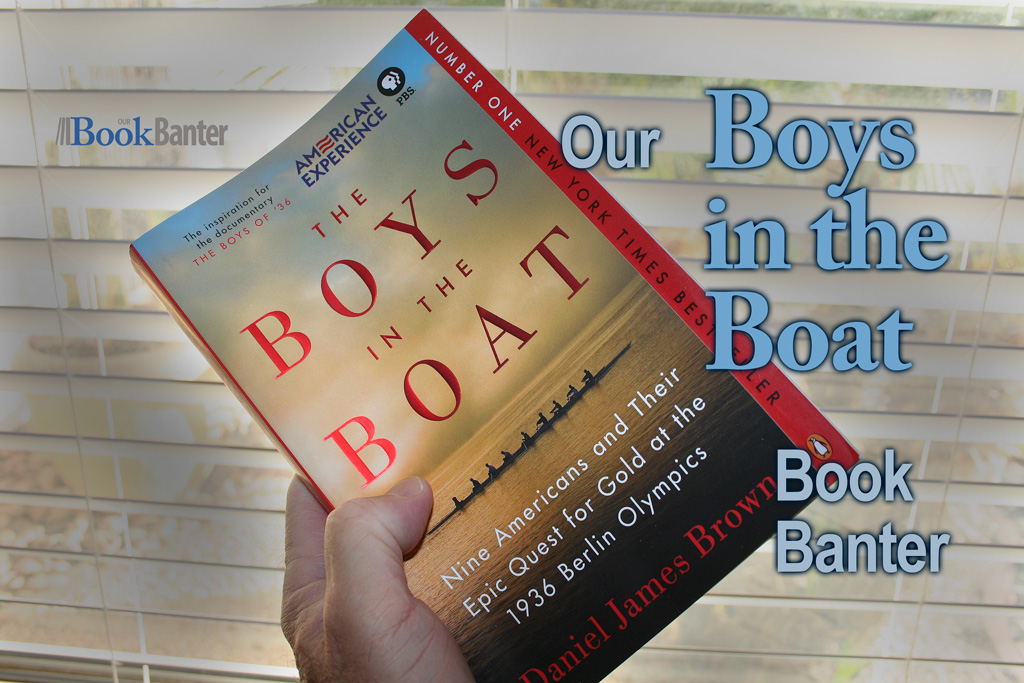
Our The Boys in the Boat book banter
True stories are the best stories
True stories are always the best kind of stories. The Boys in the Boat is a non-fictional account of a crew of college boys who loved to row. Their team rowed in competitions for the University of Washington.
Now, rowing may not strike you as being a very exciting sport, but there was a lot of tension in this story. It was fueled by heart-wrenching accounts of how these young men survived during the Great Depression, and how they overcame their short-comings to become champions.
Well-written, with many dimensions
The author, Daniel James Brown, used a compelling mixture of dramatic elements to tell this story. He tied together the personal backgrounds and hardships the rowers had to overcome, along with the fascinating history that led up to the 1936 Olympic competitions in Hitler’s Germany.
For instance, one of the young men suffered the wrenching heart-break of being abandoned as a young boy. His name was Joe Rantz. Every single day for young Joe was a struggle to survive, but he finally earned the right to row with a team that competed in the 1936 Olympics.
I thought I had it tough as a kid, but this young boy didn’t know where his next meal would come from. Plus, his family had left him alone to fend for himself as they traveled to find work—he was truly abandoned! As Joe hustled to survive, the boy-who-would-be-a-rower-someday didn’t have time to feel sorry for himself.
Help out a person who needs help
Fortunately, there were people who helped each of these young rowers along in their difficult early years. I was struck by how these “angels” weren’t searching for fame and certainly not looking for fortune.
To me, the coaches, along with the man who built the boats, and the person who helped Joe earn enough for food as a boy almost seemed like angels who appeared at the right moment. However, they weren’t angels, but they were just people who did what they could to help humanity, one person at a time.
They gave the young boy a job, or a morsel of food, or a gruff word of subtle encouragement. This story contains a subtle lesson that shows we can all lend each other helping hands, even if it is in a small way.
The heroes were underdogs
These rowers were underdogs. Some of the boys like Joe were desperately poor and didn’t look like the typical privileged, self-entitled students they saw at the University of Washington.
To win, these underdogs with different personalities had to work together. They had to develop self-discipline and self-confidence even while being willing to sacrifice for the greater good.
Seabiscuit was an underdog, too
The author did a wonderful job of weaving in other historical events that were also shaping the United States during the years of the Great Depression. One of those historical highlights was Seabiscuit, the racehorse that was too small and too stubborn to ever win a championship.
But just like the boys in the boat, Seabiscuit came from behind and won races. In fact, this small horse overtook the much-larger and more-favored War Admiral and won the 1937 Triple Crown. The boys in the boat displayed the same come-from-behind, quiet bravado to win their championships, too.
The Boys in the Boat was exciting to read
Even though I do not like to watch sports on television, and am only barely athletic, I loved reading this book. The most exciting part was when the boys competed in the 1936 Olympics in Germany.
The stakes were high, and their odds of winning were low. So each boy felt the pressure in their own unique way. That was very interesting.
A physical and psychological battle
Like an onion, the author peeled back each boy’s weaknesses. For each rower, it was not only a physical challenge, but also a psychological battle.
To overcome their weaknesses, they pulled together as one great rowing machine. It was a fantastic culmination to their young lives, and would set the stage for their later successes in life.
Fascism sprouted in a German democracy, and it can happen again
This book was published in 2013. Throughout the story, the author included ominous warning signs of how fascism overtook Germany’s fragile democracy.
Today, we see a similar rise of nationalism throughout the world. Even in the United States, the new America-first policy is reminiscent of the same seductive emotions that enabled the rise of irrational hatred of scapegoats in Germany prior to World War II.
This book and its film adaptation are so inspirational—a must-watch and a must-read!
Takeaways:
Our Boys in the Boat book banter
If you love to read books about overcoming impossible odds, then you will love The Boys in the Boat. Or, if you love reading dramatic stories about world history, you will definitely want this book to savor.
In other words, I loved the well-researched story, and the writing was superb. If my The Boys in the Boat book banter has piqued your interest, get yourself a copy and be inspired. And be sure to leave your thoughts in the comments section below!
Content and photos by Doug Martin and Our Book Banter