
As I searched for another literary adventure to enjoy, I stumbled upon the works of Virginia Woolf. She was an influential writer who used a poetical, stream-of-consciousness style of writing to tell her story. After researching, I thought Mrs. Dalloway sounded like a fun, compelling book to read, so I bought it! Here is our Mrs. Dalloway book review.
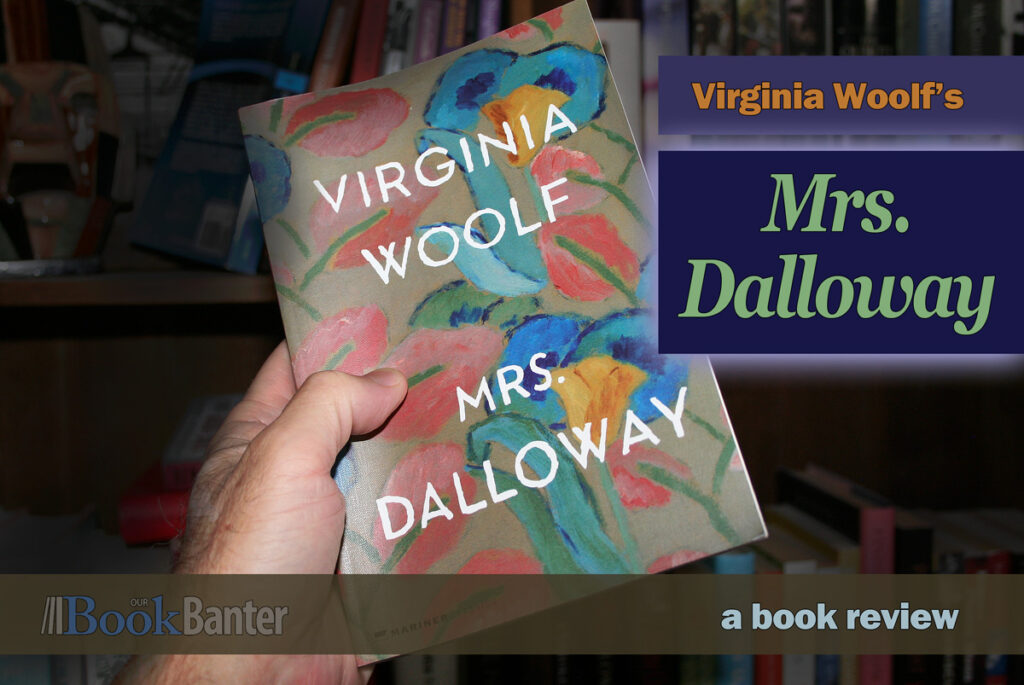
Mrs. Dalloway book review
During our Mrs. Dalloway book review, we promise not to reveal to much of the plot. Instead, we’ll discuss the characters and the important themes of this marvelous book.
Virginia Woolf’s stream of consciousness
What is stream of consciousness writing?
While writing Mrs. Dalloway, Virginia Woolf used a stream of consciousness narrative style. This technique allowed the author to convey the protagonist’s moment-by-moment thoughts, without imposing an editorial filter.
Raw and chaotic narratives
A stream of consciousness narrative is typified by run-on sentences that are often grammatically incorrect and ignore typical punctuation or syntax. However, this apparently chaotic technique is meant to mimic our own internal thought processes, which are often raw and chaotic.
More restrained narrative style
In the book, Mrs. Dalloway, I believe Woolf used a more restrained stream-of-consciousness style. Despite using very long sentences which string along a series of sensory perceptions, they are also contrasted by the author’s use of smaller, shorter, and more direct sentences.
In addition, the author used correct grammar, along with a proper use of punctuation (as far as I can tell).
Memories and feelings
Each character in the book remembered past events of their lives that created deep, emotional feelings of anxiety, loss, or victory. Those feelings were stimulated and provoked throughout their day as they did ordinary tasks, like walking, talking, or relaxing.
As I read each page, I realized that Mrs. Dalloway and the other characters processed information in the same way I do. Often, my thoughts are disjointed memories, observations, and associations from my past.
Watercolor painting and poetry
As the author unveiled each character, their intimate details were revealed. Almost magically, those ingredients formed a poetical layering of colorful and sometimes dark observations.
In other words, the author used her characters’ thoughts to paint an evolving watercolor that continued to move and change as I read.
Sometimes it was difficult to know who was narrating
One difficult aspect of Woolf’s stream-of-consciousness style of narration was that I sometimes wasn’t sure whose thoughts I was reading. When I got confused, I had to go back, and try to figure out when the narration had switched to another character.
While that made this novel more challenging to read, it also made me realize that all the characters, despite their diverse backgrounds, were dealing with similar human emotions.
This book contains only one chapter
This novel only has one chapter, but it was a big one. And, that was another interesting aspect of this book. Interestingly, that was another aspect that made it a little more difficult for me to know whose thoughts I was reading!
Sometimes the narrative streams were separated by extra space between the paragraphs. But, other times, the narratives switched without obvious cues. Actually, I thought that was pretty cool.
Main characters of Mrs. Dalloway
Clarissa Dalloway:
Mrs. Dalloway is the protagonist! Slowly, the author reveals that Clarrisa is 52 years old. And, as the wife of a conservative member of the English Parliament, she struggles to conform to her upper-class surroundings, while maintaining her private life and family.
But, despite Mrs. Dalloway’s wish to fit in with her upper-class, high society aquaintances, Clarissa also just wanted to have some spontaneous ‘fun’!
Richard Dalloway:
Mr. Richard Dalloway is Clarissa’s emotionally reserved husband. As a member of the English Parliament, he is able to provide a financially secure life, along with the other trappings that were typical of their upper-class lifestyle.
But, while Richard was dependable and provided a sense of security, Clarissa yearned for more. Unfortunately, Richard wasn’t as passionate or spontaneous as Clarrisa sometimes desired.
Peter Walsh:
Peter was an old boyfriend of Clarissa! Interestingly, this old boyfriend was the opposite of Clarissa’s conservative husband. Peter was more of a poet, or artist, and he had an adventurous, non-conforming spirit.
Ultimately, Walsh admitted that he was still in love with Clarissa, even after all those years!
Elizabeth Dalloway:
As Clarissa’s 17-year-old daughter, Elizabeth was quiet, intellectual, and introspective, and more like her father. She didn’t like parties, but most enjoyed being in nature.
Even though Elizabeth wasn’t a large part of this novel, she was an important character. Clarissa didn’t have a good relationship with her daughter, and that made her upset. In fact, Clarissa’s feelings of disappointment made her jealous, along with feelings of anxiety and even hopelessness.
Septimus Warren Smith:
Smith was a very interesting character. He was a veteran of World War I, and like many combatants, Septimus suffered from symptoms of PTSD, including hallucinations, the inability to concentrate and other symptoms of poor mental health.
I don’t want to give away too much of the story, but this character thought a lot about his legacy, as well as the legacy of his fellow comrades who were killed in action. He felt disturbed when he admitted to himself that, despite their many medals and acts of bravery, their legacy would not last long.
Smith’s thoughts throughout the book reminded me of the quote from Mike Tyson, the former professional boxer, when he talked bluntly to a young student reporter about his ‘legacy’:
We’re nothing, we’re just dead, we’re dust, we’re absolutely nothing. Our legacy is nothing.”
Mike Tyson, when speaking about his legacy
Lucrezia “Rezia” Smith:
Rezia was the young , Italian wife of Septimus, and she was devoted to her husband. Unfortunately, because of her husband’s mental illness as well as her own isolation, she and her husband faced harsh judgments from other members of the community.
Clarissa and other characters had very interesting stream-of-consciousness thoughts about the Smiths.
Sally Seton:
Clarissa knew and admired Sally when they were teenagers. Sally was attractive and rebellious, and did things that Clarissa only dreamed about. In some ways, Clarissa really liked Sally and wanted to be like her, but in another way, she was kind of jealous.
Despite having a wild youth, Sally grew up to marry into a wealthy family, and she became known as Lady Rosseter. Sally, Clarissa, as well as the other characters, all had interesting interactions and thoughts about Sally. She was such a good character of this novel.
Other characters include:
Two doctors who treated (or tried to treat) Septimus and his mental illness. Their interactions highlighted the societal differences between the upper and lower classes, as well as the rigid, conservative, and unbending thought processes in politics and society.
In addition, Clarissa’s servants had important parts to play in this wonderfully thought-provoking story.
The plot of Mrs. Dalloway by Virginia Woolf
The story of Mrs. Dalloway only spans one day
This stellar example of modernist literature takes place during a single, busy day in London after the conclusion of World War I. Throughout her immersive day of errands and observations, Clarissa Dalloway, a 52-year-old socialite, is preparing for a party.
Preparations for a party and their thoughts
And that’s the whole story—Mrs. Dalloway prepares for an important party. Along the way, she, along with the other characters, stream their sensory perceptions (thoughts) about the rain, the smells on the streets of London, and the more important moments in each of their lives.
By the end, we really understand Mrs. Dalloway
Remarkably, those uninhibited thoughts help us understand Mrs. Dalloway, along with the other characters, as though we had known them our whole lives.
But, that’s not all. In addition, we, as readers, partake in a discussion of the meaning of life, and the meaning of our personal lives.
Life was not easy for Mrs. Dalloway
Each character had their own unique set of misgivings, disappointments, yearnings, and anxieties. I found that life for Mrs. Dalloway was not easy, despite her wealth!
Mrs. Dalloway book review and my final verdict
This book was written by an artist
I thought Virginia Woolf’s book about Mrs. Dalloway and her acquaintances was delightful. The author painted a portfolio of water-colored visions in my mind of the streets of London, as well as other stimulating sensory perceptions of their environments.
The subtleties were thought-provoking
This book was like reading a beautiful poem, with lots of subtleties buried beneath the surface of each paragraph. Because of the subtle nature of the narative, it might have been easy for me to miss some of the more dramatic highlights.
Mrs. Dalloway deserves a second reading
As I was writing this review, along with the subtle complexities embedded in the poetic narrative, I thought that maybe I should read this book again. Did I miss anything important? Possibly, and that’s why I should read Woolf’s beautiful book a second time!
Not only that, but, I recommend that you should read Mrs. Dalloway, too!
TAKEAWAYS:
Mrs. Dalloway book review
Virginia Woolf wrote Mrs. Dalloway using her unique and maybe more restrained style of stream-of-consciousness narration.
The author painted pictures with her words
Throughout the book, the author painted a moving picture show of watercolors in my mind. Those ‘paintings’ helped me experience the sensory perceptions of each character—they made me feel like I was walking in the character’s shoes.
The characters experienced pain, disappointments, and hope
Each complex character had a unique perspective. Mrs. Dalloway and her husband were members of the upper class of society, while others were lower class and experienced prejudices and alienation.
Mrs. Dalloway did not have an easy life
Despite her efforts and her wealth, I believe that Mrs. Dalloway did not have an easy life. In fact, I believe that her life mimics our own in so many ways.
She experienced jealousy, anxiety, and disappointments. Yet, despite what she considered her failures, Mrs. Dalloway also experienced feelings of joy and satisfaction with life.
You should read Mrs. Dalloway by Virginia Woolf
This book was so good on so many levels. While challenging to read at times, it was also delightful to read. Even though it was not a book of poetry, Mrs. Dalloway reminded me of Walt Whitman’s Leaves of Grass. There were so many beautiful, thought-provoking subtleties in the text, and that’s what made me think it was like poetry.
Anyways, I loved reading Mrs. Dalloway, and I suspect you will love it, too!
Thanks for reading our Mrs. Dalloway book review! If you’ve already read the book, or if you’ve read other works by Virginia Woolf, please share your thoughts in the comments section below.
Content and photos by Doug Martin and Our Book Banter


