
Adventures of Huckleberry Finn is one of my favorite Mark Twain novels. Because of the realistic and ground-breaking themes, Huck Finn is now considered a classic American novel. Recently, Percival Everett published his novel, James, which tells the Huck Finn story, but from the Black slave’s point-of-view. So, which novel is better? I’ll discuss Huck Finn versus James, in this book banter!
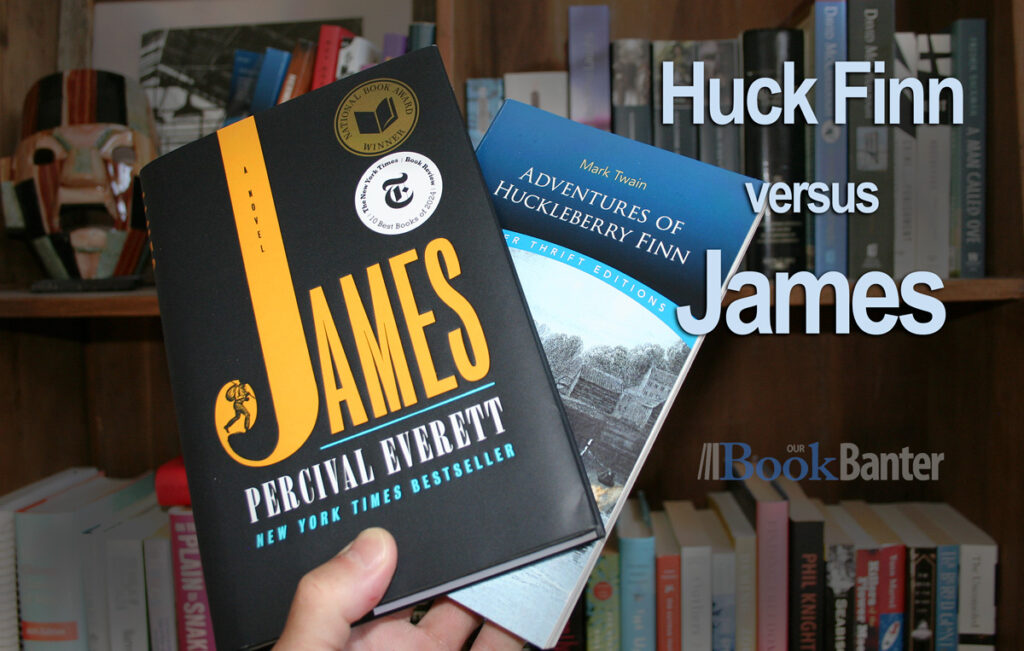
Huck Finn versus James, part 1
Read our review of Percival Everett’s novel, James
In case you missed it, we have already reviewed Percival Everett’s novel, James. That story was an eye-opening, but humorous, revelation of what the Black slave, James, experienced as he accompanied Huck Finn on his misadventures on the Mississippi River. Throughout the novel, we get James’s point-of-view during their harrowing escapades on America’s biggest river.
Huck and James were both good people
In this comparison, we will not examine whether Huck or James was the better person or better character. In reality, both characters were good people, and the authors told their stories well. They rose above their bleak, sometimes heart-breaking circumstances, to make a better lives for themselves and their families.
Their experiences with slavery and racism
Instead, we’ll examine which book most effectively conveyed their experiences with slavery, and their attitudes about the rampant racism that was (and maybe still is) prevalent in the United States.
But, we have not yet reviewed the themes and characters of Mark Twain’s novel, Adventures of Huckleberry Finn. So, here we go with that brief review!
Adventures of Huckleberry Finn book review
As always, we will not reveal major plot twists or ruin the new reader’s experience in any way. Instead, we’ll discuss the major themes and characters.
Racism, slavery, and broken families
Huck Finn, the main protagonist, was a boy who came from a broken family. His father was a drunkard, and he spent almost all of his money and time on alcohol. Understandably, both the father and his son, Huck, lived in poverty.
Huck’s optimism and hope for the future
While Huck had every right to be an angry boy, his boyish optimism often shined a light through his dire circumstances. My sense was that Huck didn’t really know he was poor. Instead, he bravely lived in the moment, and seized the meager opportunities that came his way!
Incredibly, Huck also had extravagant goals. Throughout his childhood, Huck and his best friend, Tom Sawyer, read books about conflicts between cops and robbers, as well as battles between indians and settlers. Those fictional stories carried over into their play time, and then into their dreams for a better life.
In addition, both Huck and Tom dreamed of quick riches by robbing stage coaches or being pirates on the open seas. Fortunately, they never carried those aspirations over into their real lives.
Jim, the slave, was more pragmatic
On the other hand, Jim (James), the Black slave, had an enslaved family. When Jim learned that he was about to be sold and separated from his wife and children, he ran away.
Running away from his beloved family sounds like a bad choice, but for Jim (and other slaves), bad choices were their only options. Jim had to choose his least bad option, so that was to run away, earn his freedom and money that he could later use to buy back his family.
That sounds like a bleak way to look at life, but both Jim and Huck had to make some difficult choices. Neither had what we might consider an ideal life, but they did the best they could with what they had.
Rafting down the Mississippi and fun times
After Huck ran away from his father, Jim also ran away from his owner. Days later, they accidentally bumped into each other, and figured it would be better if they travelled together. So, they did!
The essence of the Adventures of Huckleberry Finn
Huck and Jim ran away—Huck faked his own death to escape from his father, and Jim ran away, while hoping to reach a free state where he could earn enough money to buy back his family.
Along the dangerous pathway to their goals, Huck and Jim have to battle naturals disasters, interact with dangerous grifters and con artists, as well as avoid bounty hunters who were looking for Jim.
Hypocrisy, racism, and morality combined with innocent, boyish humor
Throughout the Huck Finn story, Huck faced the dangers of the Mississippi River with a folksy, boyish sense of humorous playfulness. In addition, he also battled the adult themes of religious hypocrisy and racism with innocent humor.
In fact, some of the most poignant parts of this novel were also interlaced with outrageous humor. At some points, I couldn’t stop laughing—Huck had pulled off some crazy stunts, especially when, later in the story, he teamed up with his old friend, Tom Sawyer.
The humor was the magic that allowed the author to explore the darker aspects of racism and religious hypocrisy that permeated the society in which he lived.
Religious beliefs of Huck and Jim
Both Huck and Jim were exposed to organized religion in their rural, southern community. While Huck became more and more suspicious of religious people, Jim embraced a belief in God.
Jim believed in God and magic
Jim, the Black slave, believed in the power of prayer, and also believed that his God answered prayers. In addition, Jim believed in magic and potions, as well as other more primitive religious beliefs.
Huck did not believe that God answered prayers
From Huck’s perspective, God never answered his prayers. And, Huck also observed that God almost never answered the prayers of other more religious people. The people they prayed for still died, and they still suffered from sickness and poverty.
Huck believed religious people were hypocrites
In addition, Huck observed the hypocrisy of religious people in his community. He saw that while they claimed to believe in the teachings of Jesus, they also owned Black slaves. Most of the owners of slaves considered themselves to be ‘Christians’, yet they treated their slaves like inanimate pieces of furniture.
Huck’s moral dilemma
Huck was especially troubled that Jim’s owner was a person he respected. Yet, that person was planning to sell Jim, which would have separated him from his family.
The runaway boy was disturbed that, on the one hand, Jim’s owner was following the law when she bought and sold slaves. Huck was concerned that by helping Jim escape, he would be breaking the law.
At the same time, Huck wanted to do the right thing—he wanted to be a moral person. Finally, Huck didn’t care if he would receive eternal damnation! He was going to help Jim escape, no matter what it might cost him.
Disturbing, denigrating language along with profanities
Throughout Twain’s novel, the protagonist and other characters used language that denigrated Black people. In addition, they used profanities with gusto.
In all cases, the language used throughout the novel was (and still is) commonly used, and added authenticity! That’s how they, including Huck, were raised, and that’s how they commonly spoke.
So for me, there was nothing controversial about the use of naughty words. However, the use of denigrating words towards Black people did disturb me, but that was exactly what the author intended!
Mark Twain’s best novel
I won’t reveal how The Adventures of Mark Twain ends, or whether Huck or Jim survive their existential adventures. All I will say is that this novel was brilliant, and should be a must-read! It is Mark Twain’s best novel!
Huck’s innocent humor while dealing with the darker societal themes of racism, hypocrisy, and morality, was poignant, as well as revealing. I loved Huck Finn’s innocent approach to life, and think I need to incorporate more of his philosophy into my own life.
This old Disney film about Huck Finn looks good for the kids, but I bet the book was better!
Huck Finn versus James, part 2
James was skeptical of religion
In the novel, James, the Black slave who Huck called ‘Jim’, was also skeptical of religion. Just like Huck, James did not believe in the power of prayer.
James quietly studied
Instead, James relied on the power of his mind and the strength of his will to survive. Surreptitiously, he taught himself to read, do advanced math, and speak English without a dialect.
James was like the real-life Frederick Douglass
In many ways, James’s character was similar to the real-life, former Black slave, Frederick Douglass. Like James, Frederick Douglass surreptitiously learned to read and write.
And like James, Douglass taught other Black slaves to be literate, so they could survive if they ever won their freedom. Just like James, Douglass never wanted White people to see him reading a book, or writing a letter. For Black people like Douglass, literacy often brought punishment.
To survive, James hid his literacy
Owners of slaves did not want their property to be able to read or write. To them, a literate Black slave was a danger—if their property could read diverse thoughts, they might want to gain their independence.
Literacy meant freedom
On the other hand, Black slaves realized that if they wanted to live independently, they would have to be literate. And, they would have to be fluent in the English language, and speak without the southern dialect commonly used by slaves.
James taught his family to read and write
In addition to quietly learning to read and write, James also taught his wife and children. They were all yearning for the day when they could live independent lives just as a normal White family would.
James pretended to be illiterate around White people
To protect himself and his family from punishment, James pretended to be illiterate when he was around White people. In addition, he would speak with the Black southern dialect that was common among slaves.
Jim’s double life was humorous
The Black slave’s double life of switching between being a highly intelligent, literate Black person, when around other slaves, and pretending to be illiterate when around Huck was very funny.
Sometimes, James forgot about hiding his literacy, and he used large words and spoke without a dialect to Huck, who thought James had gone mad or was dreaming.
The plot was similar, until near the end
Both novels followed a similar plot line, but James was told from the Black slave’s perspective. The themes of racism and religious hypocrisy were both addressed, but this time, from James’s perspective.
However, during the last third of James, the novel, Jim and Huck separated. James concentrated on reuniting with his family.
Like Twain’s novel, this book contained disturbing, denigrating language
Characters in the novel, James, used profanities and denigrating language when talking about racial issues. Just like in Twain’s novel, the sometimes-disturbing language added authenticity to the existential dilemmas of James and Huck.
For me, the authentic language was not controversial, but was indispensable in telling this story. However, I did find the ease with which some characters tossed around their denigrating language about Black people to be really disturbing.
But, that was author’s goal—to demonstrate how Black people were constantly diminished and denigrated—it was, and still is, and will always be a very disturbing aspect of our racist ancestry.
Revenge became an issue
For James, revenge against his slave owner became a bigger focus of the novel. In addition, James was understandably upset by the injustices he saw committed against other helpless Black families.
Once, while hiding, he witnessed a disturbing sexual assault of one Black woman by a slave owner’s employee. James wanted revenge, and I can understand that.
At this point, the overarching theme of the novel became a little darker. The boyish sense of humor that was prevelant throughout most of this poignant novel became replaced by revenge.
Fortunately, the novel didn’t descend into a blood-thirsty quest for revenge (even though blood was shed). Instead, James concentrated on freeing his wife and children. Love still surmounted every other aspect for James.
The ending of James was bittersweet
While I won’t reveal the endings of either James or Adventures of Huckleberry Finn, I will confess that I found the end for James more bittersweet.
Was it a happy ending? Well, I think so, but there were still many challenges waiting for James after the last page of this novel.
The James novel was uniquely well-written
The author, Percival Everett, wrote that he was a big fan of Mark Twain’s style of writing. Brilliantly, Everett used a similar sense of humor when relating the story of James, but with a unique twist.
I was so surprised as the author revealed James’s hidden world, and how it mimicked reality.
Do you need to read Huck Finn before reading James?
No, I don’t think you do. The novel, James, can stand on its own. While the storyline is similar, each protagonist (James and Huck) has a unique viewpoint. They are both different stories that happen to follow the same general storyline and have the same characters.
So, which is best novel, James or Adventures of Huckleberry Finn?
Watch the classic Huck Finn movie right here, starring Mickey Rooney as Huck!
FINAL VERDICT:
Huck Finn versus James
Both novels were well-written and both conveyed a unique sense of innocent humor while confronting difficult social issues. I could identify with James, and the life-threatening issues he was facing, as well as empathizing with Huck Finn. So, I liked both characters a great deal!
However, I think I enjoyed Adventures of Huck Finn the best. Huck’s innocent sense of humor and forthright way of speaking was enlightening. Even better, I loved how the author revealed Huck’s disdain for traditional religious beliefs. This was an adventurous novel, that also cleverly discussed the hypocrisy of religion and the curse of racism from an innocent boy’s perspective.
Despite my love of Huck Finn, I also really did enjoy reading James. The plots were similar, and yet differed near the end. I found it remarkable that James mirrored the real-life of former Black slave, Frederick Douglass. He, just like the James character, developed a disdain for the hypocrisy of organized religion. In that respect, Huck and James were also similar.
In summation, I liked the story of Huck Finn the best, with James coming in as a close second best! I recommend you read both novels for a more complete understanding of the plight of Black slaves and their White friends.
Content and photos by Doug Martin and Our Book Banter


