
After reading a book about The Elements and watching Neil de Grasse Tyson’s show on Netflix, I realized how much I loved science and physics. My new-found fascination with the topic led me to the next step—reading Walter Lewin’s book about physics. This is our For the Love of Physics book review.
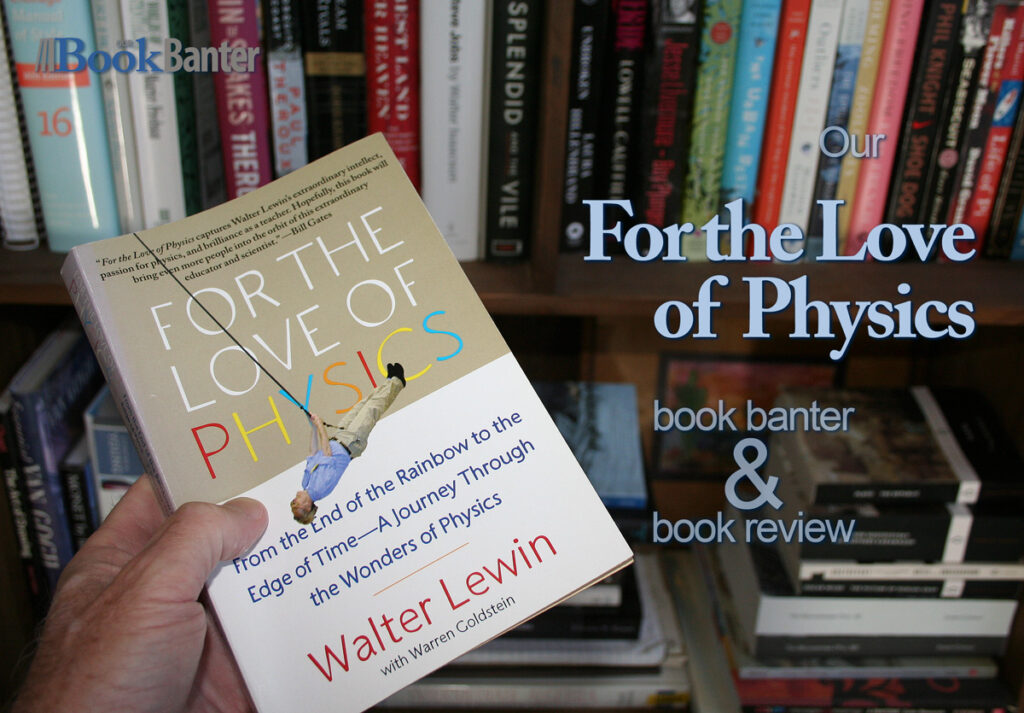
Our For the Love of Physics book review
Professor Lewin is on YouTube
If you’re like me, you’ve already watched many YouTube videos from Ivy League schools like Harvard University and the Massachusetts Institute of Technology (MIT). For instance, Harvard University allows any of us to access lectures from diverse college classes such as Computer Science and Psychology.
MIT does the same thing, and one of their most-watched professors is Walter Lewin. I must confess that I’ve followed lots of videos about linear algebra, calculus, and algorithms, but I’ve never watched Professor Lewin’s lectures about physics.
As I read Lewin’s book, I also watched his lectures for the first time. In his book and in his classes, Lewin simplifies the seemingly complex subject of physics. Surprisingly, he even simplifies the advanced mathematics and formulas physicists use to postulate theories and measure results.
Turns the mundane into the spectacular
The professor compels his readers and students to analyze mundane natural events, like the colors in a rainbow, sipping punch through a five- meter straw, and how electricity works. In addition, he poses interesting brain-teasers—if an airplane’s wings are designed to provide lift, how can that airplane fly upside down without crashing?
Professor Lewin demonstrates the conservation of energy; start video at 22:35 for the entire experiment
Spine-tingling images
All of the topics covered in For the Love of Physics were interesting, but I found his discussion of our sun, our moon, our solar system, our Milky Way galaxy, and our vast universe especially thrilling—even spine-tingling. It conjured up images in my mind and soul of a complex, unfathomable god, whose name I do not know.
The power of physics
For instance, most physicists have concluded that the Milky Way galaxy has “some 100 billion to 200 billion stars,” including our own sun. Those numbers are so mind-boggling to me that I almost can’t imagine the vast size. Can you?
We are insignificant
But, that’s not all. Lewin then wrote that our Milky Way galaxy is a part of one universe. That universe likely has 100 billion or more galaxies, just like the Milky Way. Of course, each galaxy would contain hundreds of billions of stars. I almost can’t wrap my head around those numbers.
But, that’s not all. Then, there are also billions of universes, each with their own billions of galaxies. Of course, some universes are bigger than others.
Is anybody else out there?
All that vastness makes me imagine that there must be other intelligent life forms out there, somewhere. What do they look like, and how do they live? Are they more technologically advanced that our primitive human species of life? And, are they friendly?
Those are all questions that this book has helped me contemplate. However, despite all the advancements we’ve made in physics, science, mechanics, and medicine in these last few centuries, physics doesn’t have all the answers. Not yet, anyway.
Brian Cox discusses the vastness of the universe, which Professor Lewin also discussed in his book
Despite all we know, we still don’t know a lot
According to Professor Lewin, despite our advanced knowledge in physics, “…we’re ignorant about 96 percent of the mass/energy in our universe.”
He went on, “Physics has explained so much, but we still have many mysteries to solve, which I find very inspiring.” I find it inspiring, too.
Maybe Donald Rumsfeld, a former U.S. Secretary of Defense, got it right when he said, “There are things we don’t know we don’t know.” Those unknowns and mysteries might be unlocked, little-by-little, by the future physicists of the world.
Maybe your child is a future physicist
After reading this spell-binding book, I wish I would have become a physicist. I’m inspired now, but it might be too late for me. However, if you have children, this book might inspire them into a life of scientific discovery.
Maybe your child could become a physicist. Or, maybe this book might inspire your child to simply study harder and do better in school. When I was young, I was academically lazy. I regret my wasteful youth so much.
Don’t let your children waste their educational opportunities while they are young. This book might provide a spark of inspiration. For me, this book opened my eyes to the beauty of our universe, and the mathematics that physicists use to test their theories and measure their results.
That’s why, even though I’m in my early 60’s now, I still study linear algebra, trigonometry, and calculus on my own. Mathematics is a beautiful thing, and I marvel how it can quantify the wonderful world around us.
Do you need math to understand this book?
Professor Lewin has used this book, along with his earlier MIT lectures, to “make physics come alive” for his students. “I believe it’s much more important,” Lewin wrote, “for them to remember the beauty of the discoveries than to focus on the complicated math…”
As I read For the Love of Physics, however, I felt that some of my math studies had helped me understand what he was discussing. For instance, my trigonometry studies helped me understand how physicists use parallax to measure how far away a planet, star, or other galaxy is away from us.
However, Lewin’s explanations were usually so clear that an advanced understanding of mathematics is not needed to understand the concepts and appreciate the beauty. Despite the simplicity and clarity of his explanations, there were many things that left me stumped.
Maybe if my math skills were greater, I could have understand more of the interesting concepts he posed in this book.
Physicists actually study drinking with straws?
For instance, one of the problems he posed was in The Magic of Drinking with a Straw chapter. He wrote about hydrostatic pressure, and how it can vary.
Lewin wrote about trapping liquid in a straw, and how high you could raise the liquid in a very long straw. He discussed all types of things about straws, and liquids, and gases. Who would have imagined hydrostatic pressure could be so fascinated?
Then, there were submarines and the tremendous pressures they must withstand while underwater. Of course, divers face similar pressures.
Then, the professor talked about snorkeling, and breathing while underwater. Would it be possible for a diver to breath through a snorkel while at greater depths than one foot? From all the explanations he gave, I believe we, the reader, could have figured that problem out. I think I did, but I’m not sure.
Despite my misgivings, I think if I had been a physics student in Professor Lewin’s classes, I could have logically come up with a theory. Then, by using math, science, and measurement skills, I could have verified the validity of my theory. That’s the beauty of physics.
TAKEAWAYS:
For the Love of Physics book review
If you love science, you’ll love this book
If you love science, biology, astronomy, or just watching a good science fiction movie, you’ll enjoy For the Love of Physics. This book will inspire you to study more about physics, and even learn more about the mathematics that physicists use each day.
Thanks for reading our For the Love of Physics book review. Please share your thoughts about the book in the comments section below!
Content and photos by Doug Martin and Our Book Banter


