
As human beings, we all have an innate need to wonder—we dream about what is out there among the stars. Ever since I was a child, I would gaze into the night sky, and dream about what creatures might live on other planets, or in other galaxies. My curiosity was the main reason I first read Carl Sagan’s Cosmos shortly after it was first published in 1980. And now, decades later, I have read it again. This time, more intently and more studiously. So, here is our Cosmos book review.
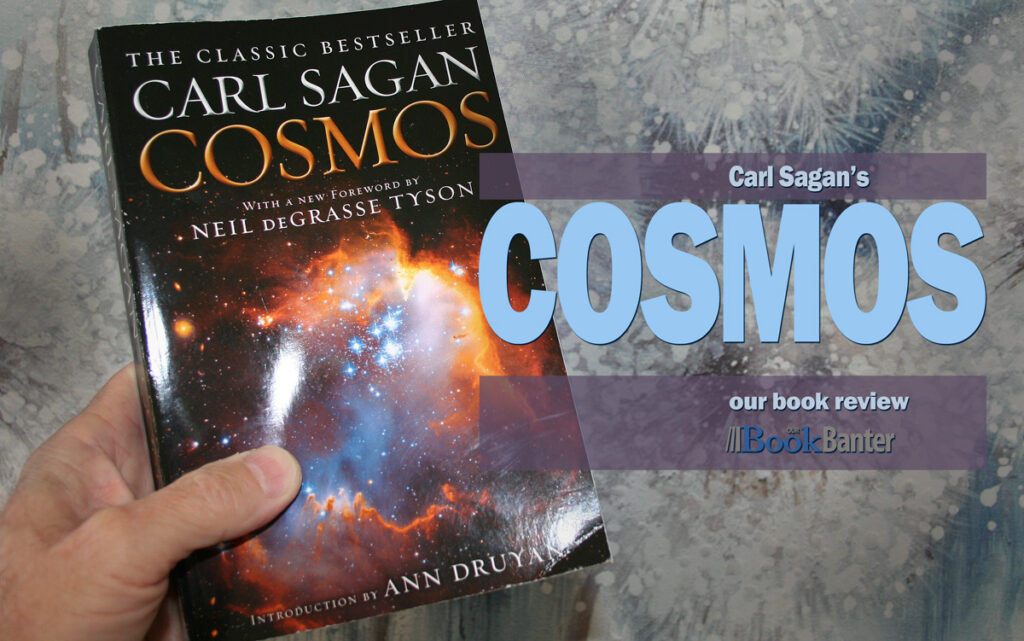
Cosmos book review
Cosmos, Carl Sagan’s book, is still relevant today
—Think critically, like a scientist would
Despite many decades of scientific breakthroughs, Carl Sagan’s book, Cosmos, is still relevant today. In his book, Sagan emphasized the valuable skill of critical thinking, and why it is important to question everything, just like a scientist would.
Not only is critical thinking important for the scientist, but it’s also an essential skill for citizens living in an advanced society.
—Complex concepts easy to understand
Even more importantly, the author made complex scientific concepts easier to understand. Thankfully, Sagan’s poetical style of writing made even the most complex formulas seem easier to grasp. And, his writing style aroused my curiosity even more.
—Are we alone in the universe?
Ultimately, Sagan had tapped into our childlike wonder that is inspired as we gaze into the star-filled night sky. What could be out there? Could we be alone in the universe? And, are there creatures more advanced than us living in the next solar system, or in a neighboring galaxy?
The content of Cosmos
A vast, unimaginable number of galaxies
The first chapter of Cosmos, titled The Shores of the Cosmic Ocean, made my spine tingle as I read. That chapter introduced us to the almost unimaginable vastness of space, and how small and inconsequential our Milky Way galaxy is in comparison.
We are a brief, flickering flash of light
As I read with a sense of wide-eyed awe, I realized that we are only a brief flash of light in the vastness of space and time. An infinite number of years have preceded us, and after we’re gone, time will continue to march on.
During our brief and fleeting time on Earth, we will continue to evolve until, once again, the atoms in our bodies become one with the cosmos (that’s my interpretation).
An immense number of planets, some possibly habitable
Here’s an excerpt (without the math formula or logarithms) that made my spine tingle and shake my head as I read it—the vastness is so hard for me to comprehend:
“There are some hundred billion galaxies, each with, on the average, a hundred billion stars. In all the galaxies, there are perhaps as many planets as stars, ten billion trillion (wow—that’s my ‘wow’). In the face of such overpowering numbers, what is the likelihood that only one ordinary star, the Sun, is accompanied by an inhabited planet?”
Carl Sagan, Cosmos
Would we recognize other advanced forms of life?
So, the likelihood is pretty high that there are other advanced forms of life on other planets. In addition, it’s likely that these creatures may not look like us, or behave like us.
As Sagan explained, we may not even be able to see these creatures. And, their societies may be so advanced that we may not be able to comprehend or discern their presence.
Amazing video from Carl Sagan’s television series called Cosmos!
The book, Cosmos, delivers a lot of content
When I first read Cosmos, I was much younger. Back then, I wasn’t very interested in the math that the scientists throughout the centuries had used to plot the stars and planets in our solar system.
So, I just glossed over those parts, and focused instead, on the aspects of vastness and probabilities of other forms of life. Unfortunately, I missed out on a big chunk of content that would have helped solidify my understanding of our universe.
This time around, I took my time, and tried to follow the logic. I studied the formulas, and tried to wrap my head around the logarithms.
Irrationality of the square root of 2
For instance, near the end of the book, in Appendix 1, the author presented more indepth content on an interesting concept. He used diagrams and formulas to prove that the square root of 2 is an irrational number.
I followed the logic, one step at a time, and I believe I understand the proof. However, when I was younger, I skipped this part.
Overall, it’s not vital for the reader to understand this concept, but it’s good to spend the time, and try to comprehend the logic.
The five Pythagorean solids
“…there can be 5 and only 5 regular solids.” From my understanding, the Pythagorean solids concepts were used to determine the masses and shapes of distant stars and the orbits of their planets.
And, it was probably used to help measure distances, along with trigonometry. So, I spent a lot of time on this appendix content, but it was mostly above my pay-grade. Despite the time I spent, I’m not sure I completely comprehend the math tools these guys used.
Timeline of the discovery of our cosmos
In the chapter Who Speaks for Earth, Sagan put together a timeline of the astronomers, mathematicians, and scientists who used their skills to study our solar system, our Milky Way galaxy, and other galaxies in our universe.
Amazingly, this timeline goes back hundreds of years before the birth of Christ. Back then, mathematicians were making amazing scientific discoveries.
Organized religion feels threatened by science
During those thousands of years, organized religion was the big hindrance to scientific discovery. Sagan discussed many times when religious leaders felt threatened by science.
Today, right here in the United States, organized religions still impede the work of scientists and still denigrate their discoveries. Unfortunately, our basic human nature has not evolved or kept pace with our scientific knowledge.
—Science can measure and reveal a creator’s presence
However, as I read Cosmos and other scientific books, I feel that science is one precise way to measure a creator’s presence, if there is one. So, it seems irrational that many followers of organized religion would feel threatened or afraid of scientific explanations.
Carl Sagan and his views of organized religion. Some of this interesting content is also included in Cosmos!
Cosmos, the book, can be easy or challenging to read
When I first read Cosmos in 1980, I enjoyed the book immensely. It was a delightful book to read, and not difficult for me to understand.
Of course, back then, I skipped all the challenging math formulas and concepts. Instead, I focused on the big picture of the vastness of our universe.
Today, I wanted to get my money’s worth, so I didn’t skim over the math examples. Instead, I spent much time trying to follow the logic.
Either way, Cosmos can be an easy book to read, or it can be challenging—that’s all up to you! And, that’s a good thing.
Recommended reading lists
After the appendixes, Sagan included a large recommended reading list. The author grouped the varied list of references by chapter. It includes further research about Christopher Columbus, science and the paranormal, and our solar system, our Milky Way galaxy, and our neighboring galaxies.
And, after reading the book, I suspect you’ll be so interested in science and astronomy that you’ll want to do your own indepth research. This topic is so fascinating!
Cosmos book review
Cosmos book review final verdict
If you buy Carl Sagan’s book, Cosmos, you will definitely get your money’s worth. The author’s content is was well-written, with lots of research to back up his theories, and is a pleasure to read.
I learned so much about the vastness of our universe (and probably trillions of other universes), and the brevity of our lives here on Earth. This content puts our own brief lives in perspective—we’re only here for a blip in time, so we should use our time wisely.
Thanks for reading our Cosmos book review and book banter. If you’ve already read the book, please share your thoughts in the comments section below. Thank you!
Content and photos by Doug Martin and Our Book Banter


