
The 2005 award-winning, nonfiction book, American Prometheus: The Triumph and Tragedy of J. Robert Oppenheimer, chronicles the life and the times of the ‘father’ of the atomic bomb. This man’s story was so fascinating that producers made a compelling film adaptation of the book in 2023. Here is our American Prometheus book review.

American Prometheus book review
25 years of research and writing American Prometheus
The 2005 Pulitzer Prize winning biography, American Prometheus: The Triumph and Tragedy of J. Robert Oppenheimer, took 25 years to research and then to write. Unsurprisingly, there are almost a hundred pages of notes in the back of the book. The notes include references for specific quotes and items from each chapter.
References add credibility
Not surprisingly, the extensive references add credibility to this expansive biography. The authors, Kai Bird and Martin Sherwin, painted a revealing portrayal of the complex personality and history of J. Robert Oppenheimer.
B&W Photographs
—Robert’s father looked like Tom Selleck
In the book, there are two sections of beautiful black-and-white photographs. They show Robert as a baby, along with his parents. By the way, I think that Julius Oppenheimer, Robert’s father, looked a lot like the actor, Tom Selleck, in the first section of photos.
—Photos of Oppenheimer’s children
The comprehensive array of pictures include some of Robert as a boy, as well as some of his friends, fellow physicists, and scientists. Also included are photos of Oppenheimer’s children, who also have very interesting and tragic stories to tell.
Who was Prometheus?
So, who was Prometheus, and how was his mythical gift related to the life of J. Robert Oppenheimer?
—Prometheus gave the gift of fire to humanity
Prometheus, who was immortal according to a Greek myth, stole fire from the Greek gods and gave it to humanity. For human beings, fire was the ultimate gift to improve their primitive lives.
—Fire greatly improved life for humanity
For instance, before fire, human beings were cold and possibly had died during the winter. And, before fire, humans were not able to cook meat, which enhanced the flavor and made it a safer food source.
With fire, human beings were able to thrive, and become less dependent on their gods for survival. So, fire was the ultimate gift.
—Prometheus was eternally punished
Unfortunately, but maybe predictably, too, Zeus and the Greek gods had become upset that Prometheus had stolen their fire. So, the gods eternally punished him, without mercy.
The Greek gods had chained Prometheus to a rock, and a large bird swooped down and ate his liver every day. Because he was immortal, his liver regenerated at night, but the next day, the predatory bird picked at and ate his liver once more.
—Oppenheimer gave the U.S. a powerful scientific gift of fire
That might be how Oppenheimer felt throughout the latter stages of his life. Despite ending World War II with his scientific discovery, Oppenheimer, too, was tortured and demonized daily by his own employer, the United States government.
—Oppenheimer’s conscience tortured him, too
In addition, Oppenheimer’s had a troubled mind. His invention had tormented his conscience. He was deeply troubled about the development of the atomic bomb, and its possible misuse. In one sense, he was astonished at the bomb’s scientific beauty, but he was also troubled about its power to annihilate human beings on a mass scale.
Who was J. Robert Oppenheimer?
—Science was changing the world quickly in 1904
Robert Oppenheimer was born on April 22, 1904. Back in the early 1900’s, the world was a more primitive place. But, early scientific discoveries were quickly making modern life more convenient. And, medical discoveries were lengthening life-spans.
—Horses were out, cars were in
For instance, gasoline-powered cars or buggies were quickly replacing the horse as the primary mode of transportation. And, the first radio broadcast took place in 1905, only a year after Robert had been born.
—Radioactivity and relativity
In addition, scientists had just discovered radioactivity in 1896. And in 1905, Albert Einstein published his special theory of relativity.
—Science fueled Robert’s imagination
So, while the world was still relatively primitive, scientific discoveries were beginning to make life more comfortable, at least in the developed world. And, these scientific developments helped fuel Robert’s imagination as a child.
—Robert was raised to believe in rational thought and equality
The Oppenheimer’s were ethnically Jewish, but Robert’s parents raised him with a relatively radical offshoot of Judaism called the Ethical Culture Society. This group revered a rational, scientific way of thinking, while rejecting the dogmas of organized religions.
In addition, people in the Ethical Culture Society believed they were responsible for helping their fellow human beings who were in need. Furthermore, they believed in social justice and equality for every person. For me, the Ethical Culture Society sounds like a perfect atmosphere in which to raise children, and to receive a good guide to live one’s life!
—Oppenheimer became deeply conflicted
After the Manhattan Project, under his leadership, had developed the atomic bomb, Oppenheimer became deeply troubled about the part he played, possibly because of his lifelong beliefs in equality and social justice for all.
After reading this book, I suspect that his childhood memories of the teachings from Oppenheimer’s parents and from the Ethical Culture Society added fuel to his tortuous and conflicted conscience as he aged.
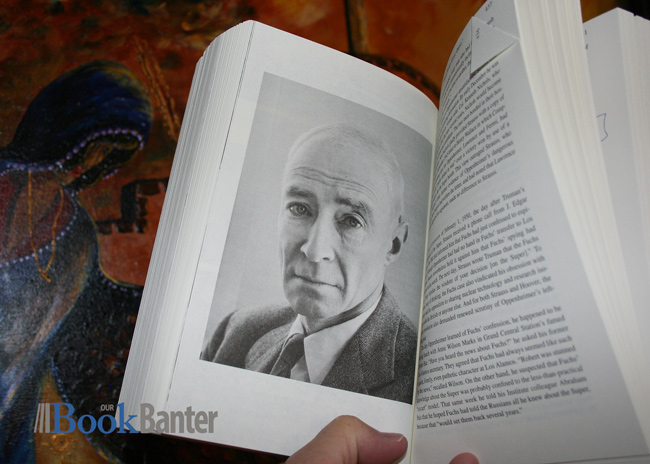
This is one of my favorite photos from the American Prometheus book. The book shows J. Robert Oppenheimer in his later years, when he was deeply troubled. He felt his government had betrayed him, and he was deeply troubled about the potentially horrific implications of his scientific work. There is no photo credit, or any other information about this photo in the book. But, it speaks deeply to Oppenheimer’s humanity. His eyes tell the whole tragic story.
American Prometheus book review continued
J. Robert Oppenheimer’s stages of life
Student and teacher
—High School
As a child, Oppenheimer’s parents encouraged his love of learning. At an early age, Oppenheimer stood out as a unique prodigy.
He became interested in rocks and geology, and quickly became an expert. From there, Robert took classes in math, literature, and psychics, and excelled at them all!
—College, university
Oppenheimer’s years of higher education were especially interesting. This amazing young man first attended Harvard University, where he obtained a Bachelor’s degree in only three years.
From there, he worked and studied at Cavendish Laboratory in Cambridge, England. Then, because of his obsession with psychics, he moved to Germany where he excelled in quantum mechanics while studying under the renowned Max Born.
By the time he turned 23, Oppenheimer had earned a doctorate in physics. Despite his young age, Robert had developed an outstanding reputation as a brilliant, ground-breaking physicist.
—Taught psychics
Even as an enterprising student, Oppenheimer was enlisted to teach classes. And along the way, he continued to learn, study, and experiment.
Not surprisingly, many of his female classmates and students found the brilliant and unconventionally handsome Oppenheimer to be a very captivating and attractive young man.
—Met and formed friendships with communists
As the Gilded Age had ended slightly before Oppenheimer’s birth, communism became a popular topic on college campuses. The oligarchs had flourished during the Gilded Age’s prosperity, but many people without financial assets or property were left behind.
Naturally, younger people who were concerned about their economic futures had considered communism to be a viable alternative to unbridled capitalism.
—Communism was an enticing alternative
I remember my grandfather, who had lived into his 90’s and had worked menial jobs and belonged to a union all of his working life. Well, he had communist literature in his small bungalow. As a very young boy, I remember trying to read and understand his magazines.
For me, the magazines and other literature were incomprehensible, but I mention this just to point out that many members of the working class before and during the Great Depression were enticed by communism. College students, too, found communism to be an alluring philosophy.
—Oppenheimer had many associates who were communists
While Oppenheimer never embraced communism and was never a member of the Communist Party, some of his associates and friends were members. This book details many of the interactions the physicist had with communist sympathizers, and how those associations came back to haunt him after The Manhattan Project’s success.
Scientific director at the Los Alamos Laboratory
Throughout the world, the growing threat from the rampaging Nazis in Europe, and imperialistic Japan’s bombing of Pearl Harbor in 1941 was spreading fear. Those unfriendly forces were working on developing their own nuclear capabilities. Unfortunately, the USA had to develop an atomic bomb—they almost had no choice. Albert Einstein had warned US President Franklin Roosevelt that other countries were already working on a new, much more powerful bomb.
In 1942, the US government recruited Oppenheimer to become the Scientific Director at the new Los Alamos Laboratory in New Mexico. From those secluded facilities, Oppenheimer and the group of scientists known as The Manhattan Project raced to develop and then test the first atomic bomb.
—Oppenheimer was worried about a catastrophic chain reaction
In 1945, Oppenheimer and The Manhattan Project exploded the first atomic bomb. But, Oppenheimer and other scientists had a big concern. According to their calculations, the heat generated by the exploding bomb could cause the nitrogen in the Earth’s atmosphere to also react, which would destroy the planet.
Fortunately, that horrific nuclear reaction didn’t happen, and the atomic explosion remained controlled. Shortly after that success, the US rushed to develop the two atomic bombs that they later dropped on Japan on August 6th and 9th, 1945.
American Prometheus movie trailer—an excellent, enthralling film adaptation of the equally excellent book. Yes, this movie was really good, and I recommend it.
—Japan surrendered and WWII was over, but Oppenheimer was troubled
Shortly after the US dropped the atomic bombs on Japan, they surrendered and the long-lasting and devastating World War II was finally over. While that was a great success, Oppenheimer would be forever troubled.
He was tormented about the devastation that his scientific invention had inflicted on humanity. In addition, Oppenheimer was worried about his weapon’s misuse, and those potentially horrific consequences.
—Oppenheimer’s gift of fire to humanity
Just like Prometheus, Oppenheimer and his team of scientists had delivered the ‘fire’ that ended the long, sorrowful saga of World War II. But, he would agonize for the rest of his life about the human suffering his ‘gift of fire’ had caused, and the potential for total annihilation from a future atomic war.
Oppenheimer became a critic of the nuclear arms race
After World War II ended, Oppenheimer began having second thoughts about his invention. In fact, he became a critic of the nuclear arms race. Because of his criticisms, he became a target of scorn and retribution from powerful people within the US government.
—Oppenheimer was accused of being a communist
Partly because of Oppenheimer’s misgivings about the nuclear arms race, and partly because of his past associations with communists, the US government investigated him. They interviewed his associates, the scientists who worked at Los Alamos, his past romances, and his college experiences. They investigated it all.
Had he sold his secrets to the Chinese? Another scientist who Oppenheimer had worked with had done exactly that. So, they investigated Oppenheimer, too.
—Betrayed by his own country
So, despite his scientific development of the ‘fire’ that had ended WWII, the US government accused Oppenheimer of being a communist. In addition, they accused him of being a traitor. Can you image how this sensitive but brilliant man had felt? He must have felt betrayed by his own country.
American Prometheus book review, continued
This last era of Oppenheimer’s life was very difficult. The authors researched and revealed the terrible toll that the 10-year FBI investigation had taken on Oppenheimer’s life.
In addition, the authors researched Oppenheimer’s children. They also bore the scars of a disengaged father while they lived at Los Alamos. In many respects, this caring father was an absent father, and his children did suffer.
—American Prometheus is a tragic true story
In many aspects, American Prometheus was a story of great scientific success. But, it was also a true story of personal loss and heartache for Oppenheimer and his family, and his associates.
FINAL VERDICT
American Prometheus book review
American Prometheus is a fascinating book, even for the non-physicist like me. The authors meticulously researched this biography, and it was engagingly well-written.
It’s no wonder that the movie studio had this compelling, Pulitzer Prize winning true story made into an emotionally moving film adaptation. The movie was very good, too. It revealed many of the emotional aspects of Oppenheimer’s life and his scientific accomplishments.
If you enjoy history, and enjoy captivating personalities who shaped our history, then you will enjoy reading American Prometheus: The Triumph and Tragedy of J. Robert Oppenheimer.
Thanks for reading our American Prometheus book review. If you’ve read the book or watched the movie, share your thoughts in the comments section below!
Content and photos by Doug Martin and Our Book Banter


