
After decades of procrastinating, I have finally read Homer’s epic poem, The Odyssey. I delayed reading this great literary work because poetry is intimidating, and because I wasn’t motivated in reading about the main character, Odysseus. Fortunately, because of the recent film adaptation, I finally relented and did read The Odyssey. Here’s The Odyssey book review and book banter!
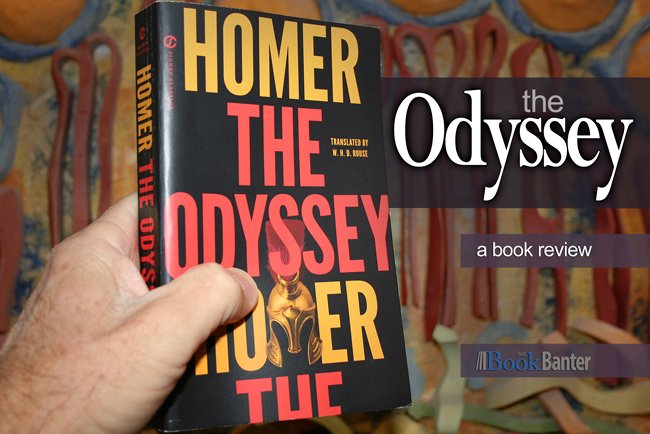
The Odyssey book review
When did Homer write The Odyssey?
Instead of being written by one author, literary experts believe that The Odyssey storyline was initially recited or performed by various poets or storytellers. Each telling of The Odyssey likely included features that the previous performances did not include, so the poem evolved.
Finally, a group of scribes and religious scholars compiled the epic performance onto papyrus scrolls and parchment. Those archives helped to preserve the original storyline into a standardized format for later generations to enjoy.
The whole process of performing The Odyssey and then committing it to its written form took place between 750 BCE and 675 BCE, or 2,800-to-2,600 years ago.
But, was there really a Homer?
Well, it’s likely that the mythical Homer, who current editions of The Odyssey credit as the author, was likely a conglomerate of scribes and scholars who first committed the storyline to papyrus.
So, no, there was probably never a real Homer who singly authored The Odyssey and The Iliad. However, depending on the researcher, there are some credible theories that there was a real poet named Homer in ancient Greece. You can read more about the mysterious Homer in this recent, interesting research from The British Museum.
Protagonists of The Odyssey
After reading The Odyssey, I concluded that there were multiple protagonists in this epic and ancient Greek story. Unfortunately, I could only empathize with one character, and he wasn’t even the main protagonist! But, I’ll start by describing the character I liked the best.
Telemachos:
The handsome, young Telemachos
The handsome son of Odysseus and Penelope (who I’ll describe shortly) was Telemachos. When we are first introduced to Telemachos, he is living in palatial luxury, along with his mother, on the Greek island of Ithaca.
Unfortunately, the father of Telemachos, who had been the king of Ithaca, had not returned home after fighting in the Trojan War. Tragically, everyone on the island thought Odysseus had died, but the beautiful Penelope and her son, Telemachos, retained hope that Odysseus would one-day return.
Meanwhile, many other wealthy young men on the island wanted to marry the mother of Telemachos. They wanted to enjoy her beauty and share the luxurious wealth that Queen Penelope and her son enjoyed. Most of those ardent suitors were the same age as Telemachos, so those guys, as you might imagine, really bothered Telemachos.
Telemachos takes a voyage
Eventually, Telemachos is so sickened and frustrated by his mother’s hopeful, but deadbeat beaus, that he decides to take a voyage of his own to find his father, Odysseus—hopefully alive!
I liked the Telemachos character
Overall, I could empathize with Telemachos. He seemed like a considerate person, who was devoted to his mother’s well-being. In addition, he was devoted to his father, and wanted to find out where he might be, and if he was still alive after all these years.
The recent film adaptation of The Odyssey has lots of romance, tons of drama, and gobs of action!
Penelope:
Beautiful Penelope was sought-after
The wealthy and beguiling young woman, Penelope, was the Queen of Ithaca and the mother of Telemachos. She, too, was devoted to her husband, and didn’t want to get married until she found out what had happened to Odysseus, and if he would return to their home.
Penelope and her schemes
During those years of living alone in the palace with her son, she kept very busy throughout the day. She even came up with a scheme to avoid marrying her young, wealthy, and handsome suitors, but I won’t reveal her clever plot.
But, will Penelope be able to resist temptation forever? And, will she live long enough to see Odysseus again, or at least find out what happened to him? For those answers, you’ll have to read your favorite translation of The Odyssey.
Odysseus:
Odysseus was a warrior and king
The strong and handsome warrior, Odysseus, had also been the King of the Greek island of Ithaca. Before he left to help fight in the Trojan War, he got together with Penelope, his wife, and fathered Telemachos.
So, Telemachos was just a baby when Odysseus left to fight. All together, Odysseus was gone for almost 20 years. However, during that time, his beautiful wife Penelope remained faithful, and hoped that her cunningly brave husband would return one day.
In a way, most of the book is focused on the exploits of Odysseus, but this protagonist isn’t really introduced until after the first third of the story is told.
Odysseus knew how to have fun
But, as we learn the story of the fierce warrior and his cunning exploits during the Trojan War, we see that he was having a wild, almost fabulous time away from his family in Ithaca. After the war, on his almost 10-year journey back to Ithaca, Odysseus was having a busy time.
I won’t share too many of the intimate details, but let’s just say that he was intimate with a beguiling Greek goddess! In fact, it wasn’t unusual for many of the Greek gods and goddesses to have intimate relations with members of the human race! Well, that sounds just deliciously convenient!
The Odyssey book review cont.
Plot of The Odyssey
Three protagonists: father, mother, and son
Most of the plot of The Odyssey revolved around the three main protagonists. First, we are introduced to the son, Telemachos, and then to his mother, Penelope.
However, throughout this epic story, we begin to slowly learn about the father, king, and warrior, Odysseus. Telemachos yearns to find out what happened to his father, and his mother, Penelope, faithfully waits for his return to Ithaca.
Odysseus takes a long time to get back home
Throughout the long journey of Odysseus, he encounters some of the Greek gods, and how they control the weather, the earth, and how they determine humanity’s destiny. Just like the mythical Christian god who I learned about as a young boy in my Protestant Sunday School, the Greek gods were brutally vengeful, but used their power in magnificent ways to impress us with their power.
Odysseus also encountered mythical monsters, which their gods created to tempt and to hurt all people on earth. There were giant cyclopes, witches, and other mystical dangers which the king encountered on his return to Ithaca.
Actually, I didn’t really like Odysseus. While he claimed to be devoted to the men who helped him fight, it seemed like he considered them ‘collateral damage’ when they got hurt or killed. He didn’t really care—just as long as he could live and continue his journey.
Odysseus yielded to temptation
In addition, Odysseus wasn’t faithful to his long-suffering wife, Penelope. She stayed true to him, yet he submitted to all kinds of carnal pleasures.
His excuse was that the temptations were too strong to resist, like when he had relations with a Greek goddess and shacked up with her! Too funny, but too typical of today’s elite politicians we read about in the news.
So, while I admit that Odysseus was the main protagonist who we should be rooting for, I found the guy to be a detestable human being! In fact, I found the secondary protagonists, the wife and son of Odysseus, to be much better, more morally upright and decent people.
The 1997 film adaptation of The Odyssey used special effects that look crude by today’s standards, but the movie still looks good!
The Odyssey book review cont.
Themes of The Odyssey
All of the themes contained in The Odyssey are timeless, and have existed throughout the existence of human life on our lonely planet. I guess that’s what makes The Odyssey poem so relatable, even in today’s modern, more rational, scientific world.
Revenge:
Show me respect, or else
In The Odyssey, everybody needs to be respected. And, if they are ever disrespected by anyone, justice must prevail. To obtain justice, they must seek revenge for whatever slight they suffered.
For instance, Telemachos sought revenge against all the deadbeat suitors who sought the hand of his beautiful, wealthy mother. Of course, that was understandable, because those suitors, many of whom were wealthy themselves, showed up everyday at the palace and received free food throughout the day.
Then, the families of those same suitors sought revenge against Telemachos and his father, Odysseus. However, I won’t tell you why they sought revenge, because that would reveal a key plot twist.
The gods sought revenge, too
Even the numerous gods in this story sought revenge. They wanted to get even with other gods, and also wanted to torment and smite other human beings for some misdeed.
In fact, the scenarios of revenge in The Odyssey reminded me a lot of similar scenarios in the Bible. When I was a child, I read the entire Old and New Testament. At that young age, people of god’s reprehensible behavior really shocked me. There was too much revenge-seeking, smiting, scheming, lying, and abusive behavior. In the Bible, just like in The Odyssey, god and human beings sought revenge.
Faithfulness:
Also in this epic poem, many of the characters were loyal and faithful to their family, friends, and fellow soldiers. Telemachos especially showed his love and faithfulness to his mother. In addition, the young son also was faithful to his father, who he hadn’t seen for almost 20 years.
Even Odysseus claimed to have the trait of faithfulness. Unfortunately, I feel that Odysseus was a hypocrite in this valuable trait, because he shacked up for years with a beguiling, tempting goddess, along with other misdeeds.
That’s why, as I read this novel, my opinion of Odysseus was diminished. In fact, I really didn’t like or respect this character. I felt that Odysseus rarely displayed faithfulness, and when he did, it was because he wanted something in return.
Hospitality:
Being hospitable to neighbors, whether they were friends or not, was an important theme and trait in this poem. Indeed, Telemachos welcomed and fed his mother’s unwanted suitors each day, despite feeling extremely resentful of their presence in their palatial abode.
Other examples of hospitality and caring for other people—even strangers—was when both Telemachos and Odysseus were traveling and needed a place to sleep at night. Strangers along their way always welcomed them with a warm bed and nutritious food.
Strategy:
All of the protagonists in this story appreciated the value of using a cunning strategy. Telemachos displayed his patient intelligence by waiting to seek retribution from his mother’s suitors.
And, his mother, Penelope, used her intellect to concoct a strategy to delay marrying one of her many suitors. In fact, her scheme succeeded for many, many years.
Above all, Odysseus displayed patience as he strategized how to gain the upper hand in a local battle in Troy. Not only that, but Odysseus strategized how to overcome hardships, temptations (at least he resisted some temptations, the ones that were convenient to resist), and survive away from his home for almost 20 years.
Home, sweet home:
Remarkably, the idea of a joyous homecoming was a central theme of The Odyssey. Odysseus left his home to go to war, but he yearned to always return home (even when he was in bed with his goddess)!
Understandably, Penelope and Telemachos displayed faithfulness as they yearned for a joyous homecoming for Odysseus. In fact, their whole lives revolved around and worked toward having that glorious homecoming with their husband and father.
Another trailer from the current film adaptation of The Odyssey. I like this trailer, because it makes the movie look like a must-see event!
FINAL VERDICT:
The Odyssey book review
Thematic elements of a good book
The epic poem, The Odyssey, included all the elements that authors use in today’s best-selling action-adventure-romance novels. Those elements include revenge, lust, betrayal, violence, and finally a ‘happy’ ending where the main characters live happily-ever-after.
Unfortunately, I wasn’t able to identify or empathize with Odysseus, who was one of the main characters. In addition, his wife, Penelope, didn’t strike me as being a great human being. This was despite her almost life-long faithfulness to her husband.
Telemachos was my favorite character
Fortunately, I was able to empathize with the son, Telemachos. He actually seemed like a decent person. Usually, he was honest, and he was a faithful son and friend. In addition, Telemachos was welcoming to, and helpful to people he didn’t care for so much.
Maybe, though, Telemachos was naive. Since he didn’t have a father-figure in his formative years, he tended to be too trusting, and viewed the cruel world through rose-colored glasses.
The Odyssey, overall, disappointed me
While I didn’t find The Odyssey to be very engaging, I still was able to read it without getting too bored. Sure, I found most of the characters to be barbaric, and not worthy of respect.
Lovers of literature should read The Odyssey
Despite those misgivings, I feel that The Odyssey is an important book for any lover of literature to read. And now, there’s a recent film adaptation that is causing its own controversy. I’m not going to get into those criticisms, since they mostly seem ridiculous, and political in nature.
Overall, I recommend that you do read The Odyssey. You’ll get an idea of many of the beliefs that the Greek citizenry used to explain the unknown aspects of life, like the weather, the cyclical nature of life, and other unknowns—they had a god for each of those unknown aspects of life!
The Odyssey book review and comments
Please share your thoughts of The Odyssey in the comments section below!
Photos and content by Doug Martin and Our Book Banter


