
As I started reading Laura Hillenbrand’s nonfictional book, Unbroken, I was immediately drawn into this true story. It was an inspiring story of determination to overcome insurmountable odds during the turbulent World War II era. Fortunately, this story is also one of survival, with a few miracles thrown in. Here is our Unbroken book review.
This is a review, but not a book report
As I present my review about this must-read, spine-tingling book about “survival, resilience, and redemption”, I hope I don’t reveal too much of the compelling story. Please rest assured that this review will not be a book report. And, I vow not to reveal any of the surprising, gut-wrenching twists-and-turns in this nonfictional book.
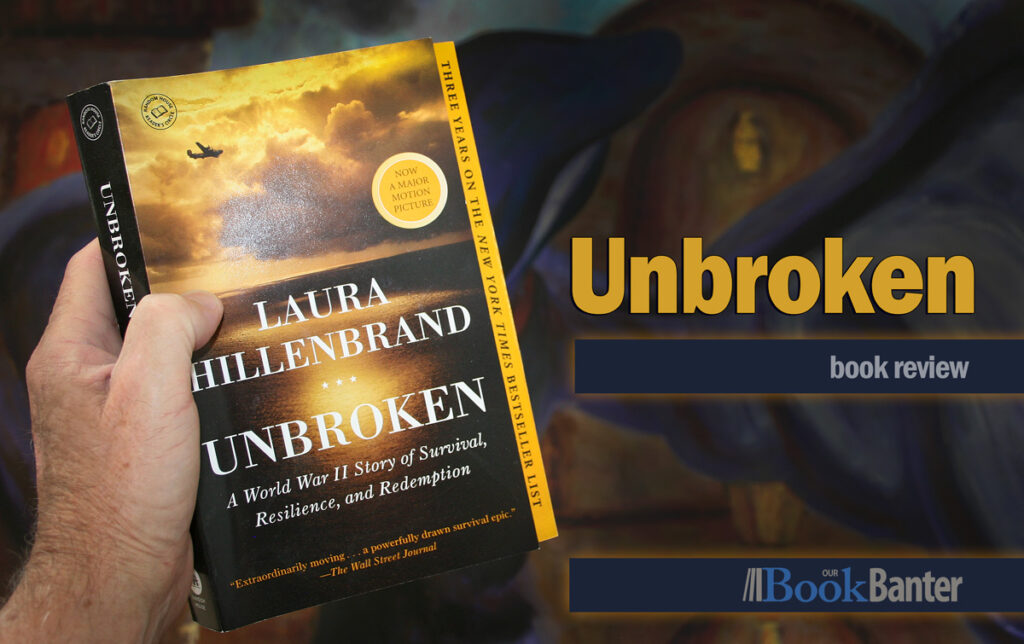
Unbroken book review
Louie Zamperini had a troubled childhood
The author did a brilliant job of setting the preliminary stage for this compelling story. She introduced Louie Zamperini, the rebellious son of poor Italian immigrants. Zamperini had a troubled childhood, and got into lots of serious trouble in his neighborhood.
However, as he grew into an adult, he turned himself around. In early adulthood, Louie engaged in Olympic track competitions. His struggle to get on his road to redemption filled me with a sense of empathy.
Louie was a juvenile delinquent
While I was not rebellious and downright ornery as Louie was as a child, I could identify with his feelings of being an outcast. In fact, Louie actually did the things I only dreamed of doing when I was a child.
Maybe his rebellious disobedience was what set him apart from the crowd, and many times, got him into trouble.
He stole food from his neighbors
He stole food from his struggling, lower-middle class neighbors, ran from police, and then came back for more the next day! I could understand the frustration Louie’s neighbors must have felt, especially when the young rebel stole their freshly baked desserts. That would make me angry, too.
Louie could outrun everybody
However, despite being a kid who misbehaved, Louie accidentally discovered a hidden talent as he ran from neighbors and police—he could outrun almost everybody. That talent would later help him to become a world-class track athlete.
Louie’s troubled childhood made him determined to overcome
As I read about Louie’s rebellious younger years, I understood how he became very determined to not accept defeat. He was not going to let his past failures keep him from fulfilling his destiny as an adult.
His early history of running away to survive was the foundation that prepared Louie for his Olympic competitions. Those earlier struggles also drove him to fight for freedom and survival during World War II.
While Hillenbrand told Louie’s story, she interwove little-known historical information about the rise of nationalism and imperialism throughout the world. Those fascinating historical details set the stage for Louie’s main storyline.
The disturbing rise of nationalism prior to WWII
The background information about the disturbing rise of nationalism throughout the world prior to WWII was interesting. But, it was also frightening. As a young adult track star, Zamperini competed in the 1936 Summer Olympics competition held in Germany. He traveled to Berlin, and saw the subtle, and the not-so-subtle, early signs of fascism.
Fueled by Hitler, many Germans felt the Aryan race was superior. They used that belief as justification to discriminate against, and then massacre, ethnicities different from their own.
Zamperini and his Olympic teammates were troubled about how Hitler’s regime separated and removed Jewish people from German society. They sensed that the stage was being set for the next world conflict.
Nationalism and arrogance
Later, the author related how the Japanese leaders also developed a misguided sense of nationalism. They believed their ethnicity was superior to the rest of the Asian world. Just like the Germans, their arrogant nationalism helped justify their expansionism.
While I had previously read and learned about Nazism and their fervent sense of nationalism, I was not aware that the Japanese also suffered from a similar, misguided arrogance.
The historical details in Unbroken, some of which I had read for the first time in my life, were fascinating. They helped me understand Louie’s fortified resolve to survive as a Japanese prisoner-of-war (POW).
I didn’t watch the movie, but I think the book painted a more vivid and horrific picture of Zamperini’s POW experiences in my mind. However, the movie does look good, too!
Zamperini’s defining moment
While I don’t want to give away too much of the plot of Louie’s story, I was especially moved when he was running in a 5,000-meter, qualifying heat for the 1936 Olympics. After the starting gun sounded, Louie paced himself for the long, 3.1 mile competition. He quickly became winded and felt exhausted.
This part reminded me so much of Hillenbrand’s book about the underdog race horse named Seabiscuit. Louie was lagging in the race, just like Seabiscuit had lagged in his important competition.
He struggled and fell behind. Louie knew that if he lost this qualifying heat, he could not participate in this Olympic event.
Inspiring words from his brother
Then, as he saw many of the runners outpace him, Louie remembered something that his older brother, Pete, had told him many years earlier. Pete had said:
A lifetime of glory is worth a moment of pain.”
—Louie Zamperini’s older brother, Pete
As Louie was falling behind, he thought to himself, “Let go.”
And, just like Seabiscuit, Louie set his sights on the lead competitor, and he ran with a dazzling, record-breaking speed. I won’t tell you the results of the race, but Louie did actually set a speed record during the last lap.
During Zamperini’s long, brutal imprisonment in a POW camp, he had also used his brother’s inspiring words to rise above his desperate circumstances.
Unbroken book review
Shortcomings of Unbroken
Despite being a well-researched, well-documented book that had me spell-bound, I found a few shortcomings in Unbroken that raised questions.
Was it really a miracle?
For instance, when Louie’s plane crashed into the sea, the plane sank and he was pulled underwater. Desperate, he realized he could not break free—he was wrapped up in a tangled mess of wires.
Then, probably because of oxygen deprivation, Louie blacked out. The next moment, he was revived. Just in the nick of time, he was able to float to the surface.
There must be a logical explanation
But, how did he break free of the wires after he had passed out? To me, the author and Zamperini implied that a miracle had happened.
And, if I had suffered the same horrific experience, I would have believed that it was a miracle, too. But, there must have been a logical explanation, even if it was an improbable one.
I was disappointed that the author didn’t investigate that accident more in depth. Had Zamperini really experienced a miracle, or was there a logical explanation for how he got free and swam to the surface?
Logical explanations can still be miraculous
After all, even if there was a logical explanation of how Louie had freed himself from the wires, it could still have been considered a miraculous event. But, we often use the word “miracle” as a simplistic way to explain things that we can’t easily understand.
Memories may have faded
I love how the author researched, cross-checked, and documented all the historical information in Unbroken. However, some of the personal memories of the main characters probably had faded over time.
For instance, I can barely remember exactly what I did only one week ago. If I had to reconstruct that specific day for an author, it would be difficult to accurately recall everything.
Of course, my life has not been as eventful as Zamperini’s. Maybe if I had been entangled in wires as my plane sank into the ocean, I would be able to recall every single second as it had transpired.
So, maybe this criticism isn’t very valid. On the plus side, Zamperini’s personal recollections had helped add color and personality to his trials and tribulations, along with his triumphs.
Unbroken book review
Strengths of Unbroken
Research and historical background
The author did a stellar job of researching and documenting the events. Not only did she delve into Zamperini’s troubled childhood, and eventual struggle to overcome, but the author also included important historical background about the rise of nationalism.
The historical content was engrossing, and really helped paint a stark picture of what Louie and other athletes were experiencing in Germany. And later, it helped us understand his Japanese captors, and how Louie became so motivated to survive.
Unbroken epilogue
At the book’s conclusion, I loved how the author tied all the characters together. It was a bittersweet finish to an intoxicating and engrossing story.
Zamperini related how he had experienced a religious transformation near the end of his life. My sense, though, was that his personal redemption had taken place during his time as a POW.
As a POW, Louie’s spirit was unbroken
There, despite suffering physical and psychological torture, Louie latched onto his human dignity. His tribulations brutalized his body and mind, but his spirit remained unbroken.
We will experience our darkest hours, too
As I read about Louie’s horrific experiences and his struggle to survive, I realized that none of us is alone as we, too, struggle. In our lives, we will all be brutalized.
And, just like Louie, we might also struggle through our own “valley of the shadow of death” (Psalm 23). Maybe we can use Zamperini’s own life as an example of how to overcome.
At the end of the book, the author included helpful notes that documented the events in each chapter. Her voluminous notes give the reader additional, in-depth information about the historical events, and alternative avenues for us to research later on.
TAKEAWAYS:
Unbroken book review
Unbroken has history and documented interviews
I loved all the historical detail about Zamperini’s early life, and how historical events intertwined to shape his life’s journey. The book was well-researched. In addition, the author documented interviews and other personal accounts.
Epilogue was bittersweet but beautiful
Then, the epilogue was a bittersweet conclusion to this “World War II story of survival, resilience, and redemption”.
Unbroken garnered many literary awards
Unbroken was the winner of the Los Angeles Times’ Book Prize for Biography, as well as Time’s Nonfiction Book of the Year. In addition, Unbroken spent three years on the New York Times’ bestseller list.
Unbroken tells an inspirational story
From my point of view, Unbroken was well-written, and difficult for me to put down. In fact, it was a very moving, engrossing, and inspirational story.
Thank you for reading our Unbroken book review. If you’ve read this compelling book, please share your thoughts in the comments section below!
Content and photos by Doug Martin and Our Book Banter


