
Years ago, I discovered a book that not only helped me with my graphic designs, but also helped me create a more attractive landscape and living space. This is The Non-Designer’s Design Book review.
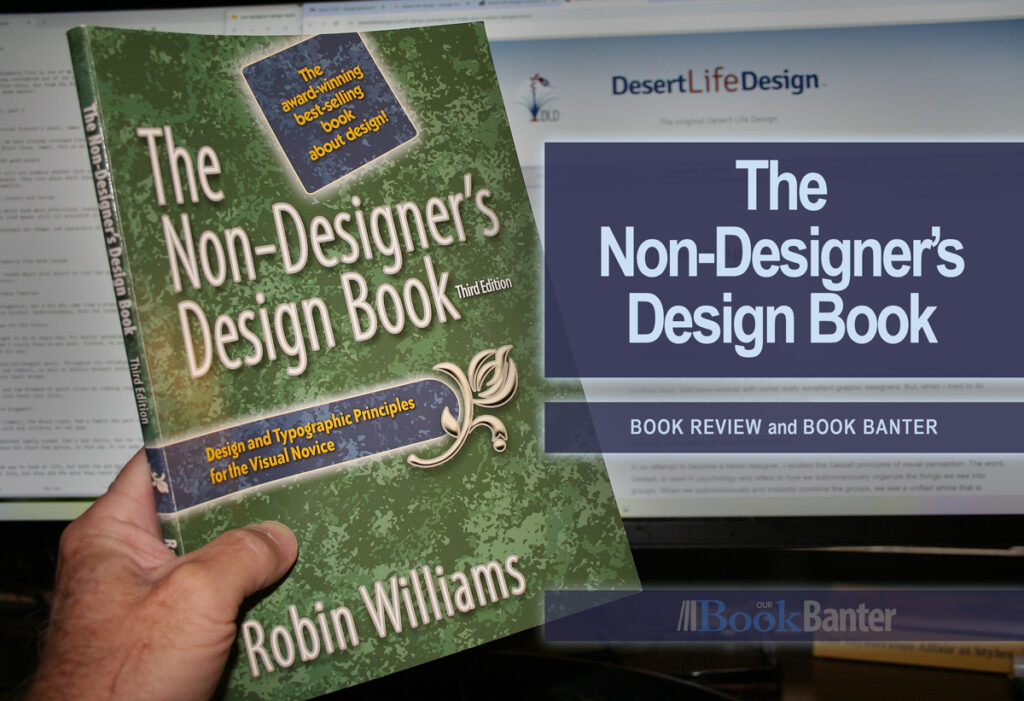
The Non-Designer’s Design Book review
BACKSTORY
I was not a designer—I was a non-designer
For most of my adult life, I have worked with graphic designers. Years ago, in my offset printing business, even I was forced to put together a graphic design in an emergency. However, I do not consider myself a designer—in fact, I used to be a ‘non-designer’!
Today, I don’t operate a printing press, but I do put together lots of graphic designs. That is why I use Robin Williams’ The Non-Designer’s Design Book—it is an indispensable reference tool for graphic design. I keep it on my bookshelf next to my desk.
You can be a designer, too
No matter what you do for a living, I’m sure you’ve had times when you needed to design a brochure, flyer, or business card. And, if you’ve ever looked for a job, you had to design your resume to show an employer how invaluable you would be as an employee.
Because our successes in life can depend on our visual communication skills, we need to develop our design sensibilities. As non-designers, you and I need to become designers, too.
Design principles based on the Gestalt Theory
The principles in this book are adaptations of the Gestalt Theory and its principles of design. In the 1920’s a group of psychologists studied how we perceive images, space, and time. Taken all together, their principles create a ‘unified or meaningful whole’, or gestalt.
As part of a class I took years ago, I studied the Gestalt Theory and found it difficult to adapt to my work requirements. To me, it was like reading a legal brief or accounting statement. Maybe it was because of the century-old style of writing, but I found it hard to apply those ancient principles to my graphic designs.
The result was that my design work didn’t benefit from all the time I spent studying the Gestalt Principles of Design. Thankfully, that is where The Non-Designer’s Design Book stepped in. The book offers practical design solutions.
The Non-Designer’s Design Book review
The Non-Designer’s Design Book has workable solutions
What I love about this helpful book is how the author used specific graphic design examples to illustrate the four design principles. There are before-and-after presentations that show how a flyer, brochure, business card, or website page might look before incorporating each principle of design.
In the past, I have had customers who gave me a rough, cut-and-paste and scotch-taped piece of paper with hard-to-read handwritten copy—many of them looked exactly like the ‘before’ examples shown in this book. Thankfully, the author shows how to take those ugly ‘before’ sketches, and just by applying simple design principles, transform the unattractive ‘rough’ idea into a professional graphic design.
Almost every page of this book has inspiring examples of how simple designs principles can magically and positively change our perceptions.
It is not magic! Instead, it’s how non-designers can use workable design principles
This book will not magically make you into an effective graphic designer. Instead, it will show the practical steps you can take to turn a mundane, rough design, into an attractive, attention-getting design.
I am not going to spoil the plot of this book by revealing those time-honored design principles. However, if you’ve ever studied the Gestalt Theory, they will sound familiar. In fact, you have probably heard or read bits and pieces of these principles throughout your life.
However, this book translates those esoteric design principles into practical, step-by-step processes. It will make any non-designer like you and me into a designer.
Every chapter has useful, practical guidelines
For me, every chapter in this book has been helpful in my design work. I especially like the do-and-don’t examples. At the end of every chapter is a summary that includes ‘what to avoid’. Those ‘don’t’ suggestions include all the amateur mistakes we see everyday in the working world.
Be bold
Above all, the author emphasizes that we should take chances and be bold. After we have learned and incorporated the principles of design into our work, we should stretch, and maybe break some rules.
Specific ways to use design principles
There is a chapter for each principle that includes specific examples. Included are quizzes that help reinforce what you’ve just learned.
I must confess that I never took the time to work out those tests of knowledge. Instead, I applied the principles to my current projects, including my landscape improvement projects. I am sure you will find many practical ways to use these principles of design in your own life.
After discussing the principles, there are chapters devoted to color and over 50 pages devoted to the use of type. In between, there are ‘extra tips and tricks’ to use when putting together letterheads, business cards, flyers, newsletters, brochures, postcards, and website pages.
Third edition versus the current fourth edition
I am still using the third edition which was published in 2008. Even though 10 years have gone by, the principles of design do not change. However, today there may be different applications and trends in graphic design. Principles never change, but trends always evolve. Thankfully, there’s an updated fourth edition!
Kerning type, widows and orphans
The updated fourth edition of this book includes updated information throughout. For instance, after looking at the table of contents on Amazon, I noticed that there are new sections in the chapter on type. The new information includes kerning, special characters, accent marks, and widows and orphans.
To me, that is impressive, because many non-designers today are not familiar with kerning, or removing the extra white space between letter groupings, such as the ‘AV’ or ‘Ta’ groups of characters. Little things like kerning can help improve your overall visual impact, even after you’ve applied all the principles. In fact, kerning is a part of the grouping principle from Gestalt.
TAKEAWAYS
The Non-Designer’s Design Book review
The Non-Designer’s Design Book has given me so much useful information in this last decade. I seriously doubt my design work would be as effective had I not bought and referred to this book.
The principles of design explained in this book are not only relevant to graphic designers, but also to any person who wants to redesign their interior living space or landscape. Using effective principles of designs is a holistic way to make your life better!
Content and photos by Doug Martin and Our Book Banter


