
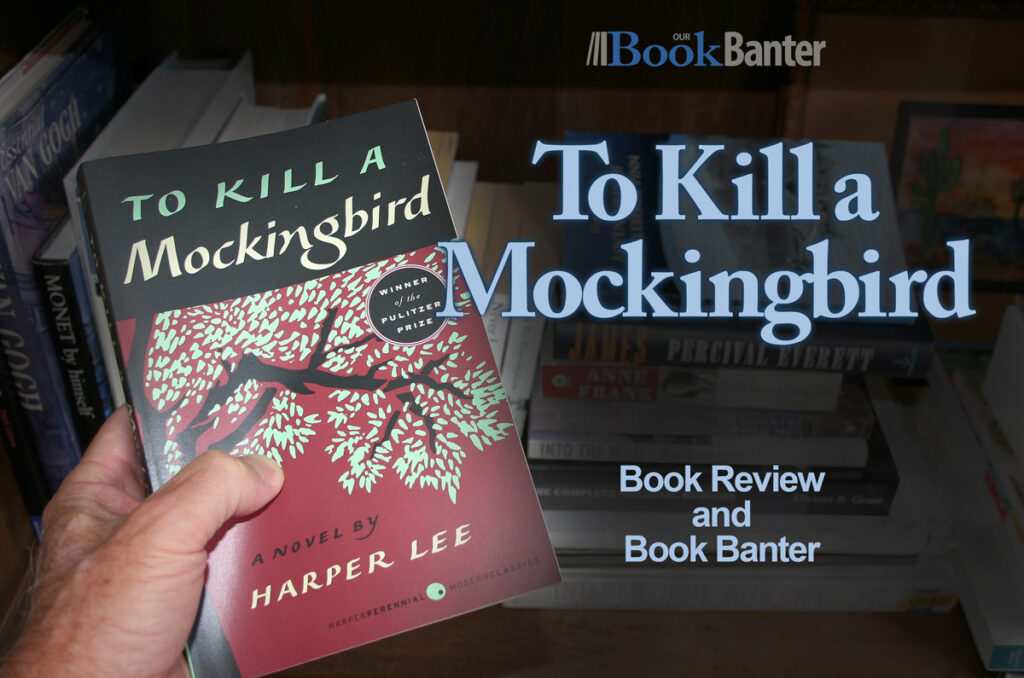
Published in 1960, To Kill a Mockingbird bravely tackled racial injustice and prejudice through the innocent eyes of a child. The book was a huge commercial success, because the themes resonated with our changing society. Here’s our To Kill a Mockingbird book review and book banter. Please share your thoughts about the book and the author in our comments section below!
As always, I will only write generally about the plot, in order to preserve your total reading pleasure. And, this book will be a pleasure to read, despite the disturbing themes. More importantly, this review will be a thoughtful probing of our preconceived notions about the people we know and our society.
To Kill a Mockingbird book review
To Kill a Mockingbird major characters
Scout Finch:
Jean Louise Finch, otherwise known mostly by her nickname, Scout, is the young narrator of To Kill a Mockingbird. Because of her youthful perspective, Scout asks even the most controversial questions with an air of precocious innocence.
Scout was a tomboy whose father encouraged her to read and do well in school. In addition, she was very curious about other people and how they lived their lives, and what motivated them.
Her observational skills, honed by her father, helped her mature and become more empathetic to other people. She became especially concerned about the people who others considered ‘not as good’, maybe because of their family heritage or their skin color.
Jem Finch:
Jem was Scout’s older brother. They spent a lot of time together in their small Alabama town. When Scout’s precociousness would get her in trouble, Gem was always there to protect her.
When he was younger, Jem had an accident. He had broken his arm, and the injury did have an effect on Jem’s overall life. As Jem grew older, he, just like his sister, became concerned about racial injustices that they saw occurring in their small town.
Atticus Finch:
Scout’s and Jem’s father, Atticus, is a Maycomb attorney. He instills in his children a love of learning, and the value of a good education. In addition, he encourages them to question authority, including him, as long as their questions are well-reasoned and backed by facts and logic.
Both Scout and Jem exercise their rights to ask questions, even if they might make people uneasy. In addition, Atticus encourages his children to publicly take a stand for people who are treated unjustly.
Atticus backs up his lessons on equality to his children by working for defendants who are treated unfairly. In their small Southern town, prominent citizens and their constituents get angry when Atticus represents unpopular defendants.
And, that is the main premise of this story.
Calpurnia:
A strict housekeeper for the Finch family. In addition to Atticus, Calpurnia also spurs Scout and Jem to study and do well in school. And, since Calpurnia is a Black woman, she helps introduce the children to the local Black community.
Other key characters:
In addition to the Finch family, there are other key characters in this story. One of the most interesting to me was their reclusive neighbor. I’m not going to go into too much detail, because I don’t want to spoil your reading pleasure.
Reclusive neighbor:
But, the neighborhood children make up stories about this reclusive neighbor, and many of those concoctions are unkind. So, it’s kind of ironic that the Finch children are drawn into this web of suspicion and spreading unkind rumors about this misunderstood neighbor.
Later in the story, this reclusive neighbor plays a key part in helping Scout understand the unfairness of misunderstanding people, and that’s all I’m revealing about that situation. But, it was among my favorite parts in this story.
Black man accused of assaulting a White woman:
Tom Robinson, a Black man who the town accused of assaulting a White woman. I’m not going to reveal anything more about this character, other than his skin color, because the whole story revolves around him, and his unfair treatment by the townspeople.
Atticus Finch makes an unpopular choice and agrees to defend Mr. Robinson against his criminal charges. Because of Finch’s unpopular stand, most of the White people in town became upset. They gossip about him and his children, and eventually threaten them.
To Kill a Mockingbird movie trailer with Gregory Peck!
Fictional small town
The story takes place in a fictional small Southern town in Alabama. Named Maycomb, Scout’s description of the sleepy town reminds me of Mayberry, where the television series Andy Griffith took place.
Scout described a town where people “…ambled across the square, shuffled in and out of the stores around it, took their time about everything. A day was twenty-four hours long, but seemed longer.” (page 6, chapter 1, To Kill a Mockingbird).
The author’s prose was simple, but profound
Through the author, Harper Lee, Scout’s descriptions of the town and the people where she lived made everything come alive. This book was brilliantly written, but in a deceptively simple manner. The author used Scout’s innocent youth to honestly see the world around her.
For me, one of my favorite parts was where she used the reclusive neighbor to teach both Scout and Jem a lesson about empathy. It was quiet, but overwhelmingly brilliant lesson—not only for the kids, but for me as a reader!
The girl became more like her father
And as the inquisitive young girl became more aware of the inequities around her, she slowly gained the courage to take an unpopular stand and voice her opinion. And as she became more cognizant of injustices, she became more like her father, even while playing with her schoolmates.
To stand against racism was dangerous
As Scout’s father became more involved with his Black defendant’s case, the more Jem and Scout worried about him. People in town were threatening them. And, Atticus’s children were worried about him—for good reason.
Atticus was taking an unpopular stand because it was the right thing to do. In this case, it all revolved around racism, but the bigger lesson was that a person should stand up for what is right, no matter how dire the threats.
Stand up for what is right, no matter the consequences
That lesson is more relevant today than ever before. In our flawed human world, the book To Kill a Mockingbird will always be relevant! But it can be hard to do the right thing, as Atticus and his two children demonstrated. Doing the right thing is not an easy thing to do.
At times, I had to reread a few paragraphs
The only flaw I can think of in this book, and it might be from my own lack of understanding, was that I had to go back and read some passages more than once. I reread to be sure I had completely understood what Scout (or the author Harper Lee) was meaning.
Maybe I had trouble sometimes because of the beautiful Southern dialect or way of speaking. The author expressed the messages in a straightforward manner (even the dark moments), but sometimes I still got confused. So, I had to reread. But, to me, that was really not a problem.
Instead, it illustrates the gravity of even the simplest words or phrases that Scout could use. Maybe the author used that simplicity on purpose—so people like me would have to spend the time to reread a passage to fully understand!
TAKEAWAYS
To Kill a Mockingbird book review and book banter
This book was a beautifully written parable about doing the right thing. It was about standing up not only against racism, but against gossiping, and other cruel and indifferent ways of categorizing people.
The lesson was so simple, but so profound at the same time. And the perspective that Scout gave, as a young, intelligent person growing up in a racist Southern community, was a perfect vehicle for expressing those truths.
At Our Book Banter, we highly recommend you and your family read To Kill a Mockingbird.
Thank you for reading our To Kill a Mockingbird book review. If you’ve already read the book, please share your thoughts in the comments section below!
Content and photos by Doug Martin and Our Book Banter


