
I believe that every person who loves to read should include this novel by Ernest Hemingway on their must-read list. Discover my thoughts about this remarkable book in our For Whom the Bell Tolls book banter and review.
Fictionalized snippets from the Spanish Civil War
One night, I eagerly sat down and read Hemingway’s For Whom the Bell Tolls. Published in 1940, this novel is a fictionalized snippet of the Spanish Civil War.
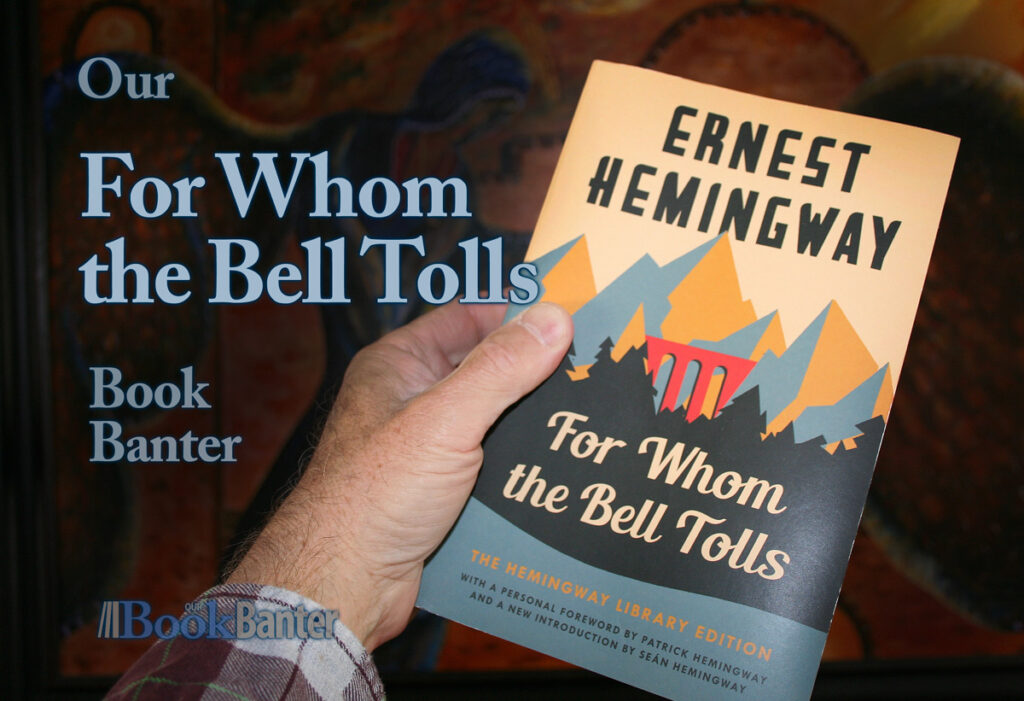
Our For Whom the Bell Tolls book banter and review
During our For Whom the Bell Tolls book banter, we will not reveal critical plot turning points, or spoil the ending for you. However, I’ll give you basic information about the main characters and their mission.
The protagonist was an American who was hired to blow up a bridge that was vitally strategic in their conflict with the fascists (right-wing nationalists). His name was Robert Jordan. And, he was an American who was very experienced with the use of dynamite.
Jordan teamed up with local anti-fascist citizens who helped, but sometimes also hindered his efforts. But, what is fascism?
What is fascism?
If you would like to read more about fascism and how to recognize it, check out this link from the Council of Foreign Relations. As you read, think about current events, especially the trends taking place currently in the United States.
For a more in-depth description of fascism, watch this excellent video lecture from Khan Academy.
Is it necessary to know what fascism is to enjoy this book
Fortunately, I didn’t find it necessary to understand fascism (even though I did), or any other political doctrines to enjoy this book. The central theme is that there were two opposing sides who were in a deadly conflict for control.
Why were they fighting? Because each group thought their philosophy was best and the opposing side was evil. Does that sound familiar, even today in these more civilized and enlightened times?
Fascism seduced many people
In the 1920’s through the 1940’s, fascism and nationalism had become more popular throughout the world. It gained more power throughout Europe as people were disrupted by economic strife. Even in the United States, many people had embraced fascism during that period.
Unfortunately, today we are seeing renewed waves of fascism emerging throughout the world, including the United States. As you might guess, I am against fascism. I am an anti-fascist U.S. citizen.
Throughout history, every society and government that was seduced by fascism and had embraced it, suffered the consequences. My concern today is that too many U.S. citizens have become lured to believe the lies and the conspiracy theories of some of our government bureaucrats and sycophants.
We are already suffering the consequences of those fascist beliefs. Hopefully, the tide of hatred, lies, and conspiracy theories can be stemmed, and we can salvage our fragile democracy.
But, was there any romance?
So, the fight against fascism is on, helped out by Robert Jordan and his team of anti-fascist rebels. But, what about the romance? Usually, every great book about war has a romantic entanglement!
Well, that’s true in this novel, also. First, we had the young and handsomely dashing Robert Jordan. Then, we had a young and pretty local woman who was helping with the rebellion.
So yes, there was romance. But was it good?
I really disliked the romantic banter
Even though Hemingway was an imaginative author and a meticulous journalist, there was one aspect that almost made me stop reading this book. It was the corny romantic banter.
The romantic banter was too saccharine
It was the romantic relationship between the main character and the young local woman that made me almost stop reading. The whole relationship seemed too contrived and corny to be convincing.
The relationship didn’t seem real to me. I felt that Hemingway could have done a better job of adding conflict between the pair at the very beginning.
Instead, there were pages and pages of sickeningly sweet dialog between the two that seemed more appropriate for a cheap romance novel. I know my judgment seems harsh, but that is how I felt as I read. It almost made me stop reading.
Thankfully, I suffered through the disgustingly corny pillow-talk and was rewarded with some really compelling scenes later on.
Things I really loved about For Whom the Bell Tolls
Fortunately, I slogged and skimmed my way through the too-sweet love banter. Then, I became enthralled by some of the more compelling and brilliantly written scenes I’ve ever read.
I loved the background stories some of the fighters told about the war. And, their psychological motivations were so interesting and compelling.
However, my favorite part was when some of the anti-fascists were surrounding on a hill. That part was so, so-very good! And, the conclusion was incredible.
Background stories about the war
At one point during a reconnaissance mission, the group stopped during their hike and rested. The older woman, who was kind-of the leader, and also served as the cook and mother-figure, told a story.
Everybody sat and listened, for what must have taken an hour to tell. I found that part a little unbelievable, but that’s only because I’m used to our modern society and social media distractions.
Anyway, she told the story of how when she was younger, she, her male partner and her group of fighters captured the village of the enemy.
Psychological motivations
It was a brutal story, but Hemingway had the lady tell it without getting too graphic. Instead, the author delved into the psychological motivations of both groups. For me, it was spellbinding.
The leaders of this village were brutally executed (I won’t tell you how, but it would have been psychologically horrendous). The author revealed what each character was thinking and also what brought out their good (and bad) characteristics.
Both sides were human beings, with their own flaws, and with their own redeeming attributes.
There were good people fighting on both sides
Those revelations made the whole conflict even more heartbreaking and compelling. It was a true-life revelation that war is hell even though there were good people, with their own families and their own aspirations for their lives, on both sides of the conflict.
Defending a hill
Another extremely good part of this book was when the enemy encircled the anti-fascists on a small hill. There were a few boys and many young men who belonged to the anti-fascist group, as well as one very old man.
All were well-armed, but so was the enemy that had surrounded them. They knew their likely fate, but they still had faith. Maybe, each man thought, they could still make it out alive, and see their families again.
Both sides prayed to the same god for help
To help them cope, the trapped men prayed Catholic prayers that they had recited as youngsters in church.
Ironically, the enemy that had them surrounded also knew that taking the hill would not be easy,. It was likely that many of them might also perish. So, they also privately prayed to their Catholic god.
Both sides had a job to do, and both sides believe they were right. As I read, I realized how brilliant Hemingway was as he stepped through each moment that each had soldier experienced during this conflict.
The conflict and conclusion had me hooked
The final half of the book got better and better. I found it more difficult to stop reading as I got closer to the conclusion.
As I continued to read, I understood why Hemingway is considered such a brilliant writer today. The build-up to the end included intrigue, espionage, romance (of course), and believable characters.
I could empathize with many of the characters, even with the enemy. The empathy I felt surprised me, and it is what made the conclusion so good.
The conclusion was very emotional
As the conclusion approached, I still couldn’t predict what might happen, but I was starting to get emotional! By the last few pages, I had shed some real tears.
This story was so moving and so remarkable.
You must read the quote from John Donne
Before you begin reading For Whom the Bell Tolls, you must read the quote from John Donne that appears just before the Contents page.
Donne was an English philosopher and poet from the 16th century. The final few words from his poem are his most famous, but I’m not going to tell you what those words are.
Instead, you would enjoy reading the poem yourself, before your begin reading the novel. Then read it again after you have finished. After I had read the book, I looked at Donne’s poem again, and the whole story came together for me.
I believe the poem illustrates Hemingway’s philosophy of life, of war, of romance, and finally of death.
TAKEAWAYS
Our For Whom the Bell Tolls book banter and review
The corny romance almost made me stop reading this book. Fortunately, I continued and the author rewarded me with a brilliant story about life, love, good and bad, religion, and our ultimate death. Also, the story revealed that people will fight for what they believe in. And, no matter which side they are on—they (we) are all the same and they (we) are all mostly good!
To put it simply, For Whom the Bell Tolls was a remarkably good book!
Thanks for reading our For Whom the Bell Tolls book banter and review. If you have thoughts about the book, please share them in the comments section below!
Here’s an excerpt from the movie. Personally, I thought the book was better!
Content and photos by Doug Martin and Our Book Banter


