Our In Cold Blood book banter started when I was much younger. I first noticed Truman Capote‘s award-winning book from my junior high school English class. The year was 1970—for two weeks, my pretty English teacher had it positioned on the corner of her desk. She was well-read, and enjoyed reading a new book during her free time.
Our In Cold Blood book banter
To be honest, I became interested in the book mainly because I was smitten with that English teacher. She had read other best sellers, too, but I was most interested in the story of In Cold Blood. I was also intrigued by the controversial, unorthodox author and how he might have told the story.
Somehow, an innocent and naive young country-boy like me had found a copy of the book. Back then, I had no discretionary income—I was poor. And to sign out some library books, we first needed permission from our parents. I did not receive that permission! To this day, I don’t remember how I was able to get that best-selling book, but I know I did.
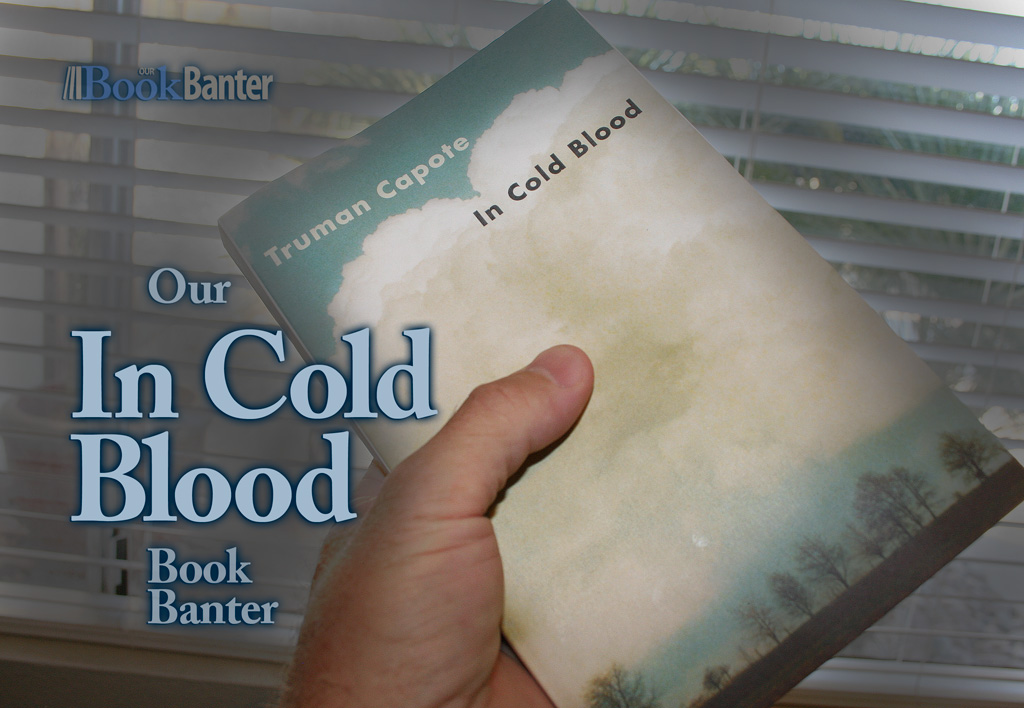
And now, for our In Cold Blood book banter and review. After reading, leave your thoughts about the book and author in the comments section below.
My teenage thoughts about In Cold Blood
In my younger years, I had an idealized view of the world. Issues were either black-or-white, with no complex hues of gray in between. However, as I read In Cold Blood, I was introduced to a world that was not always black-and-white, and not always good-versus-evil.
Capote remained detached and unbiased
Don’t get me wrong—murder is wrong—that’s not what I’m talking about when I say I had learned to look at issues with a more objective approach. As the author told the story, he purposely repressed his own judgments, biases, and opinions. Capote remained detached, as all reporters should be, as he told the story.
Why did my benevolent god allow this barbarism?
As I read, I remembered how the true-crime story raised doubts in my mind about the benevolent god I had worshiped. I challenged myself with a question:
“How could a “loving god allow two depraved people to take the lives of innocent strangers in such a barbaric manner?”—My question to god as I read the book
And then, how could god have let them get away with it and enjoy their life afterwards? Those are the doubts that started to challenge my faith and allegiance to the god from my organized religion.
Despite the fact that I was morally challenged by my first reading of this book at a young age, I remember being fascinated with Capote’s story-telling style. He spent years interviewing friends of the murdered family, and even developed a rapport with the murderers.
The author did not glamorize the murderers
Despite Capote’s devotion to get inside the brains of the murderers, Dick and Perry, he did not glamorize them or justify their actions. Instead, he allowed the two young men to reveal their backgrounds, along with many intimate and embarrassing details, so the reader might understand their motivations.
Frighteningly, I had similar characteristics as the killers
As I read Dick’s and Perry’s life stories, I chillingly found similar characteristics in my own young life. Just like Dick, when I set my mind on a goal, I followed through with action. And, similar to Perry, I had an artistic and sensitive nature.
At that time, I was also very religious, just like Perry. It was so interesting how Capote revealed the ironic nature of Perry’s religious beliefs, which he maintained side-by-side with his violent nature.
“He [Perry] knew the lyrics of some two hundred hymns and ballads—a repertoire ranging from The Old Rugged Cross to Cole Porter…“—In Cold Blood, page 48, The Last to See Them Alive section
Was there something wrong with them?
Despite some similarities I had in my own personality and experiences to both of the criminals, I still found their crimes ghastly inhumane. After the crime, while they were enjoying their time in Mexico, Perry would wonder to Dick if something was wrong with them.
After Perry had that philosophical discussion with his partner, Dick purposely sped up their car and swerved it into the path of a stray dog.
Moments like those are ones that I remember most from my first reading of In Cold Blood. They made me despise both killers, but especially Dick.
Terrifying early-morning hours
I also thought it was brilliant the way Capote weaved in Dick’s and Perry’s chilling memories from the murder as they were revealing their background stories. Slowly, I was able to get an idea of what happened throughout those horrific early-morning hours in the victims’ house. I was able to understand the terror the innocent family must have experienced.
Capote was committed to researching and writing
After reading Capote’s book, I was inspired to be a writer myself. However, I learned that the difference between me and Capote, as I tried my new goal to be a writer, was that he was more committed and serious about being a writer and researching his story than I was.
In fact, he had spent six years conducted research and interviews. I don’t think I have that kind of commitment or big-picture vision to write a book like In Cold Blood—few people do, but Capote did.
Decades after my first reading, I read it again
Many decades after my first teenage reading of In Cold Blood, I read it again. This time around, I still questioned how an all-powerful god who claimed to love us could have allowed these murders.
Hours before their deaths, the victims were making plans for the future
This time around, I was moved by how the author studied the Clutter family in their last hours of life. They performed mundane tasks and made plans for the future. Yet, their lives were about to end. Just as we do in our own lives, they enjoyed their Saturday without a care for the future.
One example of Capote’s life-is-short imagery was when he wrote about Bonnie Clutter, the mother and wife. He wrote about Bonnie’s last day like this:
“…on this final day of her life, [she] ended her day by putting on a nightgown and a fresh set of white socks. I was profoundly moved by the final day of her life.”—Truman Capote
She didn’t even suspect that her life was coming to a close. Most of us, as we go through the mundane details of our life, never suspect that death is approaching—yet, as the seconds count down, death is approaching us at lightning speed.
As Capote examined Bonnie’s room and conducted interviews with friends, he had noticed that Bonnie’s Bible was on a table beside her bed. The bookmark had an embroidered verse:
“Take ye heed, watch and pray: for ye know not when the time is.”—page 5, The Last to See Them Alive section, and Mark 13:33
As Capote interviewed neighbors and investigators, he conveyed in such an unemotional, yet powerful way, how none of them could have imagined the future.
We are fragile, and our lives are fleeting
Years later, as Capote finished weaving together all the elements and personalities involved, some acquaintances of the victims had passed away. Just like he did with Bonnie’s last day, Capote used their final moments of life to convey the fragility of their humanity. We are all only a heartbeat away from eternity, whatever that involves.
When I was a teenager, I don’t think I picked up on that subliminal theme of our fleeting lives. I believe that Capote purpose wove that concept into the book. Now, though, it has made a major impact on how I viewed the murders and the aftermath. It was brilliant!
Capote’s storytelling was objective
Throughout the book, Capote’s professionalism as a writer, and his objectivity as a reporter astounded me. He did not interject his own philosophies, opinions, or biases. Instead, he allowed the personality of each neighbor, acquaintance, and investigator to shine through.
Was the book better than the movie?
So, which was better? Was it the 1965 award-winning book or the 1967 movie? I read the book and I saw the movie, and I was impressed with them both. The movie was in black-and-white, which for me, heightened the tension. However, I was most impressed with the book and Capote’s writing style.
So, my vote is for the book. Share your own thoughts about the book and the movie below—which was your favorite?
TAKEAWAYS
Our In Cold Blood book banter and review
Truman Capote’s In Cold Blood is the horrific story of how an innocent family came to be brutally murdered. Even now, many decades after I first read the true story, the images conjured up by the author are disturbing.
Still, I would recommend this book. Not only to understand the complexities of our frail human existence, but also to savor the author’s objective reporting. The author was brilliant, and the book is still a documentary work-of-art. You should read it!
Thanks for reading our In Cold Blood book banter and review! If you’ve already read the book, or saw the movie, please share you comments below!
Content and photos by Doug Martin and Our Book Banter