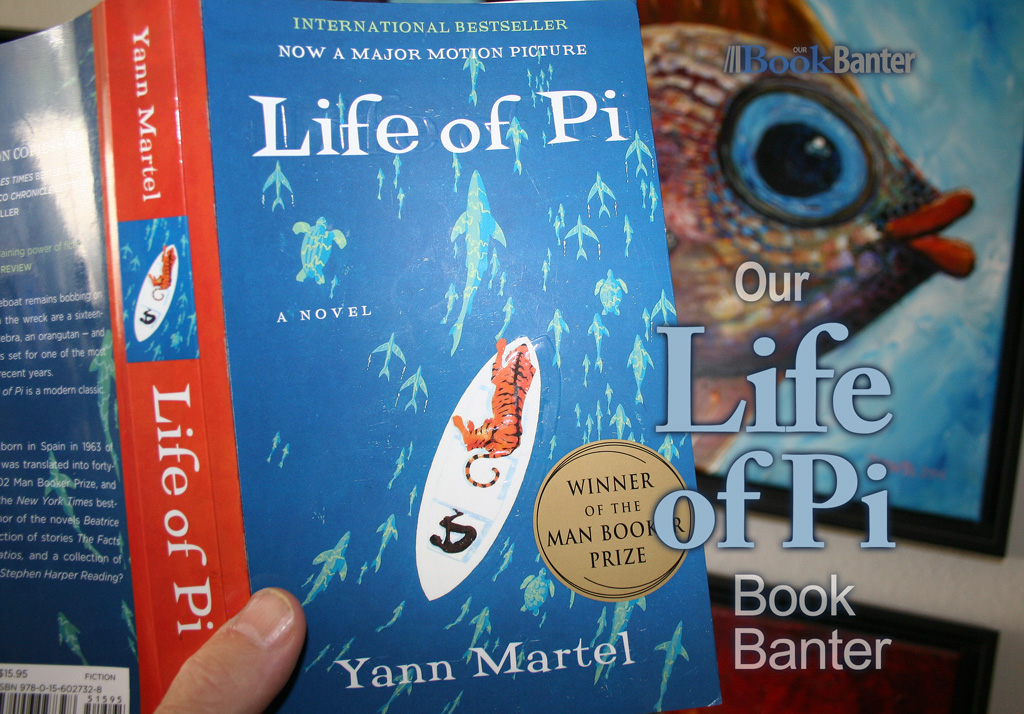
I don’t think I’ve ever read a book as unique as Life of Pi. It was only recently that I watched a few minutes of the movie on a Spanish television network. I saw a boy and a Bengal tiger stuck on a lifeboat together. What is this movie, I asked myself? Then, I wondered, what is this book? Those questions have led to our Life of Pi book banter review.
Like all my book reviews, I promise not to reveal plot secrets, or the fateful finale. The views I present in our Life of Pi book banter are my own quirky observations.
Our Life of Pi book banter
A boy, a tiger, and a lifeboat
By now, every reader knows that the Life of Pi is about a boy, a tiger, and a lifeboat adrift at sea. The “adrift at sea” part takes up the bulk of the book. Throughout, interesting survival details, animal kingdom psychology, as well as gory violence fill the book.
For me, this section of the book was the most compelling. I almost could not stop reading, even when I had other pending obligations. Instead of doing my other work, I just read.
The boy’s formative years
The prelude to the “adrift at sea” section was also intriguing. The author revealed how Piscine, or Pi for short, was raised and nurtured. His parents owned a zoo, so, for the first years of his young life, he cared for wild animals.
His father taught him valuable lessons during this time. Though Pi didn’t realize it, his father’s lessons about life and animals would help him survive during his long, isolated period of hardship.
Valuable lessons from his father:
—Philosophy and religion
Even though Life of Pi is a fictional book, the author included a lot of facts about animals that helped set the stage for the dramatic events that came later. I especially found Pi’s thoughts about religion very thought-provoking.
The author, Yann Martel, has a background as a philosophy student that really helped illustrate Pi’s developing religious ideals. To me, this part was fascinating—I found I could identify with Pi’s logic as he discovered different organized religions.
—Pi respected all religions
What I most admired by the Pi character was his willingness to consider the good and not-so-good points of all religions. In fact, he interacted with a person of the Hindu religion, one from the Christian theology, and another from the Muslim faith.
Afterwards, Pi considered himself a person encompassing all those faiths and beliefs.
“The obsession with putting ourselves at the centre of everything is the bane not only of theologians but also of zoologists.”—Life of Pi, page 31, as Pi commented on ‘friendly” or “loving” or “vicious” animals and pets
His openness to all religions definitely would have gotten this book banned in my house as I grew up. Just like Pi, my parents raised me in a dogmatic Christian family. However, Pi’s parents seemed more tolerant than mine of other religious convictions.
If I had adopted Pi’s philosophies when I was growing up, my family and church would have shunned me. In fact, after I asked too many pesky questions, my ‘Christian’ family did shun me. To this day, I find that so ironic, because Jesus was open to every person, and never pushed people away.
Here’s an example of one of Pi’s controversial philosophies. He was talking about how most religious people cling to their beliefs, and automatically reject other philosophies and gods.
“But we should not cling! A plague upon fundamentalists and literalists!”—Life of Pi, page 49
In my early formative years, I was surrounded by fundamentalists and people who believed only in the literal interpretation of their holy books. That’s why, as an adult, I echo Pi’s thoughts about the dangers of fundamentalism and literal interpretations of ancient texts.
Did authorities ever ban this book?
This book includes some violent imagery. In fact, those violent moments were difficult for me to read. Not only were there graphic animal-on-animal battles, but also human-on-human brutalities. Those parts were difficult to read.
However, despite the violent imagery, I didn’t find specific instances where authorities have banned this book. Maybe that’s because the violence was a realistic depiction of the animal kingdom, and how humans are an integral part of that kingdom.
Style of writing
From the first pages, I noticed the author had a unique style of writing. Almost immediately, I was intrigued by unanswered questions about the main character. I wondered how he got his odd name, and I also wondered about the tiger’s human-sounding name. Sometimes, the tiger had human characteristics.
Was the tiger really a person?
Those are the questions that the author cleverly planted in my mind as I began reading. And I continued to read:—I was on a to find the answers to those questions and many others.
I couldn’t stop reading Life of Pi
And read is exactly what I did. I finished this book in only three sessions. It’s unusual for me to finish a book that quickly, because I also have other things to do in my life, just like you.
Lessons learned from Pi’s ‘adrift at sea’ challenge
—Accentuate the positive
During the “adrift at sea” section, Pi had to survive horrific circumstances. Even now as I remember his harrowing experiences, I cringe. However, despite the hardships, Pi harnessed his religious philosophies to accentuate the positive.
Of course, it wasn’t simply positive thinking that helped him survive. He took the necessary steps, no matter how unpleasant they were, to get through his circumstances.
—Forget the past, and don’t worry about tomorrow
I admired that about Pi, and I also noticed how he mostly seemed to live in the present moment. When danger is all around you, I guess living in the present moment is an easy thing to do.
But, it’s an example of a good way for us all to live our own lives, even when we aren’t threatened with our own immediate death. I think that is part of the existential philosophy of life.
Forget the past and don’t worry about the future – – just live in the present moment. That’s a good way to live our lives. Because, nothing is guaranteed, and the only thing we have now is the present moment.
And that’s it, for now. There are no guarantees for a tomorrow. Our past and our future are irrelevant.
TAKEAWAYS:
Our Life of Pi book banter
The book’s ending disappointed me a little bit
As I was getting close to the final pages, I was a little disappointed. After all the buildup and tension, I thought there would be a more dramatic ending.
Despite my apprehension, I kept reading and kept hoping for a dramatic surprise, similar to the ending of the popular movie, The Sixth Sense. But, that dramatic moment never came.
Amazing last paragraph
However, I read the last paragraph, and I was amazed. It was the conclusion of a dry, analytical report conducted by the investigators and it left me with a powerful sense of reverence.
The investigators surprised me. They displayed a sense of understanding and compassion for Pi’s difficult experiences. It was such a simple display, and one that I suspect that even the most careful reader could have missed it.
Despite the facts that the investigators uncovered, they respected Pi’s accounts and wishes, and that was a great thing.
Questions about what we perceive and what is real
The book addresses heavy, fundamental questions about our lives, our religions, and what we believe is real! The Life of Pi was such a fascinating story.
I highly recommend Life of Pi
And, that’s all I’m going to say about that. To say any more, would be to destroy your adventure as you read the Life of Pi yourself. And I highly recommend you do!
Thanks for reading Our Life of Pi book banter and review. If you’ve read the book, please share your thoughts in the comments section below!
Photos and content by Doug Martin and Our Book Banter